




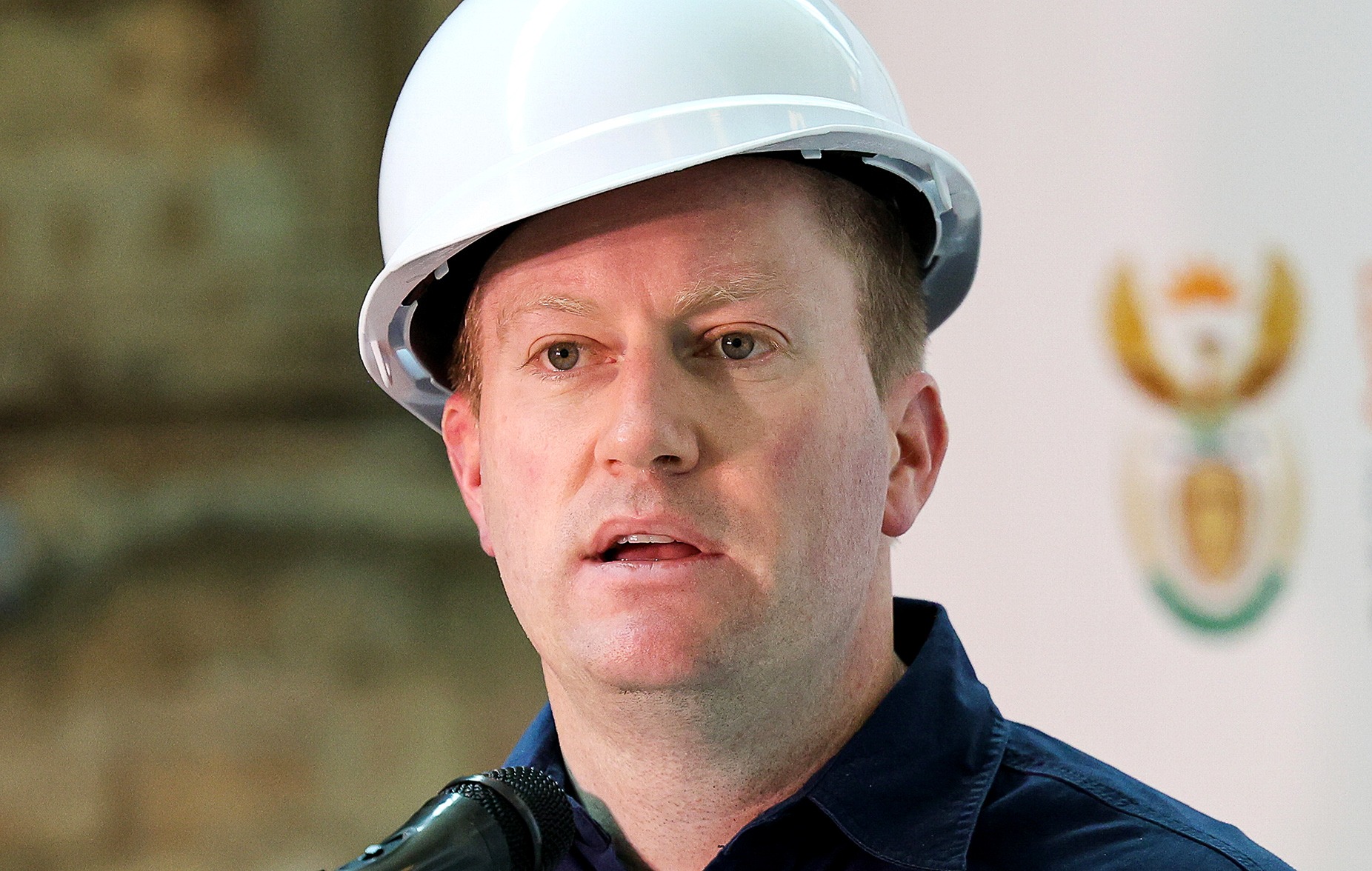
 Minister of Public Works and Infrastructure Dean Macpherson. (Photo: Gallo Images/Luba Lesolle)
When Minister of Public Works and Infrastructure Dean Macpherson took up his Cabinet post, his slogan was “turn South Africa into a construction site”.
“South Africa cannot turn itself into a construction site if construction sites are controlled by criminals,” was his latest concession two years after being sworn in. He made this admission at a press conference on Tuesday, 7 July, announcing the Cabinet-approved Integrated Social Facilitation Framework (ISFF) as a binding national policy instrument and the playbook for how the Department of Public Works and Infrastructure (DPWI) and its partners will dismantle the extortion economy on construction sites.

Macpherson is focusing his energies on consequence management, standardisation and refusing to compromise, saying:
“There can be no negotiation with extortionists. There can be no compromise with criminals. And there can be no future for a construction industry where delivery depends on paying protection money.”
The DPWI will also penalise colluding or underperforming contractors. “Since September 2025, 52 contractors have been blacklisted, with a further batch currently under review,” said Macpherson. This is a massive acceleration compared with previous administrations, which blacklisted only two contractors in 22 years.
Tallying the cost of extortion
In the 2025/26 financial year, the DPWI reported a 79% delay rate across its portfolio, with 164 out of 206 infrastructure projects experiencing significant delays. This has frozen R1.3-billion in incomplete projects for the current year alone, and nearly R3-billion across recent fiscal periods.
But if you cast the data gathering net more widely to include think-tank and government data, the construction mafia drains a conservative R17-billion per year directly from the South African economy.
To answer a question from the media, Macpherson went to the old well of the frequently cited data point showing that criminal syndicates have disrupted more than 180 projects valued at nearly R63-billion (with some estimates escalating to R68-billion).
/file/attachments/orphans/ED_546747_322681.jpg "Lilian Ngoyi construction site on 14 February 2025 in Johannesburg, South Africa. (Photo: Gallo Images / Sharon Seretlo)")
This figure is sometimes misinterpreted as the direct cost of extortion, but it is actually the total capital value of the infrastructure developments that were delayed, halted or affected.
While the construction mafia did not steal R63-billion in cash or assets, their actions froze and jeopardised R63-billion worth of critical state assets, roads, schools and water infrastructure.
Macpherson’s comment on the delays was insightful:
“Every day that they are delayed, government gets penalised by the private sector ... we then have to pay penalty fees for it.”
Construction disruptions drastically inflate project costs. For instance, construction mafia interference forced the termination of the Nancefield Primary School contract after R56-million had already been spent; restarting the stalled project required a further allocation of R87-million.
Local governments are forced to spend massive portions of their budgets on security. Macpherson said the City of Cape Town spends “tens of millions of rands” on securing construction sites and protecting threatened officials.
Social structure
Molatelo Mohwasa, acting deputy director-general for real estate management services at the DPWI, detailed the operational mechanics of the ISFF; how it transforms local communities from passive bystanders into the state’s “first line of defence”.
“Communities are saying, ‘Nothing for us without us.’ So the social facilitation ... brings that for communities to not only be passive partners but active partners in the development of infrastructure,” said Mohwasa.
The three Cs of ISFF
The framework is built on three core operational principles:
Community profiling: Conducting comprehensive socioeconomic assessments before project commencement to identify legitimate residents, local businesses and specific regional challenges like unemployment.
Co-creation: Establishing formal project liaison committees where government and legitimate community representatives actively collaborate, replacing top-down tokenistic consultation.
Co-ownership: Ensuring that when communities help build and benefit from local infrastructure, they protect it. “If you have participated in the building of infrastructure ... you will be the very first person to protect that infrastructure,” Mohwasa explained. “In fact, you will provide intelligence when there are some people who want to disrupt.”
Compared to the cost of doing nothing, the cost of implementing the ISFF is minimal. Mohwasa clarified that the DPWI “is not there to appoint social facilitators”. Instead, the department is establishing a national standard, framework and guidelines.
Under the new framework, social facilitation is integrated into the project planning and procurement budgets from the very beginning. And this proactive investment in standardised, professional social facilitation completely de-risks projects.
Bricks and mortar
Sharon Shunmugam, president of the South African Council for the Project and Construction Management Professions (SACPCMP), was on hand to represent the professional bodies tasked with implementing the framework.
“Social facilitators normally become involved in the project around Stage Five, which is known as implementation, when it’s shovel about to hit the ground,” she explained.
“What we are saying ... is that we are bringing those community ... persons ... in at Stage One [project initiation] ... that’s the very big differentiation between a fragmented approach and a professionalised approach.”
By defining professional competencies, qualifications and a strict code of ethics, the SACPCMP aims to ensure that social facilitators act as a legitimate, accountable — in her words — “bridge between communities and projects, not as gatekeepers, brokers or political intermediaries”.
The transition from the law enforcement focus in Macpherson’s hometown, Durban, to the preventative mechanisms of the ISFF shows a maturing in the understanding of the crisis and is a genuinely comprehensive strategy.
While multidisciplinary policing and asset forfeitures continue to penalise active criminals, the ISFF permanently de-escalates conflicts by ensuring that transparent, local economic participation cannot be hijacked by politically connected syndicates.
In taxpayer money terms, the cost of early engagement is a fraction of the cost of crisis management. DM
Comments
Scroll down to load comments...