



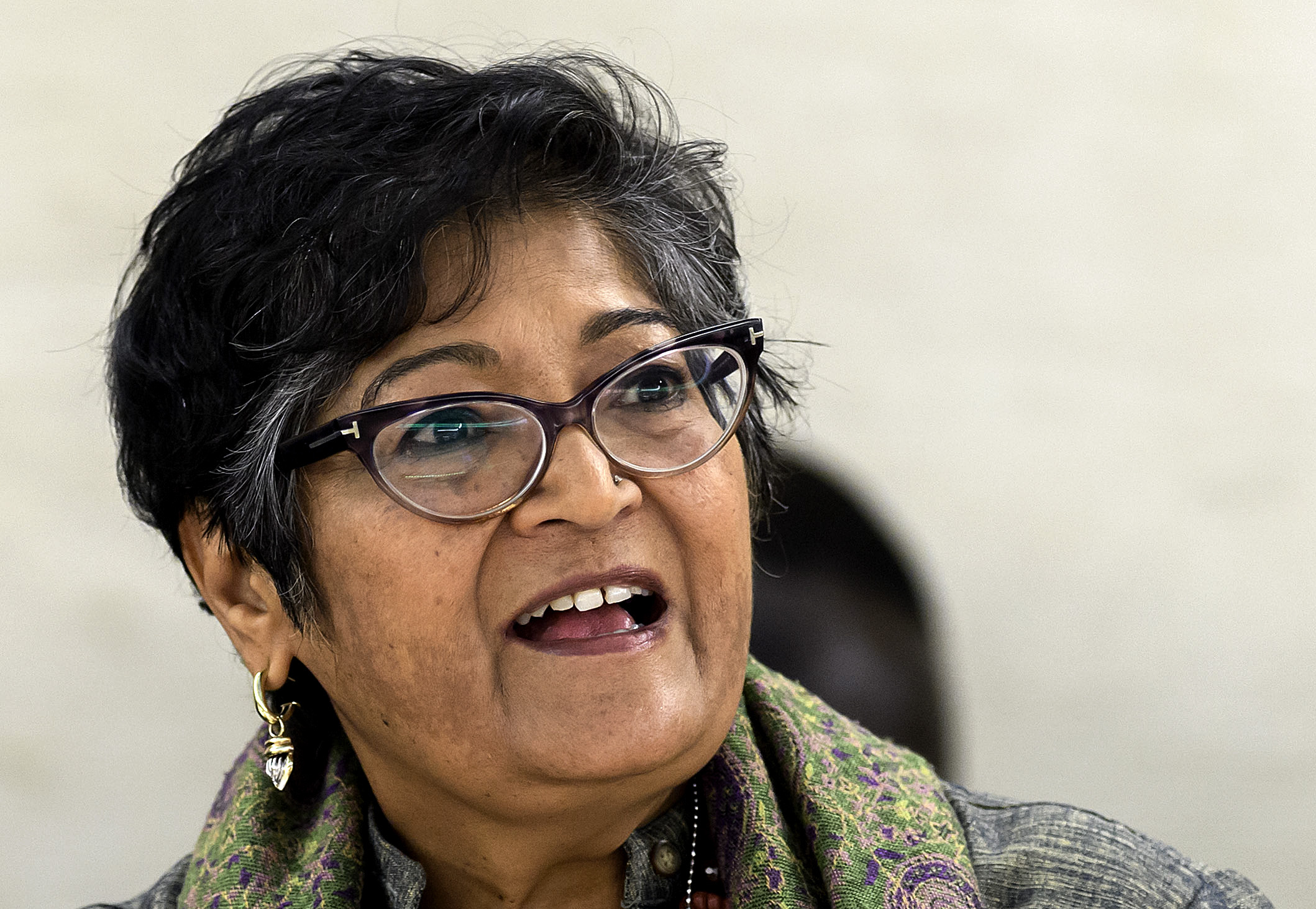
 Former TRC commissioner Yasmin Sooka has told the Khampepe Inquiry that the refusal to disclose names on 'hit lists' had made it impossible for investigators to identify other victims targeted by the state. (Photo: Martial Trezzini /EPA)
 Testifying at the Khampepe Inquiry on 6 August, human rights lawyer and former TRC commissioner Yasmin Sooka outlined efforts to challenge political pardons for the perpetrators of apartheid-era crimes, specifically those involved in the 1989 poisoning of the Rev Frank Chikane.
Sooka told the commission that in 2007, after a “special dispensation” on political pardons had been announced by President Thabo Mbeki, more than 2,000 perpetrators applied for pardons. An initial list of 150 names, including those convicted for Chikane’s poisoning, was recommended to Mbeki.
A “reference group”, chaired by lawyer Tertius Delport (a former National Party MP), was established as part of this “dispensation”. Its purpose, said Sooka, was to resolve the “unfinished business of the Truth and Reconciliation Commission [TRC]” by issuing pardons for offences claimed to be “politically motivated”.
The shadow hand
The commission previously heard that former apartheid generals, including those in Military Intelligence, had weaponised the “Chikane matter” to threaten ANC leaders – including Mbeki – with arrest.
/file/attachments/orphans/WhatsApp-Image-2026-03-04-at-165153_797341.jpg "Advocate Anton Ackermann testifying remotely at the Khampepe Commission.
<br>(Photo: YFM / Wikipedia)")
(Photo: YFM / Wikipedia)
Advocate Anton Ackermann, former head of the TRC’s Priority Crimes Litigation Unit, testified that Jan Wagenaar – the generals’ legal representative – used groundless threats of imminent ANC arrests to derail post-TRC prosecutions. The inquiry also heard that Wagenaar was unable to produce any evidence to support his claim.
At the time, the National Prosecuting Authority (NPA) was about to arrest former police minister Adriaan Vlok, former police commissioner Johan van der Merwe and their underling collaborators, security policemen Gert Otto, Hermanus van Staden and Christoffel Smith for the attempted murder of Chikane.
The arrests should have also included those who procured and manufactured the deadly poison that almost killed Chikane.
The second charge brought against the men, that the then head of Project Coast, South Africa’s chemical warfare programme, Dr Wouter Basson, as well as chemist Dr André Immelman (and others), had also conspired “to commit the crime of murder of persons unknown to the State or to assist with the commission of such murders” was struck down during the court case.
/file/dailymaverick/wp-content/uploads/2024/03/12-Wouter-Basson.jpg "Dr Wouter Basson, who headed the apartheid government’s Project Coast. (Photo: Lulama Zenzile / Gallo Images / Die Burger)")
The late SAPS national commissioner, Jackie Selebi, the inquiry also heard, continued to push the narrative of imminent ANC arrests, including himself, even after the NPA and Ackermann met with government officials to dispel the rumour.

The former acting head of the NPA between 2007 and 2009, Mokotedi Mpshe, testified in April that the intended arrests in the Chikane matter had led to a “deep rift” with Ackermann.
Those who got away
Chikane himself gave emotional testimony to the inquiry that Basson could have been brought to book for the murders of at least 200 opponents of the government.
What had stalled any further prosecutions, he said, was the dismissal of the second count in the prosecution of Vlok and Van der Merwe
/file/dailymaverick/wp-content/uploads/2023/06/4-Frank-Chikane.jpg "Reverend Frank Chikane at the launch of his book, Eight Days in September, in Johannesburg, South Africa, on 14 March 2012. (Photo: Gallo Images / Sunday World / Tsheko Kabasia)")
Sooka testified that the “reference group” dealing with pardons had initially rejected requests by victims and civil society to participate or provide input. In 2009, an interdict was obtained and a landmark Constitutional Court ruling in 2010 established that “no political pardon could be issued without prior consultation”.
It was a victory for the young democracy and accountability. However, Sooka told the commission that the whole truth of the past and atrocities committed had still not been disclosed.
In the Chikane poisoning case, critics argued that granting pardons would undermine “national reconciliation” as the truth was being buried while nameless perpetrators stood on the sidelines and watched.
Evidence presented to the commission makes clear that pursuing “national reconciliation” was a delicate balancing act for those tasked with steering the country toward a future free from human rights abuses.
/file/attachments/orphans/000065683_789244.jpg "Former Minister of Law and Order, Adriaan Vlok with former Police Commissioner, Johann van der Merwe, Gert Otto, Hermanus van Staden and Christoffel Smith after their trial at the High Court relating to the attemptive murder of Frank Chikane on 17 August 2007. (Photo: Johnny Onverwacht/City Press/Gallo Images)")
Buried truth
Sooka testified that Vlok and Van der Merwe continued to conceal critical details, including the identities of the “higher authorities” who ordered the killings, and the names of other activists on a Military Intelligence hit list.
Despite having access to the list, both men refused to disclose any additional targets. “They appeared to deliberately avoid implicating any living person,” said Sooka.
In his application for a political pardon, Van der Merwe only disclosed two names that were on the “hit list” discussed during a 1987 meeting: Chikane and SACP leader Joe Slovo, who was in exile at the time.
On 14 July 1986, Vlok briefed the powerful State Security Council (SCC), the highest echelon of the apartheid establishment, on steps to be taken on names on a list of “politically sensitive persons”.
A month before that, the National Party government had declared a State of Emergency, which gave the government wide powers of arrest and detention without trial.
Thousands were detained and held in solitary confinement, including children. Many people “disappeared”, and that year alone, four activists died in police custody, including the Northern Transvaal UDF president, Peter Nchabeleng, and an Upington Youth Congress activist, Mxolisi Johannes “Dicky” Jacobs.
Sooka told the commission that at that meeting of the SSC it had been recorded that the list “needed to be shortened” and that “methods other than detentions must be considered”.
She said that it was unclear whether the 1986 list of “politically sensitive persons” was the same “hit list” discussed a year later with the South African Defence Force.
The 1987 list, compiled by Military Intelligence, explicitly authorised the “elimination” of activists in “extreme cases”.
Van der Merwe had indicated that the meeting had been informed that a “higher authority” had instructed that “drastic steps” using the “full capacity of the state” had to be taken against certain political activists, Sooka told the commission.
By 22 September 1986, this list was officially “accepted after discussion”, she added.
A specialised unit had been established for the “execution of the directive to carry out these unlawful operations and which included the participation of high-ranking officers like Chris Smith, Gert Otto and Roché van Staden”, the inquiry heard.
Chikane’s dilemma
Sooka told the inquiry that in 2012 she met with Chikane, who, at the time, refused to join opposition voices against the presidential pardons.
She said the decision was “deeply disappointing” as “perpetrators continued to conceal the truth from the South African public for decades”.
Testifying in May, Chikane said that he had been required to retell the story of his attempted murder at so many commissions that it hovered over him like a low, dark cloud.
The veteran churchman said that the TRC was, in the end, “a political project completing our struggle and ending our war”. There was a saying at the time: “‘Don’t let the past kill the future.’ There were those who felt that,” Chikane told the panel.
South Africa, he said, “ended up with a political settlement, and there was the view, which was not codified officially, that we should let sleeping dogs lie in order to avoid destabilisation of the new democratic order. Among those who thought like this, there was not much appetite for looking back.”
Sooka told the inquiry that the refusal to disclose names on “hit lists” or identify the “higher authority” had made it impossible for investigators to identify other victims targeted by the state.
“This concealment prevented families and communities of those who perished from knowing exactly what happened to their loved ones” she said, a requirement that remains “immensely important” for their closure. DM
Comments
Scroll down to load comments...