



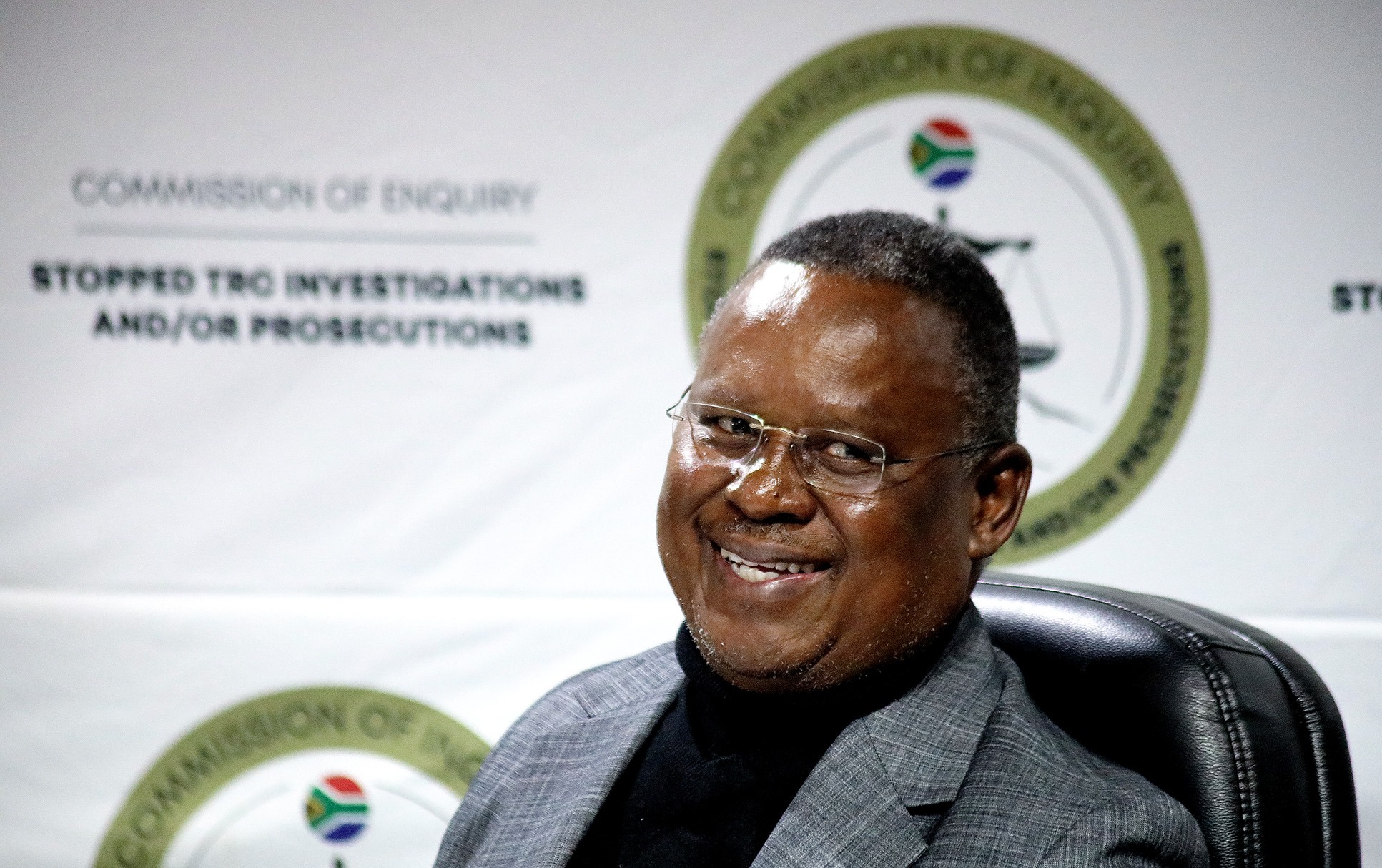
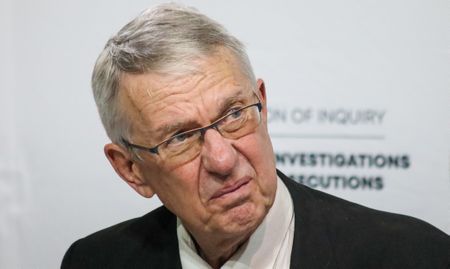
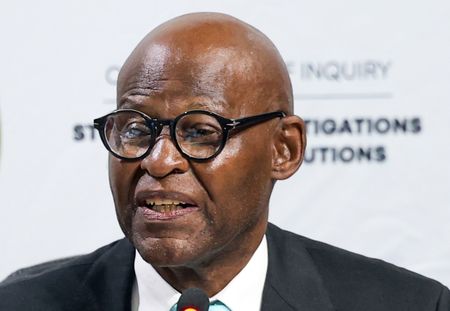
 Reverend Frank Chikane testifies at the Khampepe Commission of Inquiry in Johannesburg on 19 May 2026. (Photo: Gallo Images / Fani Mahuntsi)
Veteran anti-apartheid cleric, Reverend Frank Chikane, survivor of two poisoning attempts by the security police in 1989, told the Khampepe Commission of Inquiry into delayed Truth and Reconciliation Commission (TRC) prosecutions that the suspended sentence given to those who plotted his murder had left him “distressed”.
The 2007 sentences handed to former apartheid minister of police Adriaan Vlok, police commissioner Johan van der Merwe and three security policemen for their collective role in ordering Chikane’s poisoning, had left him “with a deep depression”, he told the Khampepe inquiry on Tuesday.
“I went to the court for the plea bargain sentencing. They went home. I went to my office with a deep depression. I had to leave at 2pm. I had to go home. That was the price we had to pay,” he recalled for the panel.
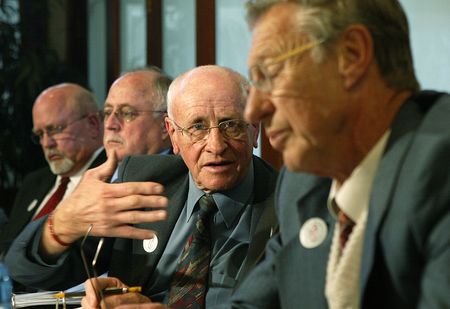
/file/attachments/orphans/000065683_789244.jpg "Former apartheid cabinet minister Adriaan Vlok (centre), with former police commissioner Johan van der Merwe (right), Gert Otto, Hermanus van Staden and Christoffel Smith, on 17 August 2007 after their high court trial over the attempted murder of Frank Chikane. (Photo: Johnny Onverwacht / City Press/Gallo Images)")
Chemical warfare
He said perpetrators like Dr Wouter Basson, head of Project Coast, the apartheid government’s chemical warfare programme, could have been brought to book for the murders of at least 200 people.
In 1999, Basson was initially charged with 67 criminal counts, including 229 murders, drug trafficking, fraud, embezzlement of R36-million, and conspiracy to commit various crimes.
What had stalled any further prosecutions was the dismissal of count two in the Vlok and Van der Merwe prosecution that Basson and chemist, Dr André Immelman (and others), had conspired “at or near Roodeplaat Research Laboratory, Security Branch Headquarters in the district of Pretoria” to commit the crime of murder of persons unknown to the State or to assist with the commission of such murders.
The laboratory was a front for the apartheid government’s chemical and biological warfare programme.
“In so doing, the collaboration between the police, the special unit and Wouter Basson and the procurement of the lethal chemicals was not probed any further,” Chikane told the commission.
Advocate Anton Ackermann, head of the Priority Crimes Litigation Unit (PCLU), previously testified to the commission that apartheid-era generals had inserted a false narrative at the time – that the PCLU was about to arrest President Thabo Mbeki as well as 37 other ANC leaders who had not applied for amnesty.
Ackermann said he had found no evidence to charge Mbeki or anyone else, but that then national police commissioner Jackie Selebi had believed otherwise and had muddied the waters.
Testifying on Monday, advocate Torie Pretorius, who succeeded Ackermann as the head of the PCLU, told the commission that the NPA’s prosecution of Basson had not been lacking, but had been handled with “meticulous attention to detail”.
The acquittal of Basson, said Pretorius, had not been due to prosecutorial failure, but rather due to “judicial misdirection and errors” by the presiding judge, some of which were later confirmed by the Constitutional Court.
/file/dailymaverick/wp-content/uploads/2021/09/MC-Book-Herwitz_1.jpg "Wouter Basson, the apartheid-era ‘Dr Death’. (Photo: Gallo Images / Foto24 / Lisa Hnatowicz)")
Keys to the toxic vault
Chikane told the commission it was clear from the 2007 plea bargain that more information could have been extracted about names of high-profile members of the “anti-apartheid movement struggle” who were targeted, and “in extreme cases” murdered by security police operatives as well as the South African Defence Force (SADF).
“The State should have been interested in a copy of that list, and who was on it and what happened to them.
“There is no indication as to what discussions the NPA had with General Basie Smit (General Sebastiaan Smit, who played a key role in the plot) and Basson to secure more information about operations, particularly of SADF involvement,” he said.
Smit had ordered the “toxic substances that could be used against the enemy” from Basson.
Chikane remarked on the irony that after 1994, he found himself as a director-general and secretary of the Cabinet, and was given the keys to the vault at Roodeplaat Research Laboratory, where chemical weapons and other toxic agents were stored.
This included the highly toxic organophosphate anticholinesterase (a compound used in agricultural pesticides and chemical nerve agents) that had been used to lace his clothes.
Chikane was also responsible for writing policy on these apartheid-era chemicals.
/file/attachments/orphans/7d4267207515b83f00ad645fb3f39ac3_381272.jpg "Jackie Selebi, the former head of the South African Police Service, during his sentencing in Johannesburg on 3 August 2010 after being found guilty of receiving bribes from a drug kingpin. (Photo: Reuters / Werner Beukes / Pool)")
Just a pawn
In 2007, Vlok and Van der Merwe were sentenced to 10 years’ imprisonment, wholly suspended for five years, while the three security police officers who had executed the plan, Christoffel Smith, Gert Otto, and Hermanus van Staden, were sentenced to five years’ imprisonment, wholly suspended.
Chikane said that at the time, he had been in the unique position of having been a victim of apartheid era atrocities – having been tortured and beaten several times between 1977 and 1982 – but also as someone who was later included in the top echelons of the first democratic government led by Nelson Mandela in 1994.
He said he had leveraged this position to dig into the truth of the apartheid-era toxic chemical warfare unit and their “dark deeds”.
“No one got involved”, he said, and it was left to him to dig for the entire truth about who had attempted to kill him. At the time he was poisoned, Chikane had travelled to the US to push for economic sanctions.
The decision by Ackermann and the NPA to prosecute Vlok and Van Der Merwe has been highlighted at the commission as a turning point in post-TRC politics in South Africa.
It was Ackermann’s determination to charge the men that led to an irreparable rift between the NPA, headed then by advocate Vusi Pikoli, the SAPS, headed by national commissioner Jackie Selebi and the minister of justice, Bridget Mabandla.
Chikane said Ackermann’s threats to force him to testify as a witness had “rubbed salt into the wounds”.
Ackermann, said Chikane, had sought information that Van der Merwe and Vlok had given to him, but he had refused to hand this over. The prosecutor had also informed him that Basson was due to face “other charges” and that the NPA had wanted him to testify as a witness.
He said statements should have been obtained from Basie Smit as well as Vlok, Van der Merwe and the three security police members, as the “confessions of the five in this case would implicate others but no charges were preferred”.
/file/attachments/orphans/0000226646_359346.jpg "Former apartheid minister of law and order Adriaan Vlok on 30 June, 2015. (Photo: Gallo Images / Rapport / Deaan Vivier)<br>")
The Vlok feet washing
The much-publicised 2006 washing of Chikane’s feet by Vlok was viewed as a highly symbolic act by some at the time, but the churchman said, “I refused to get my feet washed. He [Vlok] had said it was for him. After the passing of his wife, he had had some Damascus Road realisation”.
He said that Immelman, a veterinary toxicologist and former colleague at the Roodeplaat Research Laboratories, had played a central role in his near-fatal poisoning.
Concerning the prosecution of Vlok and van der Merwe, Chikane said that the NPA had “lied” at the time, stating in the plea bargain that he had been consulted, when he had not. Over and above this, he noted, there had been factual errors in the document.
“I felt caught between three parties, those who perpetrated gross human rights violations against me, the NPA officials, and government officials who held conflicting views”.
/file/dailymaverick/wp-content/uploads/2024/09/10-000033507.jpg)
An end to the war
Chikane said that the TRC Act, as it was finally adopted, was not what those in the liberation struggle had had in mind.
“But we realised this was a political project completing our struggle and ending our war. There were conflicting interests at play in the old order and the new order. I think what is more complex is that we set up the TRC not in the way the Act ultimately did. It is a compromise document”.
This had been decided, he said, to encourage the generals and perpetrators to come forward.
“But they had another interest, to say, ‘we want also the liberation movement to be charged’. It was complex. We were dealing with [a] fragile transition,” he told the panel.
He said that there was a saying at the time, “ ‘Don’t let the past kill the future’. There were those who felt that,” Chikane said.
“We ended up with a political settlement, and there was the view, which was not codified officially, that we should let sleeping dogs lie in order to avoid destabilisation of the new democratic order. Among those who thought like this, there was not much appetite for looking back.” DM
Comments
Scroll down to load comments...