



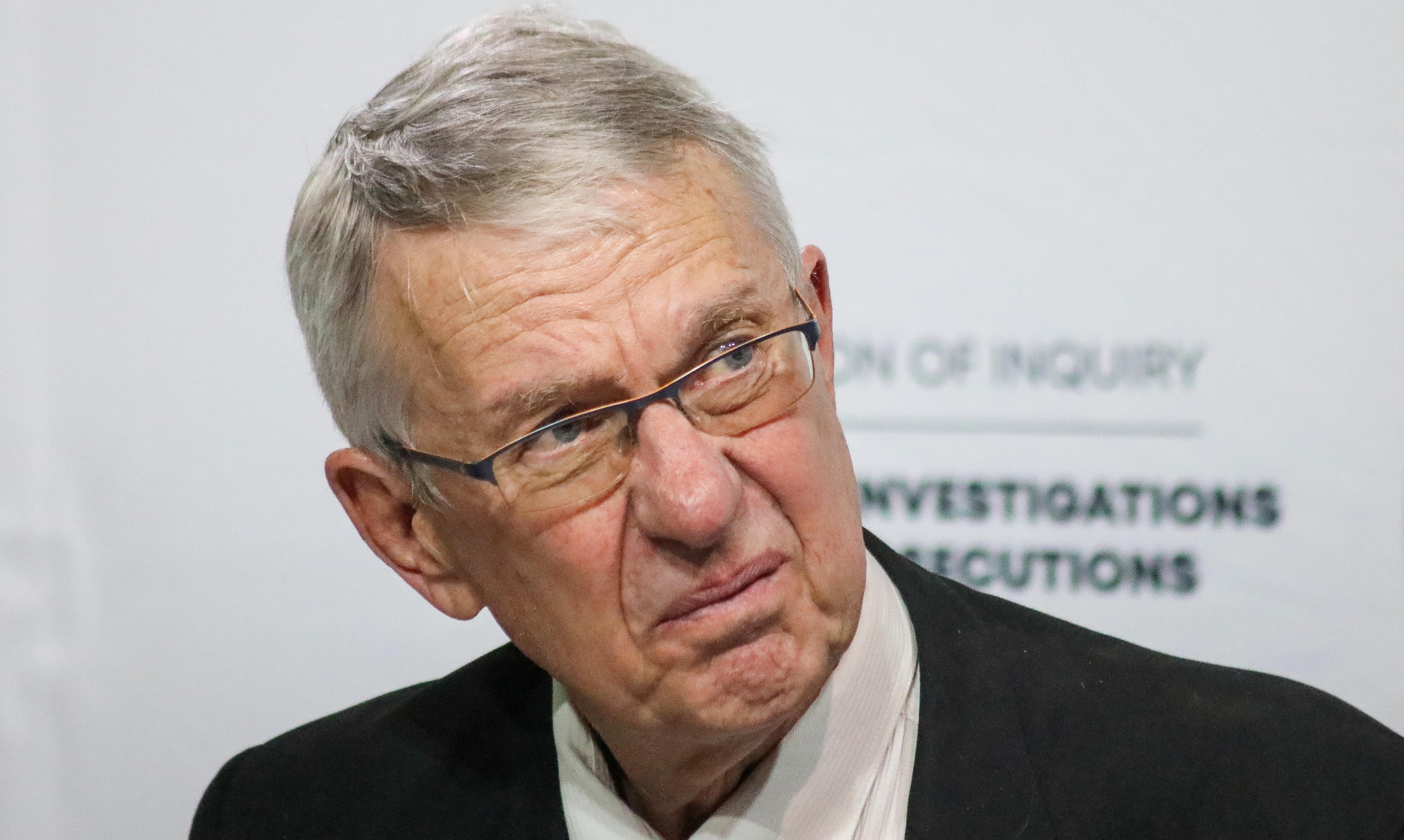
 Former Deputy National Director of Public Prosecutions (NDPP) Jacobus Petrus ‘Torie’ Pretorius testifies at the Khampepe Commission of Inquiry in Johannesburg on 18 May 2026. (Photo: Gallo Images / Fani Mahuntsi)
Advocate Torie Pretorius appeared before the Khampepe Commission into Truth and Reconciliation (TRC) prosecution delays on Monday, confirming the view of his former boss, former National Prosecuting Authority (NPA) head, advocate Vusi Pikoli, that there had been direct political interference in post-TRC matters.
Pretorius told the panel that while he had no personal knowledge of the interference at the time, he accepted and believed Pikoli’s account of events that had transpired under his tenure, until his suspension.
Then president Thabo Mbeki suspended Pikoli after he had initiated fraud charges against the late SAPS national commissioner Jackie Selebi in 2007.
Pikoli has testified to being subjected to “withering pressure from political forces” – specifically from former justice minister Bridget Mabandla, and Selebi – to abandon TRC cases.
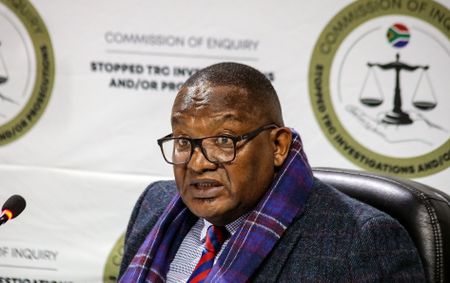
Pikoli’s affidavit, said Pretorius, “clearly indicates that the highest office of the National Prosecuting Authority was subjected to political interference and pressure not to prosecute TRC leftover cases”.
Pretorius cited the suspension of Pikoli as a key example of this and also that the National Director of Public Prosecutions (NDPP) had “faced retaliatory action for making independent prosecutorial decisions”.
/file/dailymaverick/wp-content/uploads/2022/03/ED_201332.jpg "Food and Allied Workers’ Union members outside the Johannesburg high court in support of Neil Aggett, who died while in detention on 5 February 1982 after his arrest by the apartheid South African Security Police. (Photo: Alet Pretorius / Gallo Images)")
Accusations of incompetence
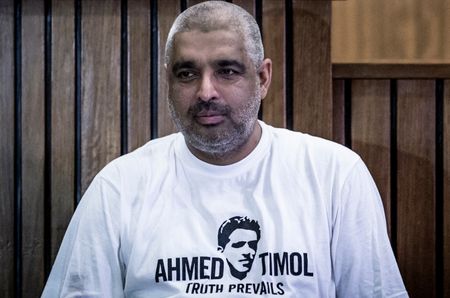
Previously, Imtiaz Cajee, nephew of murdered activist and teacher Ahmed Timol, levelled specific allegations at Pretorius, claiming there had been “no concerted and intentional will” on his part in guiding prosecutors in the matter.
He also claimed that Pretorius and Priority Crimes Litigation Unit (PCLU) head, advocate Anton Ackermann, had presented a “substandard” case during the prosecution of Dr Wouter Basson, head of the apartheid-era army’s chemical warfare unit.
Cajee earlier told the commission that when the PCLU had first handled TRC matters in 2003, there had been “no political interference”, nor a lack of capacity or logistics. The delays, Cajee said, had been caused by deliberate incompetence.
Pretorius said on Monday that Cajee had made the “sweeping and slanderous accusation” that an “old guard” within the NPA was coordinating investigations specifically to “prevent the truth from being exposed”. He denied all Cajee’s claims. He said his conduct had always been “diligent, professional and in good faith”.
He told commissioners that a 2017 email from Cajee, written shortly after the Ahmed Timol inquest had been reopened, expressed his “appreciation to the NPA team”, specifically mentioning Pretorius, advocate Shubnum Singh and investigating officer Ben Nel.
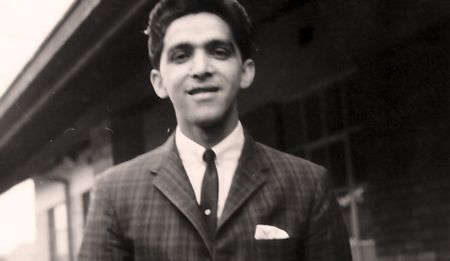
Cajee had also described in the communication the team’s conduct as “professional and thorough”, which was “inconsistent with the allegations” Cajee later advanced.
Pretorius led the state team in the reopened 2017 Ahmed Timol inquest and supervised matters related to the reopening of the Neil Aggett and Hoosen Haffajee inquests, and the Reverend Frank Chikane matter. (Chikane, a key witness, is due to give evidence on Tuesday).
Legal pedigree
Pretorius worked his way up the ranks from a clerk of the court in 1976 until he served as the acting special director of the PCLU from October 2015 to March 2019.
Between 1991 and 1994, he was seconded as an evidence leader for the Goldstone Commission investigating apartheid-era “Third Force” assassination squads and other major violent events.
These included the Boipatong and Bhisho massacres, and his work contributed to the dismissal of several generals in the former SADF.
The Boipatong massacre happened on the night of 17 June 1992, near Vanderbijlpark in Gauteng, when about 300 armed Inkatha Freedom Party (IFP) dwellers at the KwaMadala Hostel, attacked residents in the Joe Slovo informal settlement, killing 45 people and maiming and injuring many others.
The ANC accused the IFP of working with SAPS, and the mass killing led to the party pulling out of the Convention for a Democratic South Africa (Codesa) pre-democracy talks. The same year, 28 ANC supporters and a soldier were shot dead when the then Ciskei Defence Force opened fire during a protest march in Bhisho.
/file/attachments/orphans/ED_466267_164723.jpg "Dr Wouter Basson, once the head of the apartheid South African Defence Force’s chemical warfare unit. (Photo: Gallo Images / Die Burger / Lulama Zenzile)")
‘Not substandard’
In his affidavit, Cajee accused Pretorius of presenting a “substandard” case against the apartheid era’s “Dr Death”, Wouter Basson, who was acquitted in 2002 on 16 counts of murder involving more than 229 deaths, fraud, embezzlement, the manufacture of and dealing in illegal drugs (including Mandrax and Ecstasy) and conspiracy to murder.
Basson was the head of “Project Coast”, a covert chemical and biological warfare programme.
Pretorius denied that the Basson prosecution had been lacking, stating it had been handled with “meticulous attention to detail”. The Basson trial, which ran between October 1999 and April 2002, was one of the longest-running and most expensive trials in South African history.
The acquittal, said Pretorius, had not been due to prosecutorial failure, but to “judicial misdirection and errors” by the presiding judge, some of which were later confirmed by the Constitutional Court.
His prosecution of Colonel Eugene de Kock and Civil Cooperation Bureau (CCB) killer Ferdi Barnard, who assassinated Johannesburg academic David Webster in May 1989, was evidence of his track record, Pretorius said. DM
Comments
Scroll down to load comments...