




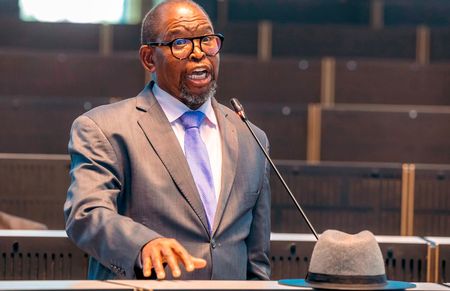
 Loyiso Masuku, Deputy Mayor of Johannesburg, during the City of Johannesburg's presentation of the 2026/27 annual Budget Speech. (Photo: Gallo Images/Lubabalo Lesolle)
The City of Johannesburg has announced the referral of 13 alleged acts of financial misconduct – totalling R4.07 billion – to its independent disciplinary board for preliminary investigation.
The timing of the announcement on Thursday, 23 July 2026, comes as the National Treasury faces a strict seven-day deadline imposed by Parliament to justify its decision to withhold R3.6-billion in equitable share funds from the metro, or present a lawful plan that protects basic service delivery.
Yet, despite trumpeting the referrals as a victory for accountability, municipal officials continue to shield the identities of those involved and the precise details of the alleged fraud behind a wall of secrecy.
What the City announced
In a media statement issued on Thursday, 23 July, the City revealed that Council had approved the referrals under the Municipal Finance Management Act (MFMA) Regulations on Financial Misconduct Procedures and Criminal Proceedings.
According to the administration, the matters stem from widespread non-compliance with the MFMA and Supply Chain Management legislation, resulting in massive unauthorised, irregular, fruitless and wasteful expenditure.
Commenting on the Council’s resolution, Deputy Mayor and MMC for Finance, Loyiso Masuku, defended the decision: “Yesterday’s resolution sends a clear message that the City of Johannesburg is committed to ensuring that accountability extends beyond financial reporting, and that consequence management will be pursued wherever the facts and the law require it.
“The City remains committed to ensuring that allegations of financial misconduct are dealt with transparently, fairly and without fear or favour... This resolution is not merely about compliance with legislation; it is about strengthening public confidence in the City’s governance systems and reinforcing the principle that every allegation of financial misconduct must be subjected to an independent, transparent and lawful process.”
Addressing why these referrals did not automatically result in immediate dismissals or criminal charges, the City stressed the legal distinction between accounting write-offs and official liability, while maintaining a presumption of innocence: “Importantly, the accounting treatment of unauthorised, irregular, fruitless and wasteful expenditure is separate from the conduct of officials.
“While Council may, in appropriate circumstances and in accordance with the MFMA, regularise or write off expenditure where investigations have found that there was no financial loss or prejudice to the City, such decisions do not absolve any official from accountability. Where there is evidence of alleged financial misconduct, the conduct of the officials concerned remains subject to investigation and, where warranted, disciplinary or criminal proceedings in accordance with the law.
“It is important to emphasise that today’s resolution does not constitute a finding of guilt against any official. These remain allegations at this stage, and all affected officials are entitled to due process in accordance with the Constitution, the MFMA, labour legislation and other applicable laws.”
Secrecy at Wednesday’s Council meeting
The secrecy surrounding these cases was underscored at Wednesday’s extraordinary council meeting in Braamfontein. While the Council considered and voted on the referral of the R4.07-billion misconduct matters, the specific items and reports dealing with the disciplinary proceedings were considered “in committee” behind closed doors.
The public and media were excluded from hearing the details, and the documentation was withheld from the open Council agenda, leaving the media release issued late the following morning as the City’s sole public accounting of the decisions taken.
The Auditor-General’s accusations
The City’s claim that it is aggressively pursuing consequence management comes after the damning findings of the Auditor-General and parliamentarians who grilled the mayor and his team earlier this month.
In recent audit cycles and parliamentary hearings, the Auditor-General repeatedly flagged Johannesburg for systemic governance failure, pervasive procurement non-compliance, and an inability to hold failing officials accountable:
- R24.5-billion exposure: The Auditor-General highlighted that Joburg sits on over R24.5-billion in unresolved unauthorised, irregular, fruitless and wasteful expenditure accumulated over years.
- Unrealistic revenue and procurement breakdown: The Auditor-General reported severe material weaknesses and repeat audit findings across key entities like the Johannesburg Roads Agency and City Power, driven by unrealistic revenue targets and unchecked supply chain violations.
- Unresolved material irregularities: The Auditor-General flagged at least eight historical material irregularities where municipal money was lost due to non-compliance, noting that accounting officers routinely failed to take statutory steps to investigate or recover the funds.

This persistent failure to prosecute internal corruption led the National Treasury to invoke Section 216(2) of the Constitution and freeze R3.6-billion in equitable share transfers to the metro.
During recent joint parliamentary hearings, Cogta Committee Chairperson Dr Zweli Mkhize explicitly criticised local administrations like Johannesburg for using “legal red tape” to shield corrupt officials while ordinary residents suffer service delivery collapses.
The 75-day ultimatum
Adding to the pressure on the metro, the intergovernmental intervention has placed Joburg on a strict, time-bound ultimatum. As part of the oversight conditions set following the National Treasury’s funding freeze and provincial Section 154 intervention, the City administration has been given just 75 days to execute a comprehensive operational cleanup.
This mandate requires the metro to clean up its historical accounting backlogs, stabilise critical revenue collection mechanisms and demonstrate tangible compliance progress before the next formal review – leaving City Manager Floyd Brink and Mayor Dada Morero with little room to hide behind procedural delays as statutory deadlines loom. DM
Comments
Scroll down to load comments...