




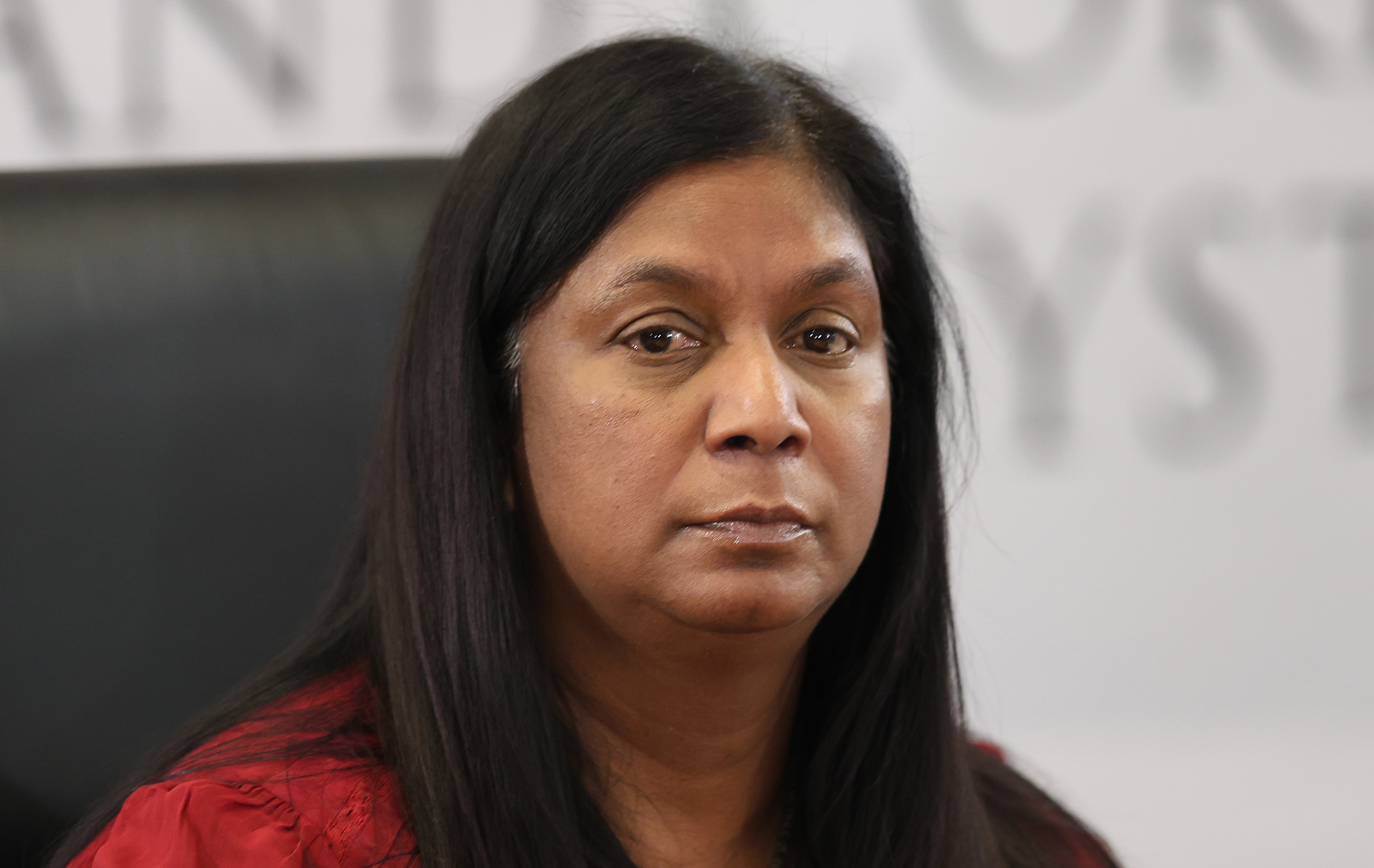
 Head of the Investigating Directorate Against Corruption advocate Andrea Johnson testifies before the Madlanga Commission in Pretoria on 21 July 2026. (Photo: Felix Dlangamandla)
On Thursday, 23 July, after three days before the Madlanga Commission of Inquiry, Investigating Directorate Against Corruption (Idac) boss advocate Andrea Johnson buckled under sustained cross-examination by the evidence leader and commissioners, making a series of significant concessions on key decisions she took during Idac’s investigation into top Crime Intelligence officers.
The day’s most striking moment came during questioning by Commissioner Sandile Khumalo SC, when Johnson withdrew her description of Crime Intelligence Brigadier Dineo Mokwele’s appointment as “token” and apologised for using the term.
Idac led the arrest of Lieutenant-General Dumisani Khumalo, Mokwele, and other Crime Intelligence officers in June 2025, alleging that Mokwele was not qualified to lead Crime Intelligence’s Technical Support Services division. Before her appointment, Mokwele was a BMW mechatronics engineer, and Idac alleged that she had been placed in the job to help capture the policing unit.
Khumalo challenged Johnson on what factual basis she had labelled Mokwele’s appointment as “token” when she had never seen Mokwele’s CV, qualifications or application for the post.
/file/attachments/orphans/ED_611248_249422.jpg "Advocate Sandile Khumalo SC at the Madlanga Commission. (Photo: Gallo Images / Frennie Shivambu)")
“It is an unfair statement to make, having not seen her CV, her qualifications. It is insulting to say. It is one thing to question an appointment; it is quite another to say it was a token appointment,” Khumalo said.
Johnson conceded that the description had been based on a briefing by investigators, but accepted that, having since considered the file, the word “token” was “totally inappropriate”. Khumalo outlined Mokwele’s extensive qualifications, and Johnson conceded that she was qualified for the position.
Khumalo turned to what he described as an even more troubling issue. If Johnson had never examined Mokwele’s job application, on what basis had she recommended in her memorandum to the Director of Public Prosecutions that Mokwele be prosecuted for fraud and corruption linked to State Capture?
Pressed to identify the alleged fraudulent conduct, Johnson again acknowledged that her recommendation had been based on information supplied by the investigating team rather than her own independent assessment of the underlying evidence.
Major concessions
On Thursday, Johnson was forced to make a series of concessions that went to the heart of whether she had exercised independent prosecutorial judgment before recommending charges against senior Crime Intelligence officials. She:
- Admitted she had not personally reviewed key documents before signing the memorandum recommending prosecution.
- Accepted she could not independently verify that the documents supported the definitive conclusions set out in her memorandum to the Directorate for Public Prosecutions.
- Acknowledged making categorical assertions about the evidence, applicable legal provisions and the accused’s alleged involvement, despite not having personally examined all the underlying material.
- Accepted that she could not independently verify that the documents supported the conclusions set out in her memorandum.
- Acknowledged making definitive assertions about the evidence and the accused’s involvement, despite not having personally examined all the underlying material.
- Accepted the memorandum did not indicate that many of its conclusions were based on information provided by the investigating team rather than her own verification.
Johnson faced sustained questioning about Idac’s handling of the investigation into Crime Intelligence that culminated in the arrests of several senior police officers, which is widely seen as the trigger for KwaZulu-Natal police commissioner Nhlanhla Mkhwanazi’s July 2025 press conference, in which he alleged criminal cartels were being protected from investigation due to law enforcement infiltration.
The complaints lodged on the Mokwele matter originally came from National Coloured Congress (NCC) leader and member of Parliament Fadiel Adams. Johnson was pressed on whether she placed undue reliance on allegations that were, at the time, unsubstantiated, and whether she authorised intrusive investigative and prosecutorial steps before there was sufficient evidence to justify them.

Illegal investigation?
One of the most consequential issues to emerge from Thursday’s hearing was whether Idac effectively conducted a full criminal investigation under the guise of a preparatory inquiry before obtaining the statutory authorisation required by the National Prosecuting Authority Act.
The issue arose during questioning by evidence leader Mahlape Sello SC, who took Johnson to her 30 May 2025 application for an investigation in terms of section 28(1) of the NPA Act.
The application recorded that a preparatory investigation had commenced on 6 December 2024 and that evidence had already been gathered before Johnson sought authority to launch a formal investigation.
Sello argued that section 28(13) allows only a limited preparatory inquiry to determine whether reasonable grounds exist to authorise a formal investigation under section 28(1). Yet, by Johnson’s own evidence, investigators had already obtained witness statements, subpoenaed documents and carried out extensive investigative work before 30 May 2025.
/file/attachments/orphans/ED_603956_556548.jpg "Advocate Mahlape Sello SC at the Madlanga Commission of Inquiry in Pretoria. (Photo: Gallo Images / Frennie Shivambu).")
The issue became even more complicated when Commissioner Khumalo recalled Johnson’s earlier evidence that investigators had approached her as early as February 2025 for authority to issue subpoenas, including one to BMW, and to interview company officials.
“How could they do that,” Khumalo asked, “if they had not yet been designated as investigators in a formal section 28 investigation?”
Johnson responded that investigators were designated during the preparatory investigation authorised on 6 December 2024, allowing them to conduct investigative work.
Sello, however, disputed that interpretation, arguing that the Act distinguishes between a preparatory inquiry and a formally authorised investigation, with the latter only commencing on 30 May 2025.
/file/attachments/orphans/Madlanga12_643697.jpg "Investigating Directorate Against Corruption head advocate Andrea Johnson testifies before the Madlanga Commission in Pretoria on 21 July 2026. (Photo: Felix Dlangamandla)")
The questioning then turned to timing. If the formal investigation began on 30 May, how had Idac completed it, secured arrest warrants and arrested Lieutenant General Khumalo and six other senior Crime Intelligence officers by 26 June, less than four weeks later?
Pressed on what new investigative steps had been taken after 30 May, Johnson was unable to identify what additional evidence had been uncovered during that period, saying she would have to establish precisely what investigators did after the formal authorisation.
Sello suggested the sequence raised a more fundamental legal question: whether Idac had already conducted the substantive investigation before obtaining the statutory authority to do so, formalising the process only afterwards.
“If that is what happened,” Sello remarked, “Idac used the mechanics of section 28(13) to conduct a full-blown investigation, cured the defect by obtaining authorisation on 30 May, and within four weeks was ready to arrest.
“If that is how it happened, I will applaud the efficiencies within Idac.”
Missing links
Another major weakness identified during Johnson’s evidence concerned the factual basis on which Idac expanded the scope of its investigation far beyond the allegations contained in the original complaint lodged by NCC leader Adams.
The commission heard that Adams’ section 27 referral affidavit identified only a handful of people. Yet, when Idac sought authorisation under section 28(13), the list of people to be investigated had grown to 12 names supplied by investigator Dylan Perumal.
Commissioner Khumalo questioned how Johnson could have concluded there were reasonable grounds to believe that all 12 had committed serious offences when most of their names did not appear in Adams’ affidavit.
“What was the factual basis for concluding that these people had committed offences when the affidavit makes no allegations against them?” Khumalo asked.
He pointed out that, if the prosecutor had not interviewed Adams and had relied only on his affidavit and a list of names supplied by investigators, there appeared to be no evidential foundation linking many of those individuals to any alleged criminal conduct.
Khumalo repeatedly pressed Johnson on how she could authorise an intrusive criminal investigation into people “unknown” to the complainant, against whom no allegations had been made and whose conduct was not described in the founding affidavit.
Johnson ultimately conceded that the application should have established a factual link between each of the additional names and the alleged offences.
“What I have to concede is that, in the absence of a link between what is contained in the affidavit and the list of names, they should not have been included,” she told the commission.
Khumalo said the issue struck at the heart of Idac’s exercise of its investigative powers.
“For you to conclude that these people committed fraud or defeated the ends of justice, there has to be a factual basis. It cannot simply be done in the dark. Idac cannot use its powers to target South African citizens without a factual and legal foundation and then decide to investigate them.
“I would understand if you said Mr Adams came back with a supplemented section 27 affidavit and in that affidavit he made allegations against these people and told Idac what conduct on their part constituted an offence,” Commissioner Khumalo stated. DM
Comments
Scroll down to load comments...