




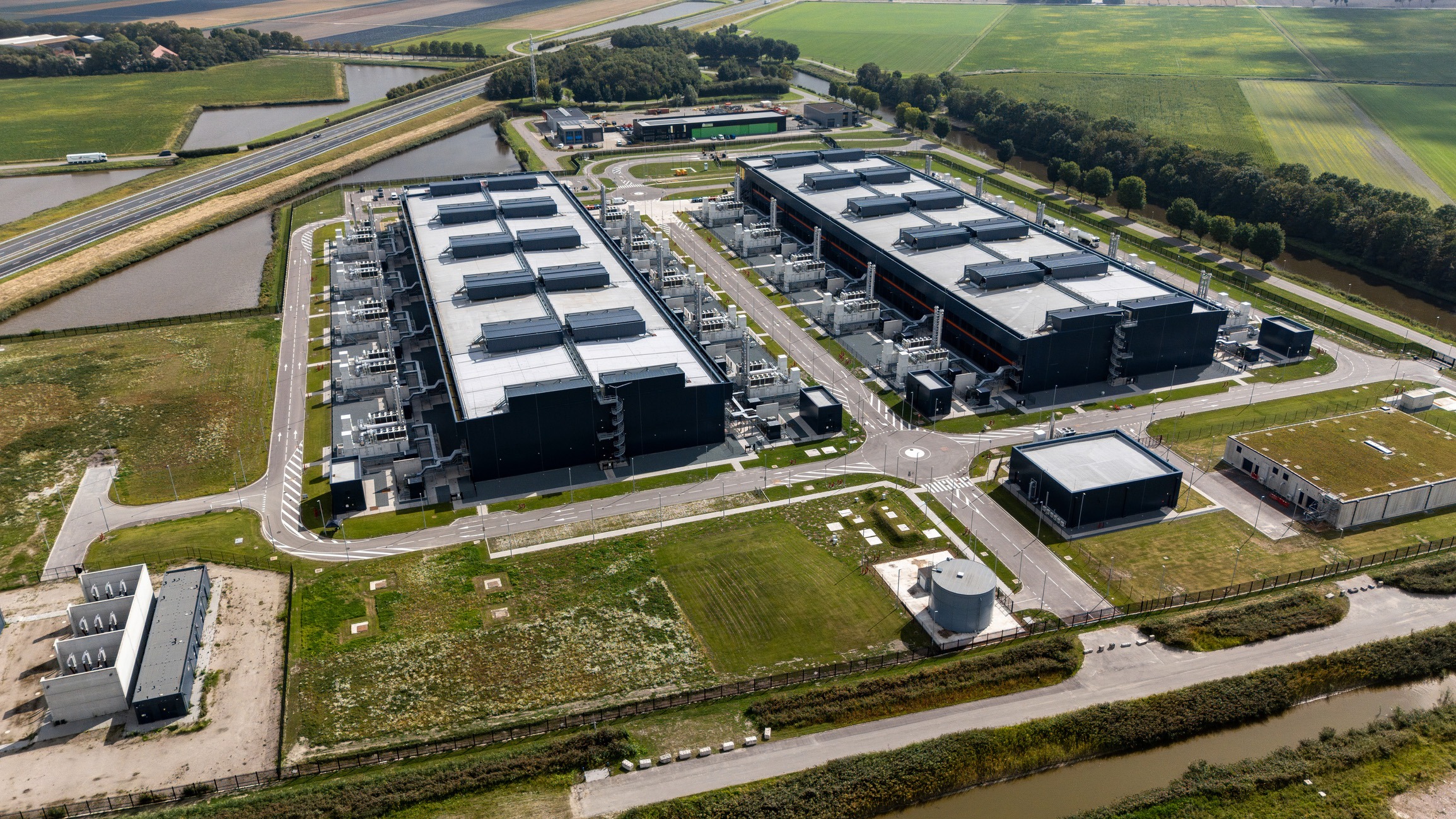
 Cape Town is poised to welcome two new hyperscale data centres. Pictured are the Microsoft data centres in Middenmeer, Netherlands. (Photo: iStock)
 /file/dailymaverick/wp-content/uploads/2025/10/label-analysis-2.jpg)
In 1956, the King David Golf Club was established to give the growing Jewish community in what is now Greater Tygerberg (read: Parow and Bellville) a place to swing their clubs and stretch their legs.
The thing about golf courses is that they’re incredibly thirsty, slurping up to three million litres of water per day. That is enough to support the needs of 60,000 individuals under the Level 6B water restrictions (read: 50 litres per person, per day) at the height of Cape Town’s Day Zero fears – 120,000 if the Mother City ticked over to the dreaded Level 7.
That is enough to support the needs of 60,000 individuals under the Level 6B water restrictions (50 litres per person, per day) at the height of Cape Town’s Day Zero fears — 120,000 individuals if the Mother City ticked over to the dreaded Level 7.
You can use any maths you want, but data centres — even in the US, and those monster AI complexes are thirsty — do not guzzle as much of the essential H2O as the luscious fairways, which do not pay their fair share of taxes, nor do they contribute to GDP at the same level.
This doesn’t completely absolve Equinix and the City of Cape Town of blame for the intricate square dance they did when unlocking the former golf course grounds for the current industrial revolution, but we can give them a break on some of the environmental fronts.
Swapping land
When the King David club’s membership collapsed in the mid-2010s, it wound up operations and signed a 99-year land lease with Atterbury Property and Old Mutual Properties. The developers commenced a R3-billion redevelopment to transform the former fairways into a world-class logistics gateway, capitalising on its 2km proximity to Cape Town International Airport’s freight terminal.
Under Case ID 1500156580, the developer, Planning Partners, on behalf of the global digital infrastructure firm Equinix, applied to the Municipal Planning Tribunal (MPT) for land-use rights to establish their second hyperscale data centre within Phase 4 of the park.
On 14 July, the MPT approved the application by a 4:1 majority, overriding a formal, joint objection from the Housing Assembly and the UK-based non-profit Foxglove, legally represented by the Legal Resources Centre (LRC).
The real tea, however, is in the details of the commercial deal between the City of Cape Town, the developer (Atterbury/Old Mutual), and Equinix. It is an elegantly executed multilayered transaction that ties land-use rezoning directly to municipal grid infrastructure.
The three-part deal
1. The physical core of the electricity deal is a land-swap agreement between the City of Cape Town and the developer, authorised by the Geordin Hill-Lewis via a Mayoral Committee round-robin process on 25 May.
The City transferred Erf 179607, a small 280m² property zoned Mixed Use 1 (MU1) located on Pilatus Street, to the developer. The purchase price was set at a nominal R100 (excluding VAT) or “nil compensation”.
In exchange, the developer gratuitously ceded a significantly larger piece of land — Erf 180452, measuring 2,962m² — to the City. This parcel was transferred as a Utility Zoned property.
This land swap was designed to clear cadastral boundaries and secure a large enough site to construct a massive 240MVA electrical switching station.
2. A 160MVA grid connection is a massive electrical load, comparable to the demand of a small municipality, or around 15,000 households. So, to secure this capacity for Equinix’s two data centres, the developer paid shared network charges of approximately R33-million directly to the City of Cape Town to secure the 160MVA allocation.
This means the 240MVA electrical switching station serves a dual purpose: 160MVA is dedicated to powering the two Equinix data centres (Phase 2 and Phase 4); the remaining 80MVA of capacity is integrated directly into the City of Cape Town’s primary electrical network. The City’s energy department accepted this to strengthen and expand its 132kV network in the area, preventing local grid redundancy.
The physical power will be routed from Eskom’s Philippi and Erica transmission stations; the essential upgrades at the Erica station are currently funded in the budget, with completion projected for August 2028.
3. It was in the developer’s best interest to secure these rights without applying for a completely new, intensive heavy-industrial land-use permit from scratch. Since July 2019, the 71-hectare King Air Industria development has operated under a package of plans with an approved “basket of rights” capping total floor space at 305,548m².
The deal reallocated Gross Leasable Area (GLA) within the existing basket, and the developer slashed approved industrial GLA from 47,687m² to 11,479m², and approved warehousing GLA from 220,880m² to 134,543m². This new carved-out bulk was combined to create a brand-new, standalone land-use category in the basket: Data Centre; and was allocated 122,545 m² of GLA across Phase 2 (50,003m²) and Phase 4 (72,542m²).
Then the developer layered the icing on the cake. To ensure structural uniformity, the 280m² substation site (Erf 179607) was rezoned from Mixed Use 1 to General Industry 1 (GI1) and consolidated with Erf 180449 and unregistered Erf 180450 to create a single, clean development site (Erf 180451) for the Phase 4 data centre.
Administrative semantics
To ease the regulatory path, the developer relied on an administrative interpretation that classified the data centre as a warehouse.
Wait, why did they do that?
As Daily Maverick previously reported, under Cape Town’s old planning guidelines, a data centre was interpreted as “the storage of computers/data” and thus fell under warehousing.
Although the Development Management Scheme (DMS) was formally amended in 2025 to explicitly categorise data centres under GI1 and warehousing zones, the LRC rightly argues that treating a 160MVA, high-intensity digital processing plant as a standard physical warehouse is a regulatory fiction.
A warehouse is a low-intensity use with minimal resource consumption. A hyperscale data centre operates 24/7 and draws massive public resources, meaning its environmental impact profile is entirely different.
Since the original July 2019 approval, KAI has undergone at least seven rounds of planning and condition amendments.
Each amendment (whether increasing total bulk by 3,000m² in 2021, reallocating GLA, or extending phasing timelines) was presented individually as a “minor technical adjustment”. The cumulative result is a fundamental transformation: Equinix’s two data centres will consume nearly half (122,545m²) of the entire park’s approved GLA.
By dragging out approvals step-by-step over seven years, the developer dodged a full assessment of the project’s cumulative impact on local resources and the community.

However, a 160MVA data centre requires industrial backup generation, as per the 99.9999999% uptime guarantee needed to secure the data centre contract.
Under National Environmental Management Act Environmental Impact Assessment Regulations (Listing Notice 2, Activity 2), any non-renewable electricity generation facility of 10MW or more requires a full, national Scoping and Environmental Impact Assessment. The developer bypassed providing these details at the planning level, creating a risk that land-use rights may be granted for a facility lacking environmental authorisation.
So, while the water-use argument was easy to dance around, the legal challenge brought by the Housing Assembly, Foxglove and the LRC is justified. It exposes a systemic governance gap: the City’s willingness to grant valuable, long-term land-use rights to a colossally resource-intensive hyperscale development while kicking the critical environmental and resource-consumption assessments to a non-public, administrative stage. DM