




 The interior of a typical data centre. (Source: Switch)
“Infrastructure. Okay. That’s all it comes down to. [Cities] must have enough infrastructure capacity to supply a data centre... So we are talking about upgrades of existing substations or new-build substations.”
That was Kovilan Naicker’s clarification when Daily Maverick asked him what he meant when he said that African cities need to be “energy ready” to become attractive destinations for data centre investment.
Naicker is the manager of the Hitachi Energy Grid Automation business unit, so power infrastructure investment means he gets to spin up the local factory to produce more grid protection equipment, which helps protect power assets (transformers, substations, your TV) from exploding when something goes wrong on the electricity lines.
He was at the Hitachi stand at Enlit Africa — “Africa’s premier gathering for the power, water, and energy sectors” — a little tired from being on his feet all day, so he sat down for the interview. Questions had to be limited to the components on display on the wall behind him. Luckily, Hitachi makes almost everything that a power utility could need on its grid.
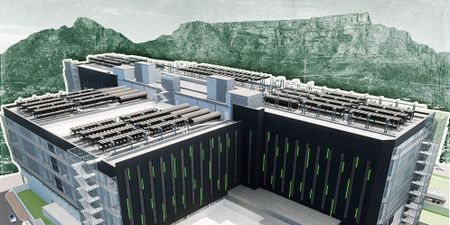
It’s also fortunate that these Tier 4 facilities — those that require fully redundant power, 2N+1 fault tolerance (where every component is duplicated), 99.995% uptime and only 26.3 minutes of unplanned downtime per year — need full utility-scale substations to land the energy infrastructure. Like the two 132kV transmission cables that stop at the private substation at the data centre housed within Cape Town Film Studios, which is the primary photography location for the Netflix live-action anime adaptation One Piece.
According to Naicker, attracting such large-scale projects brings substantial benefits to a city that go far beyond just job creation: “It helps put the city on the global map and integrates it into a massive worldwide ecosystem.”
He also pointed out that successfully drawing a data centre into a metro provides a guaranteed and substantial revenue stream for the municipality. “These facilities don’t like to stay idle; it’s guaranteed megawatts that they’re using.”
Economic value
The Actom stand stretches high into the CTICC hall, just across the conference floor walkway from Hitachi.
“In most of our product lines, we own the intellectual property. So, we’re able to add a very high local content to our product, going up to 100%. We employ approximately 8,000 people ... and add a lot of economic value to the economy,” Actom group CEO Mervyn Naidoo explains to Daily Maverick.
Outside of being a big supplier to Eskom on the power generation side (subsidiary John Thompson is one of the best in the boilermaking business), the full-service firm is one of the first points of contact when you need private power systems at utility scale. Actom is also a big customer of Hitachi.
Naidoo firmly positions the data centre boom as an opportunity to build an African-led industrial base:
“We see ourselves as an African OEM [original equipment manufacturer]. The intent is to localise [so] that you ensure that the demand in those economies is actually satisfied and built by African people, in Africa, for Africa.”
To that end, Actom has expanded its production capacity to battery energy storage solutions — importing only the cells — as well as now owning LH Marthinusen, which allows the conglomerate to manufacture and provide aftermarket repairs and support for electrical rotating machines, transformers and fans. This forms part of the company’s broader “cradle to grave” service model, in which it manufactures the building blocks of power systems, integrates them, and maintains the products over their full life cycle.

It’s an input problem
By all accounts, the demand for South African electricity infrastructure and expertise is there for the long haul.
“Data centres are a very, very good investment and also career for the long term. A substation for a data centre will be the same as a substation that goes into a mine or a paper plant. No different ... the core technologies remain the same.”
That’s not Naidoo’s problem. His challenge is in the classroom, where many potential engineers and technicians are dropping from pure maths to maths lit.
To solve this skills crisis, the company has partnered with the Department of Basic Education on a tutoring programme to help support children in maths and science.
“First, we encourage them to do maths and science, then it’s encouraging them to pursue two careers in engineering,” explains Naidoo.
“Those children then feed into our artisan training centres. They feed into our bursary programmes into university. They feed into our engineer training programmes. So, we walk a path with children from an early age.”
The electricity minister has admitted that the 14,000km transmission expansion planned for 2035 isn’t yet priced into grid liberalisation plans. Crucially, however, the conservative R440-billion estimate for this buildout already includes the salaries for the future engineers needed to build it.
Naicker’s colleague Stuart Michie, sub-Saharan Africa head of sales and marketing for Hitachi Energy, is happy with the trajectory South Africa is on; at least on the grid-planning side.
He says that Eskom’s forward-looking transmission planning has been a critical stabiliser for international original equipment manufacturers (OEMs), allowing them to secure global supply chains for South Africa.
“What Eskom have done really well is that they have put a lot of effort into their development plan providing the view to the market. They say, ‘For the next 10 years we’re going to do this.’ It also helps us, because we can see what’s coming and planned, and work towards putting that on the radar of our particular suppliers. So yes, it’s actually been very good.”
/file/attachments/2992/PHOTO-2026-05-20-18-11-172_673031.jpg "The author interviews Stuart Michie on the Hitachi stand at Enlit Africa, with the wall of energy systems in the background. (Image courtesy of Hitachi)")
Patches of excellence
Unfortunately, that kind of best practice doesn’t extend to the distribution side. Not all municipalities are at the same energy readiness. Daily Maverick has it on good authority that the City of Cape Town has been actively trying to modulate the influx of data centre projects within its domain by opening up dialogue to send the colocation facilities to other locations.
Annexure 26 of the City’s draft budget for 2026/2027 lists multiple power projects in its lengthy account of individual projects that will cost more than R50-million. One standout is the ground solar photovoltaic project planned for a plot of land in Somerset West. The city is also actively trying to get Eskom infrastructure onto its books to better fulfil those Tier 4 mandates.
Meanwhile, Eskom is threatening to cut Johannesburg’s power if it doesn’t get its account payments in order.
To be fair to these AI data centres, they are not simply passive consumers of energy. They are anchor clients driving the digitalisation of the national grid, stimulating massive local manufacturing pipelines, and creating highly skilled, long-term technical jobs.
Supported by Eskom’s transparent long-term planning and immense private sector investments in renewable energy, the data centre industry is becoming a foundational pillar for South Africa’s modern, industrialised economy.
As it turns out, rumours of rampant deindustrialisation of the Mzansi economy are hard truths limited to our country’s former strengths. Those are also where the mass employment opportunities are, so the grass isn’t all that green in the energy-ready cities. DM
Comments
Scroll down to load comments...