



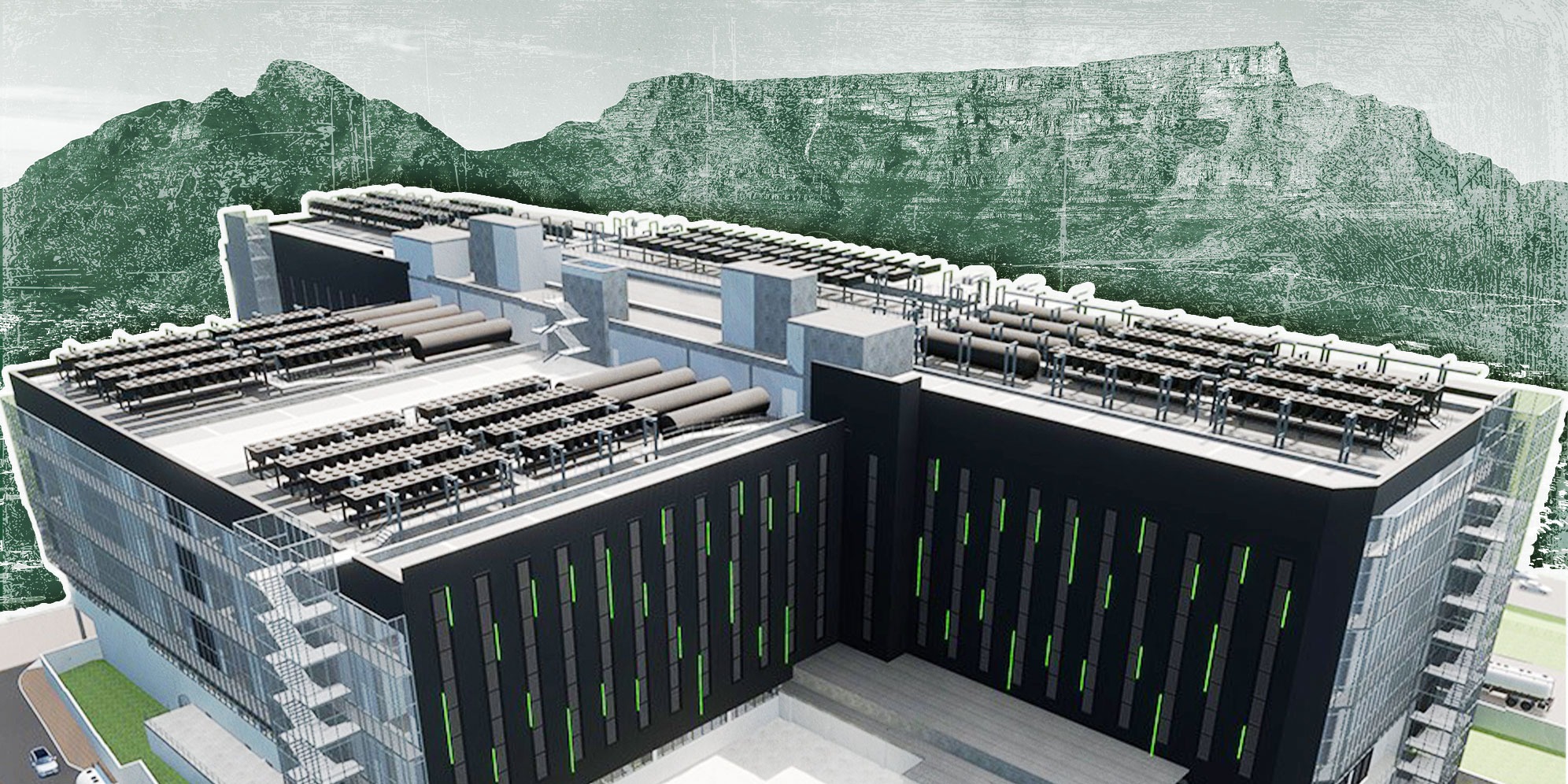
 Illustrative image: Table Mountain. (Photo: Francois Nel / Gallo Images) | Impression of Teraco data centre in Johannesburg. (Image: supplied) | (By Daniella Lee Ming Yesca)
 Cape Town houses about 10 data centres whose cumulative electricity demand is relatively modest — but this is set to change with the construction of another four much larger data centres in the city.
Last year, the Cavaleros Group announced plans to build a massive 360MW data centre in the city. (This is thought to be linked to the Microsoft corporation, but neither Cavaleros nor the US multinational have confirmed or denied a link).
Teraco, currently the largest data centre operator in South Africa, is planning another 60MW expansion in the city, while the latest entrant, Equinix, aims to build two new centres with a combined peak demand of 160MW.
Collectively, these four new data centres would require 580MW of power, which equates to just over 34% of the City of Cape Town’s current maximum electricity demand of 1,676MW.
In response to our queries, the city did not comment on this calculation, simply noting that it was “unable to provide information on the maximum demand projections at this time” and that overall customer demand for electricity in Cape Town had dropped by nearly 20% since 2008.
“From that perspective, these additional demands [from data centres] are not that great in scale and might well be seen as a welcome reinvigoration of a grid electricity business that is required to service and connect an increasing number of subsidised customers,” said a senior city official.
/file/attachments/orphans/tony-guzzler-3-AWS-data-centre-Atlantic-Drive-image-Google_803522.jpg "The Amazon Web Services data centre in Atlantic Drive, Cape Town. (Image: Google)")
We asked the city to provide figures for the cumulative electricity demand of the current data centres in Cape Town. But the city failed to provide this information, asserting that “data on specific customer demand is protected under Popia [the Protection of Personal Information Act].”
So far, data centres in South Africa’s three biggest cities have been approved with relatively little public participation or scrutiny, despite growing global concern over the massive volumes of electricity and water used by hyperscale data centres.
A stormier ride
However, new development proposals by Equinix and others in South Africa are set to encounter a stormier ride.
In a formal letter of objection sent to the City on 13 April, two civil society groups challenged a rezoning application lodged by the Planning Partners group over Equinix’s proposals to build two new data centres next to Cape Town International Airport, on a 122,545m³ site on the old King David Golf Club course.
/file/attachments/orphans/cape-town-international-airport-image-source-Google-Earth_911319.jpg "The orange and yellow blocks show the proposed location of two new Equinix data centres at the old King David Golf Club, opposite Cape Town International Airport. (Image: Sourced / Google Earth / Daniella Lee Ming Yesca)")
The first two objectors lining up to contest willy-nilly expansion are Foxglove (a London-based group of lawyers, tech and communications experts) and the Cape-based Housing Assembly, both represented by the Legal Resources Centre non-profit law clinic.
Foxglove describes itself as a non-profit organisation whose ambition is to use litigation and communication to “stand up to tech giants and governments for a future where technology is used to benefit everyone, not just the rich and powerful”.
The Housing Assembly is an advocacy group representing residents of informal settlements, backyard dwellings, temporary relocation areas, rental properties and RDP housing to ensure better access to water and other basic services.
In their objection to the proposed rezoning of the King David/King Air Industria development, Foxglove and the Housing Assembly say: “This application asks the City to approve one of the largest and most resource-intensive developments in the northern suburbs on the basis of a 24-page motivational letter that says nothing about water, nothing about emissions, limited on electricity, nothing about diesel generators, nothing about air pollution, nothing about noise, and provides no plans for the buildings themselves.
“It is presented as a technical adjustment to a Basket of [development] Rights. It is not. It is a decision that affects the water, air, energy supply, and services that communities across this city depend on.”
Planning Partners claims in the rezoning application that the data centres “will have no impact on the general public or the City of Cape Town” as no new development rights were sought.
It has further applied to be exempt from further external advertising requirements on the basis that this is merely a “technical, administrative process that does not impact on neighbours, existing rights or the general public”.
But the Legal Resources Centre challenges these assertions, noting the recent “devastation” caused by Eskom load shedding.
/file/attachments/orphans/tony-guzzler-4-Eskom-loadshedding-flashback-image-Eskom_832722.jpg "Flashback to June 2022, when Eskom's load shedding became an almost daily occurrence. (Image: Eskom media release)")
“When a multinational company proposes to draw 160MVA from the grid, the City and its residents are entitled to know the implications for electricity supply in the broader area.”
Foxglove and the Housing Assembly note that hyperscale data centres in other parts of the world use very large volumes of water to cool down the electrical heat in their computer servers.
“In the absence of any information from the applicant about the cooling technology, water source, or projected consumption of these facilities, the City cannot assess the impact on Cape Town’s water infrastructure — a city that narrowly avoided ‘Day Zero’ in 2018 and remains acutely vulnerable to water scarcity.”
Further, to ensure 24-hour operations in the event of power cuts, data centres are equipped with back-up power generators — but Equinix had provided no information about how many generators would be needed, how much diesel would be stored and what pollutants would be emitted.
The communities surrounding King Air Industria (including Nooitgedacht, Matroosfontein, Gugulethu and other residential areas) had a right to know whether they would be exposed to diesel exhaust, noise, and the explosion risks associated with large-scale fuel storage, said the two organisations.
According to government regulations, developers must conduct a full environmental impact assessment for new power generation projects. The facility could also be classified as a Major Hazard Installation if large volumes of diesel were stored for back-up power.
/file/attachments/orphans/tony-guzzler-5-Teraco-rooftop-plant-equipment-image-Teraco_496638.jpg "Part of the extensive cooling system on the roof of a Teraco data centre in Johannesburg. (Photo: Teraco)")
In response to questions from Daily Maverick, Equinix said the new data centres in Cape Town would use dry, air‑based cooling systems.
“These systems require no water for data hall cooling. As a result, there is no material operational water consumption associated with the cooling of the data centre beyond limited domestic and ancillary uses.”
Regarding electricity, Equinix said power would be supplied via the City of Cape Town’s electricity distribution network, with upstream generation and bulk supply ultimately sourced from Eskom.
‘Maximum-case scenario’
It described the 160MW power demand as a “maximum‑case scenario rather than committed or immediately deliverable capacity”.
“Equinix is committed to achieving 100% renewable energy coverage globally by 2030 and has already reached 100% renewable coverage across its Europe, Middle East and Africa operations.
Renewable energy for Equinix’s South African operations would be achieved through a combination of mechanisms, “including Power Purchase Agreements (PPAs), Energy Attribute Certificates (EACs/REGOs), and, where feasible, direct investment in new wind and solar generation”.
Spokespersons for the City of Cape Town said they were “unable to provide information on the maximum demand projections at this time.
“However, with these developments, it is typical that the operators pay for all the network impacts. This includes payment for their portion of the shared-network costs, and as far as we can, the City encourages them to self-build parts of the network to the City’s standards as a way to contribute to resources.
“Typically, the base-load consumption they provide and the subsidy that is included in their tariffs enable the City to cross-subsidise other customer groups. This increase in revenue is essential for financial viability.
“The City always maintains a balanced approach and takes into account the full context of operations. Importantly, attracting the creation of data centres and other mechanisms to unlock economic growth and to boost investment for employment remains a key focus of the City and to the benefit of the greater Cape Town.”

Energy Availability Factor
The city further stated that the Energy Availability Factor from Eskom had improved significantly.
“Currently, it is being monitored, but the impact by data centres is not currently a major concern, given that in many cases, new data centres take several years to reach their full load, which will allow the Eskom recovery plan to reach full fruition.”
On the question of back-up power, the city said: “In general, data centres require near 100% backup of their load, typically by diesel-fuelled onsite generators combined with UPS systems to prevent data loss and equipment damage. Typically, the data centre is incentivised to minimise operating these because they are so much more expensive than grid power. They are therefore only run for periodic maintenance testing and in emergencies. This question then links to the magnitude of the load, which would indicate the approximate size of backup capacity, but which we cannot disclose due to Popia, as mentioned. Please approach the operators involved.”
Regarding the rezoning application, the city said: “To date, due process has been followed with the advertising of the application as per the City’s municipal planning by-law, as well as the requirements for notification to interested and affected parties. The City still needs to evaluate the application together with all comments and objections received from internal and external departments/interested and affected parties. As such, we cannot comment on the objection that was received.”
On water demand, the city said it assesses each proposed development, including data centres, through standard development approval processes.
“Importantly, the City actively promotes the use of alternative water sources, such as treated effluent, particularly for high-consumption industrial users like data centres, to reduce reliance on potable water.” DM


Comments
Scroll down to load comments...