




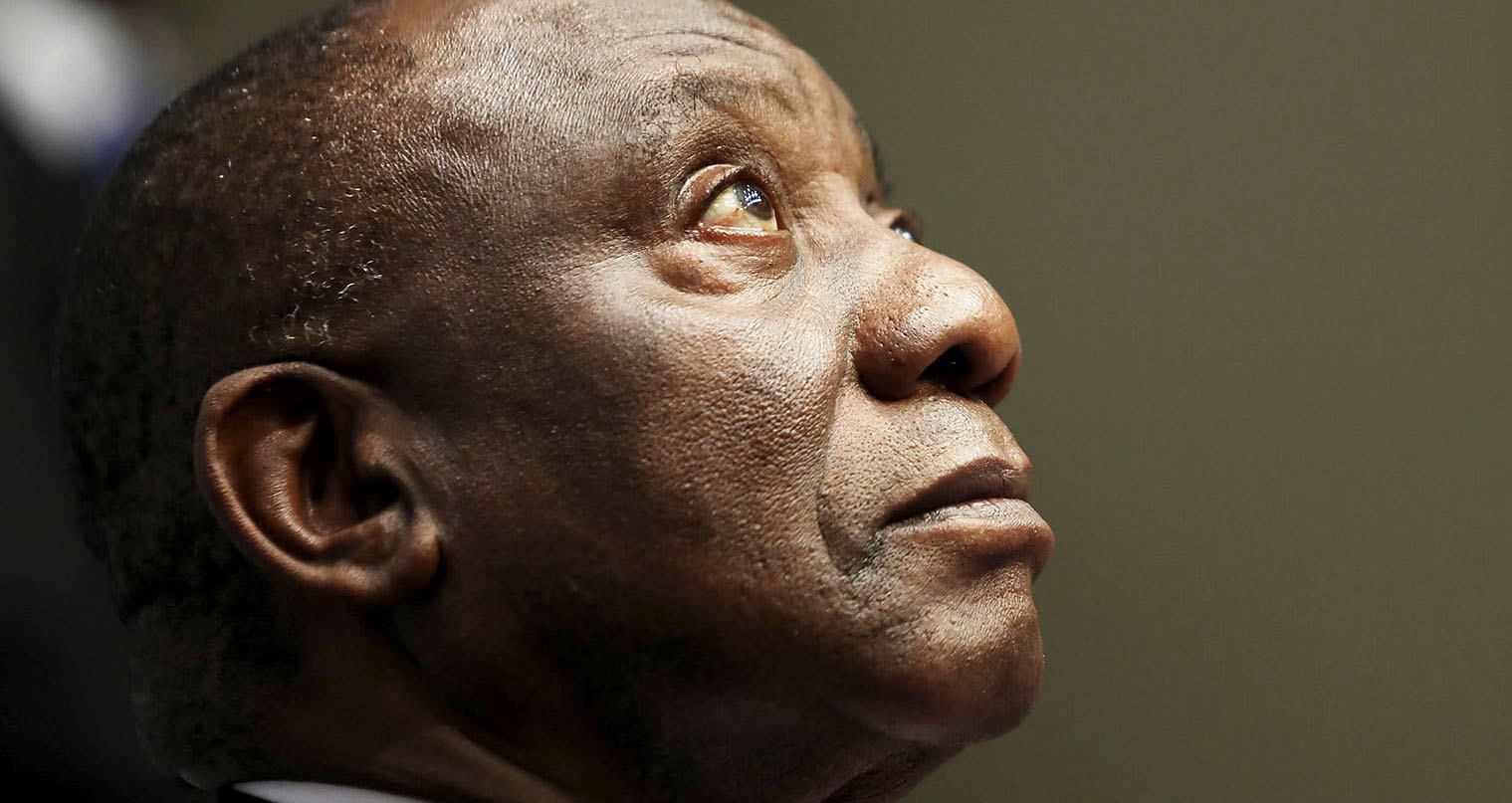
 President Cyril Ramaphosa will suffer humiliation should impeachment proceedings against him go ahead, his advocate has argued in the Western Cape High Court during an application for an urgent interdict to halt the proceedings. (Photo: Esa Alexander / Gallo Images / Sowetan)
 To subject a sitting head of state to the public spectacle of an impeachment inquiry on the back of a flawed Section 89 report would be a “humiliation” from which the President cannot easily recover.
That was the core argument of advocate Wim Trengove, representing President Cyril Ramaphosa. He said Ramaphosa stands to “suffer irreparable harm” to his reputation should the high court not issue an interdict to stay the impeachment committee’s proceedings against him.
On Thursday, 16 July, the Western Cape Division of the High Court in Cape Town wrapped up two days of arguments in Ramaphosa’s application. The President is seeking an urgent interdict to halt the committee’s proceedings — which stem from his conduct in the Phala Phala saga — pending a review of the Section 89 independent panel report.
That panel, chaired by former Chief Justice Sandile Ngcobo, found that Ramaphosa had a case to answer over the theft of $580,000 in cash hidden in his sofa at his Phala Phala game farm.
In May, the Constitutional Court cleared the way for an impeachment process to begin when it ordered Parliament to refer the report to an impeachment committee. Ramaphosa subsequently launched a review of the report, which is set to be heard in early September.
The African Transformation Movement (ATM), Economic Freedom Fighters (EFF), uMkhonto Wesizwe (MK) and United Africans Transformation (UAT) parties are opposing Ramaphosa’s interdict application. The impeachment committee, chaired by Rise Mzansi’s Makashule Gana, also resolved to oppose the interdict on legal grounds.
Trengove argued that the Rules of the National Assembly were designed not only to facilitate an impeachment process, but also to protect the President, and that he would be deprived of that protection if the matter went to an impeachment committee without a valid panel report.
“We submit, in this case, the balance is easy to strike, because on the one hand there is a risk of unlawfully depriving the President of the buffer designed for his protection. That would be an irreversible prejudice suffered by the President once he’s had to suffer the humiliation of an inquiry. As against that, he asks for a two- to three-month delay of that inquiry,” said Trengove in his rebuttal on Thursday.
/file/attachments/orphans/ED_615723_502085.jpg "Advocate Wim Trengove presents his case on behalf of Ramaphosa at the urgent interdict hearing in the Western Cape High Court on 15 July. (Photo: ER Lombard / Gallo Images)")
A full bench of the Western Cape High Court comprising judges Andre le Grange, Matthew Francis and Diane Davis presided over the matter.
Judgment was reserved. Judge le Grange said the court intended to deliver a ruling by the end of next week.
Claim of irreparable harm
On Thursday, Judge Francis scrutinised Trengove’s point regarding the humiliation Ramaphosa would allegedly suffer if the impeachment proceedings went ahead. He raised specific concerns around the delay an interdict would cause the public, who would have to wait longer for the proceedings to unfold.
“Section 89 to hold the President accountable … [is] really for the people of South Africa, the general populace, so they must also be factored into the issue of harm… It’s keeping the populace — the electorate — in abeyance.
“If I understood [the advocate] Mr [Dali] Mpofu yesterday [Wednesday], he said it’s actually a parallel process — continue with your review, but also let the accountability mechanism continue on its part as well. If there is going to be humiliation and so on, that is just part of the job, so to speak. When the President took on the position of President, he knew Section 89 was in place. Simple as that,” said the judge.
On Wednesday, Mpofu, representing the MK party, argued that Ramaphosa had failed to make a case for irreparable harm, and that instead, the harm would be caused to the people of South Africa, should the court grant an interim interdict.
“The people of South Africa can only hold the President accountable through their elected representatives, which is Parliament. That’s the only tool in the hands of the people of this country to get answers to what happened in Phala Phala.
“Who’s going to talk about the damage to them?” Mpofu asked the judges.
/file/attachments/orphans/ED_615715_598939.jpg "Advocates Wim Trengove and Dali Mpofu exchange pleasantries at the urgent interdict hearing on 15 July. (Photo: ER Lombard / Gallo Images)")
In his arguments, Mpofu — as well as advocate Anton Katz, representing the ATM — referred to a case involving the former Public Protector Busisiwe Mkhwebane in which she sought to stop Parliament’s Section 194 inquiry into her removal from office. In this matter, the Western Cape High Court found in October 2020 that Mkhwebane failed to show irreparable harm from such proceedings, and instead upheld public interest and Parliament’s constitutional responsibilities.
Mpofu represented Mkhwebane in the case, and argued that the parliamentary removal proceedings against her were part of a “vendetta” drawn up by the DA.
Judge Davis on Thursday asked Trengove for his response to the findings of this “binding” ruling.
“It’s been put to us that the court has already said as a matter of principle that you can’t suffer reputational harm if you’re a person like the President or the Public Protector because you signed up to the office and accountability is your duty,” she said.
Trengove, in response, said that the National Assembly rules are in place to “protect the President against unwarranted impeachment proceedings.
“You must understand the milieu in which it operates, where the President has aggressive adversaries forever bent on scoring political points and, if possible, destroying their opponent. That is the environment in which they live … that’s how politics works.
“But it is in those circumstances, where you operate in those aggressively adversarial playing fields, that the legislature has, under its Section 89 mandate, put in place rules that protect the President against unfounded allegations. As a matter of public policy, the courts are bound to respect that protection and not to allow it to be taken away.”
/file/attachments/orphans/ED_615869_245573.jpg "Judges Matthew Francis and Andre le Grange at the urgent interdict hearing on 15 July. (Photo: ER Lombard / Gallo Images)")
In response to Judge Francis’ concerns regarding a potential delay in proceedings, Trengove said Ramaphosa was merely asking the court for “an indulgence of two to three months.
“He doesn’t ask for anything more. The fact that there’s already been a delay of four years is not the doing of the President. It shouldn’t be laid at his door, and he should not be made to pay the price for that delay… It is unfair to burden the President because there has already been undue delay in this case,” he said.
Sufficient evidence vs prima facie
One of the core arguments of Ramaphosa’s review application is that the Section 89 panel misunderstood its mandate, in that it interpreted “whether sufficient evidence exists” to mean “whether there is a prima facie case”. This, he said, was a “fatal flaw”.
Trengrove argued that the Section 89 panel should have applied a standard of “sufficient evidence”, but instead asked only whether there was a lower “prima facie case” against Ramaphosa.
“What the panel is required to do is to assess whether there is sufficient evidence to refer the matter to an impeachment committee. The panel interpreted that to mean whether there is prima facie evidence of a transgression. We submit that more is required than that,” he said.
“I’m not seeking to persuade you that if they [the panel] had applied the proper test they would have come to a different conclusion. That’s not the debate before you. But the question merely is: did they apply the right test? And we submit that they tell us that what they did was to ask themselves whether there’s a prima facie case, when what the rule requires is sufficient evidence, which it is a bit more than that.”
/file/attachments/orphans/ED_615712_235472.jpg "Members of the MK Party protest outside the Western Cape High Court on 15 July. (Photo: ER Lombard / Gallo Images)")
Trengove stated further that “sufficient evidence” required the panel to conduct a “qualitative assessment of the information” before it. This was not done, he said.
“The President would be deprived of that protection — that qualitative assessment — if the decision by the independent panel is taken on a prima facie basis, because a prima facie assessment looks at the incriminating evidence and simply asks itself whether there is enough — whether the President would be guilty if all this evidence was true. It doesn’t weigh it up,” he said.
Judge le Grange disagreed, saying in this instance it was clear that the panel was aware it needed to take into account, and weigh, the President’s response to the allegations against him.
“It appears from looking at this panel report that they indeed considered the evidence of the President,” he said.
Committee to continue work
After the hearing ended, Gana told reporters that the work of the impeachment committee would continue, until or unless a court decided otherwise.
“We do have a meeting scheduled for Wednesday [next week]... Until such time that the competent court can stop or indicate that we must not proceed, we will proceed,” he said.
He said that the committee was currently considering nominees for evidence leaders. DM