




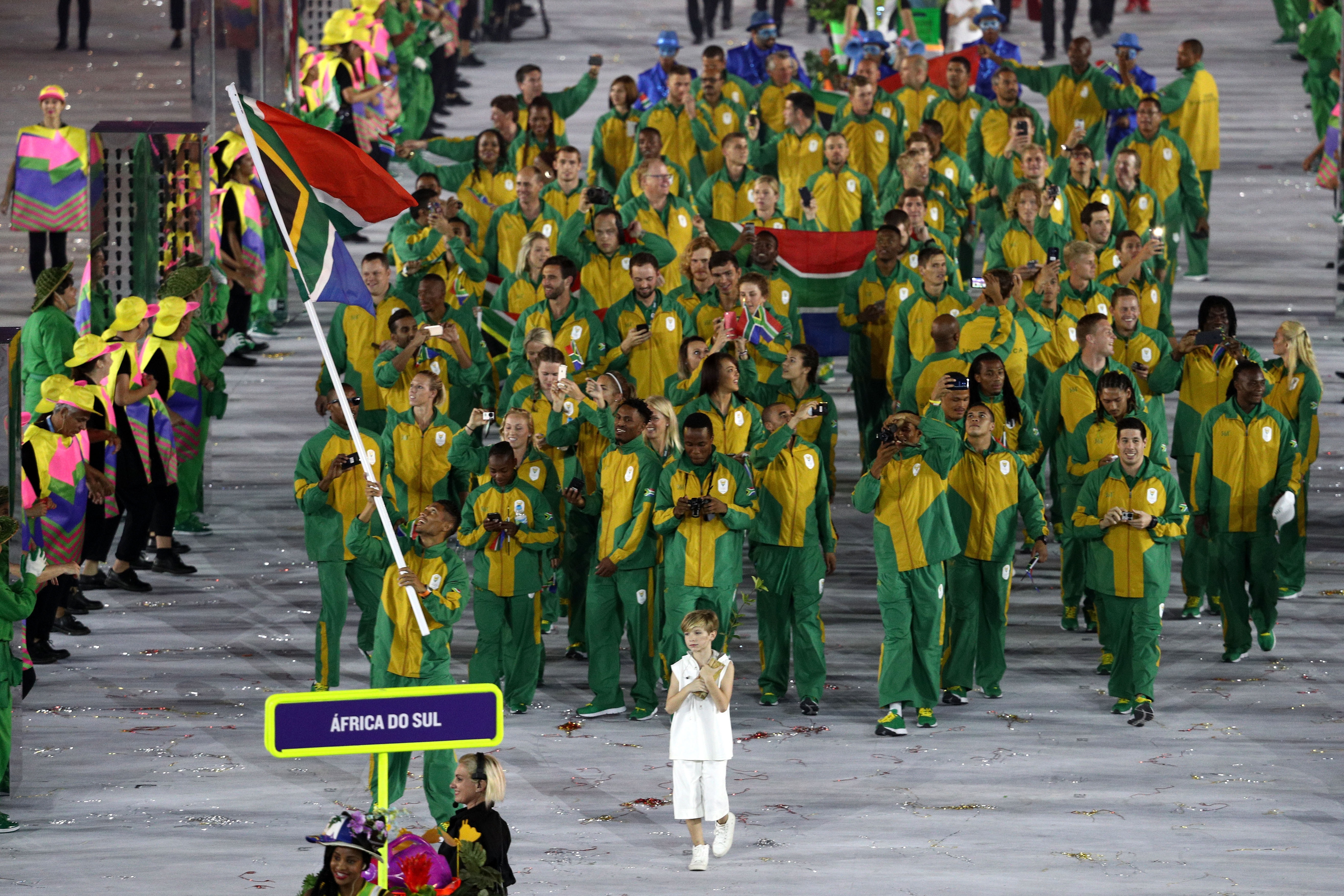
 Wayde van Niekerk of South Africa carries his country’s flag during the Opening Ceremony of the 2016 Olympic Games at Maracana Stadium on 5 August, 2016 in Rio de Janeiro, Brazil. (Photo: Paul Gilham / Getty Images)
In 2016, while South Africa’s Olympic athletes were being told to book their own flights to Rio de Janeiro for the Olympic Games, R24.98-million in lottery money earmarked for their send-off was siphoned off to a four-month-old foundation.
With the athletes hoping to perform on the biggest stage of their lives, the money was paid out to a shell company, a travel agency owned by a senior official’s relative, and ultimately went into the pockets of some of the National Lotteries Commission’s staff. A decade later, the Hawks are on the case.
On 27 May, a Special Tribunal found that a R24.98-million National Lotteries Commission (NLC) grant, approved in July 2016, nominally to fund a nationwide Olympic “send-off roadshow”, had been obtained through material misrepresentation and fraud.
Judge BA Mashile declared the grant, its underlying agreement, and the payment itself unlawful and invalid from the outset.
Eleven respondents, including the shell foundation that received the funds — the Mshandukani Foundation — its directors and the companies it paid out, were ordered to repay R24.83-million jointly and severally — meaning the Special Investigating Unit (SIU) can pursue any one of them for the full amount.
/file/attachments/orphans/1289944833_736501.jpg "Caster Semenya of South Africa competes in the Women's 800m semifinals at the Rio 2016 Olympic Games. (Photo: Ian MacNicol / Getty Images)")
Sascoc’s involvement
The South African Sports Confederation and Olympic Committee (Sascoc), which facilitated the application, was treated separately: its direct liability was “only” a R150,000 “administrative fee” it retained, which Sascoc says it has since repaid.
Sascoc rapidly sent out a clarification statement on 26 June when media outlets reported that the Olympic body had been ordered to repay the entire R24.98-million.
“Sascoc notes with concern that several media reports have incorrectly stated that the organisation has been ordered to repay the full grant amount of R24.98-million,” Sascoc stated.
“This interpretation does not accurately reflect the findings of the judgment delivered by the Special Tribunal. The order specifically found that Sascoc and its former Chief Financial Officer, Mr Vinesh Maharaj, are jointly and severally liable for an amount of R150,000, representing an administrative fee retained by Sascoc in relation to the grant.
“The Tribunal further found that Sascoc had not derived any substantive benefit from the grant beyond this amount. The judgment expressly states that Sascoc and Mr Maharaj are required to repay the amount of R150,000 to the National Lotteries Commission. Sascoc can confirm that the amount of R150,000 has been paid in full.”
It’s all well and good that the “administrative fee” has been repaid “in full” 10 years later, but it avoids several material questions.
According to Judge Mashile: “Sascoc confirms that no due diligence was undertaken in respect of the [Mshandukani] Foundation. This omission is sought to be justified on the basis that Sascoc is wholly dependent on the National Lotteries Commission for funding and therefore did not consider it necessary to question the suitability of an organisation identified by the commission through its chairperson. This amounts to Sascoc’s dereliction of its duties under the grant agreement.”
The judge further found that Sascoc “acted dishonestly and was complicit in the scheme to siphon funds”, even if it didn’t pocket the bulk of the money.
Take a moment to absorb that. The national sporting body, whose mandate is to support Team SA athletes, has been accused by a respected judge of being complicit in siphoning funds intended to support those same athletes.
Asked to respond to those specific findings, Sascoc did not acknowledge or reply to questions submitted by Daily Maverick before or after the deadline.
/file/attachments/2995/TW_0028853_425411.jpg "Entertainment during the combined Rio Olympic Games farewell dinner for SA's Olympic and Paralympic teams, hosted by Sascoc at Emperors Palace on 22 July, 2016. (Photo: Wessel Oosthuizen / Gallo Images)")
The NLC grant money was supposed to support Olympic awareness events nationwide. However, investigators found it had been used to pay for motor vehicles, livestock, panel-beating bills and decor for an “unveiling event”. Some of the money was even paid directly to individuals connected to senior NLC officials — officials who are now the subject of a Hawks investigation.
The money trail
In February 2016, a non-profit organisation (NPO) called the Mshandukani Foundation was registered.
Two of its listed directors were a receptionist and a geologist intern at Mshandukani Holdings, whose identity documents were used without their knowledge or consent to get the organisation registered.
On 7 July 2016, Sascoc submitted an application to the NLC for R34.83-million on the four-month-old foundation’s behalf. It was approved within six days, although the amount was reduced to R24.98-million.
That was despite regulations requiring applications without mandatory documentation to be declined outright.
No site visit was conducted, and no missing paperwork was requested.
“The modus operandi of these characters, inter alia, involved the seizure of lawfully registered non-profit organisations, that is, the clandestine use of their documentation and information, or the fraudulent alteration of certain of their records,” the judgment reads.
“These ‘hijacked’ NPOs were then utilised to apply for grant funding from the NLC. Once such grant funding was approved and disbursed, the funds were unlawfully and improperly appropriated for the personal benefit of the perpetrators.”
No due diligence
The NLC, responding to questions from Daily Maverick, described at length its current due diligence processes, listing site visits, identity-based screening and automated fraud detection through its Thuthuka grants management system.
But it did not explain how the 2016 application cleared any equivalent process at the time.
The question of how a four-month-old NPO with no financial statements was approved in six days remains unanswered.
“The NLC has revised its grant funding process and currently applies a comprehensive due diligence process to ensure that funding is awarded only to organisations that are legally compliant, financially sound, operationally capable, and able to deliver sustainable development outcomes,” the NLC wrote in an emailed response to Daily Maverick.
“Due diligence does not end with the approval of funding. It continues throughout the grant lifecycle, encompassing progress reporting, monitoring and evaluation, and compliance assessments.
“Where instances of non-compliance or suspected fraud are identified, appropriate corrective measures are implemented, including grant suspension or withdrawal, referral to the Non-Compliant Grantee Committee for listing as a non-compliant grantee, forensic investigation, referral to law enforcement agencies where criminal conduct is suspected, and referral to the Special Investigating Unit where matters fall within the scope of the relevant presidential proclamation.”
The ‘process’
The NLC paid Sascoc on 20 July 2016. Within a week, Sascoc had transferred R24.83-million to the Mshandukani Foundation, keeping R150,000 as an administrative or service fee.
From there, the money moved quickly. Within days, R15.35-million had been transferred to Ironbridge Travelling Agency, R7.23-million to Mshandukani Holdings — a company directed by one of the foundation’s office-bearers — and R2-million to Ndzhuku Trading.
All these transactions carried the payment reference of “Sascoc Events”.
Forensic tracing then showed Ironbridge funnelling R450,000 to Philemon Letwaba, the NLC’s then chief operations officer, R3-million to a trust linked to him, and R600,000 to the NLC’s then manager of legal services. None of these expenditures fell within the grant’s approved purposes.
Just as the Mshandukani Foundation’s application was being prepared in early July 2016, South African newspapers were reporting that Olympic-bound athletes had been told to cover their own flights to Rio and wait months for reimbursement.
That story broke within hours of the NLC announcing a separate R70-million grant to Sascoc for the Games, prompting swimmer Roland Schoeman to ask publicly where the money was going.
Sascoc’s then CEO, the late Tubby Reddy, dismissed the reporting as a distortion. The tribunal’s judgment names Reddy as central to “laying the groundwork” for the Mshandukani scheme alongside the then NLC chairperson, Alfred Nevhutanda.
Sascoc’s then CFO, Maharaj, was held jointly liable for the R150,000 despite not personally profiting: his failure, the judge said, was a breach of fiduciary duty in following instructions he knew were “potentially tainted by illegality.”
/file/attachments/2995/mshandukani_money_trail_802253.png "How the money was spent. (Graphic: Daily Maverick)")
In its response to Daily Maverick, the NLC confirmed that the SIU had referred the matter to the South African Police Service and the Directorate for Priority Crime Investigation — the Hawks — for criminal investigation, with a view to possible prosecution.
“The SIU has been authorised under the relevant presidential proclamation to investigate this matter and to institute civil proceedings on behalf of the state for the recovery of losses arising from the unlawful conduct identified during its investigation,” said the NLC.
“Consequently, the SIU is the institution presently seized with the civil recovery process, and the NLC does not institute parallel civil recovery proceedings in circumstances where such proceedings are already being pursued by the SIU.”
The NLC says it has regular meetings with law enforcement agencies monitoring the cases.
Whether Letwaba, Nevhutanda, or others named in the judgment face charges remains an open question, but the referral to the Hawks marks a significant escalation beyond the civil recovery proceedings that produced last month’s judgment.
Screening?
On the question of whether implicated individuals could re-enter the NLC’s funding pipeline through new entities, the NLC described identity-number-based screening that flags applications where the same ID number appears across multiple organisations.
That system would not, however, have detected the 2016 scheme: the Mshandukani Foundation used the real identity numbers of two people who hadn’t consented to being listed as directors.
The NLC did not address that specific gap, nor would it say whether its Non-Compliant Grantee Register is public or how many individuals from this matter appear on it.
The recovery effort, meanwhile, continues on multiple fronts. In 2025, the SIU froze two luxury properties in Centurion linked to Mashudu Shandukani and his wife, Pretty, and a R1.7-million Powerstar borehole drilling rig traced back to Letwaba.
These assets were acquired, the SIU says, with Rio Olympics campaign money.
The NLC declined to estimate what proportion of the R24.83-million it expects to recover, saying it would be “legally inappropriate and speculative” to do so while proceedings are ongoing.
Asked how much NLC funding from the same period is currently the subject of recovery action across all matters, it declined to answer, directing the question to the SIU.
None of this is without precedent inside Sascoc. Daily Maverick’s 2017 investigation found the organisation had received nearly R300-million in lottery funding between 2014 and 2016, while individual athletes crowdfunded their own travel.

A commission of inquiry led by retired judge Ralph Zulman the following year found Sascoc’s board “essentially dysfunctional,” its governance a fiction, and Reddy guilty of multiple instances of misconduct.
By 2018, the NLC had imposed a funding cap and cooling-off period. By the time of the Paris Olympics in 2024, it was barring implicated Sascoc figures from applying for grants altogether.
The Mshandukani judgment is now the starkest paper trail yet of where the money actually went. DM
Comments
Scroll down to load comments...