




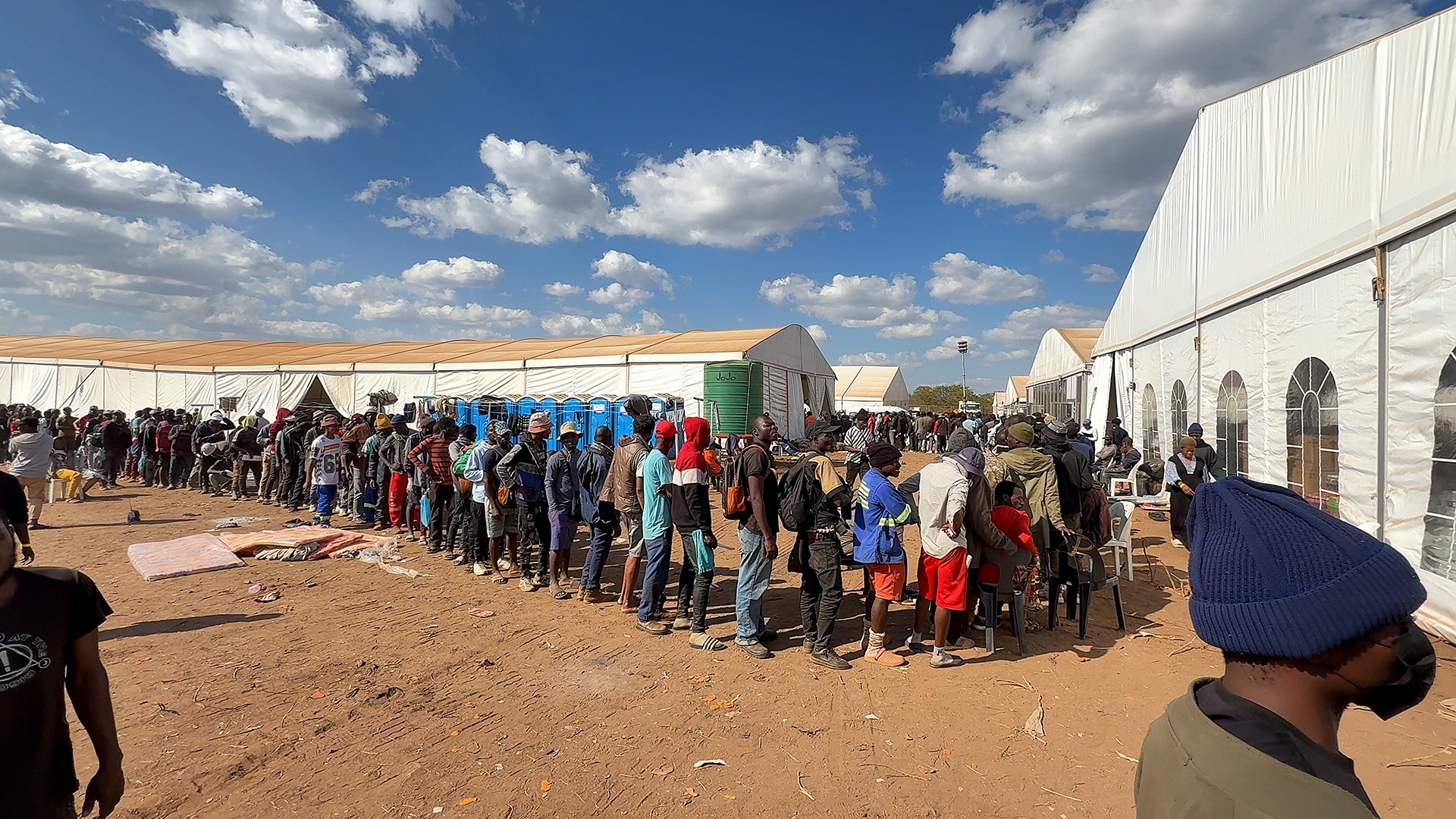
 Thousands of migrants queue for processing at the Musina Temporary Repatriation Processing Centre. (Photo: Catherine White)
 /file/dailymaverick/wp-content/uploads/2025/10/label-Op-Ed.jpg)
On 29 June, public health professionals warned that the unlawful “30 June” deadline set by anti-migrant groups risked triggering a public health emergency. That warning has materialised: in just over a week, the government processed tens of thousands of people – driven from their homes by violence or the threat of it – through the Musina Temporary Repatriation Processing Centre and the Beitbridge border post. This process has been blind to people’s humanity, reducing them to numbers, ignorant of the lives that have been thrown into upheaval.
Ministers have presented the pace of this operation as proof of success. But speed of removal is not evidence that a crisis has been addressed. Instead, it disregards people’s rights, health and dignity – including the constitutional right to healthcare, which carries no documentation requirement. Throughout the process, none of these rights has been protected. The evidence shows the government is failing, and the cost will be paid in broken treatment courses and new injuries long after the buses stop running.
In response, Healthcare Workers Against Xenophobia have released a statement endorsed by 33 organisations.
A crisis of the government’s own making
The unlawful deadline set by March and March, and Operation Dudula, was allowed to stand for weeks before the government acted. When it finally did, it moved people faster than it could provide shelter, food, water, sanitation or continuity of healthcare. Many of those swept up at Musina are documented, and others have been rendered undocumented by Home Affairs’ own inefficiency. Migrants did not cause this crisis and so removing them resolves nothing and discharges none of the government’s constitutional obligations.
The risk, moreover, was foreseeable. Musina was linked to a cholera outbreak under comparable conditions in 2008, and the government acknowledged this publicly at the time. Presenting overcrowding and neglect at the same site as a policy success, rather than a repeated and documented failure, is a failure of accountability and a lack of compassion.
The health toll doesn’t end at the border.
Beyond the terror inflicted on non-nationals – terror that has violated multiple laws and the Bill of Rights without consequence – people forced to leave mid-treatment have lost access to ART, TB treatment, antenatal care and chronic disease management, carrying clinical risks that will outlast the processing centres.
Home Affairs maintains that these sites are being managed lawfully and humanely. There is little evidence to support that, and plenty to counter it. Overcrowding and poor sanitation are exactly the conditions that produce disease transmission, exposing infants, pregnant women and older people to hypothermia and respiratory illness. The psychological toll of displacement, family separation and continued threats from vigilante groups – sometimes operating alongside police – is profound and ongoing, absorbed almost entirely by the non-governmental sector and civil society – already stretched before this began.
Nor is the damage confined to Musina. In Durban, the Denis Hurley Centre – the city’s only free healthcare provider for foreign nationals – has reported patient numbers three times higher than before the blockade, and a tenfold rise in medicine expenditure. The Ashraful Aid Humanitarian Organisation’s Roshnee IMA Mobile Clinic has treated 74 patients unable to access public healthcare. Médecins Sans Frontières (MSF) has launched an emergency medical response across Gauteng, KwaZulu-Natal and the Western Cape, flagging continuity-of-care concerns for patients with HIV, TB, diabetes and hypertension. This is a national health crisis, not a localised one.
We are equally troubled by the human cost of how people are being moved. A Malawian died during transport to Beitbridge; separately, a fatigued driver was killed and 11 passengers injured in a crash near Musina. Both point to the same failure: people are being moved too fast without basic medical screening or safe driver rostering.
The threat has not passed.
March and March, Operation Dudula and sympathetic politicians have signalled weekly protests for the next six months. Vigilante groups – sometimes operating alongside the police – continue to target refugees, asylum seekers and documented and undocumented migrants alike, as though lacking documentation removes their constitutional protection, or their humanity.
MSF has linked this violence to at least four deaths, numerous injuries and the destruction of homes. The climate of fear has its own health consequences: people delay or avoid clinic visits, ART collection and antenatal care. The violence has widened – from a campaign nominally aimed at undocumented migrants, to one targeting anyone perceived to be foreign.
On 5 July, the Constitutional Court found key provisions of the immigration legislation the government relies on to be unconstitutional. Thirty years into our democracy, these defects should never have needed a court order to be remedied. A government that processes people rapidly while failing to protect their rights cannot claim to uphold the Bill of Rights.
What the government owes people now
Health workers will keep providing care to everyone who needs it, without exception, as that was never in question. But our willingness to do so cannot absolve the government of its constitutional responsibilities, or let it outsource the consequences of its own actions to frontline health workers while migrants continue to be scapegoated for problems they did not cause.
What we are asking for is neither radical nor complicated. We call for:
- An end to rhetoric dressing up rapid repatriation as success, and public acknowledgement of the humanitarian and health consequences of this crisis;
- Uninterrupted access to ART, TB treatment and essential medicines at every processing site, regardless of documentation status;
- Medical screening and support before transportation for those who require it, and an independent investigation into the deaths already recorded;
- Independent monitoring of health and psychological wellbeing at every site, with funding for the community organisations carrying out this work unpaid;
- Public disclosure of the government’s plan for protecting healthcare access at every facility, including structured engagement with healthcare workers and facility staff to ensure migrant-sensitive and rights-based practices;
- Full enforcement of the existing November 2025 high court order against Operation Dudula and effective protection of all migrants, refugees and asylum seekers from vigilante violence, regardless of documentation status;
- A credible pathway to regularise migrants’ status to ensure continuity of healthcare and other essential services; and
- A public, evidence-based government statement rejecting the false claim that migrants are responsible for this country’s failures.
None of this is beyond the government’s capacity. What is needed is compassion on all of our parts, as well as a fundamental shift in perspective: to see people not as policy problems to be processed, but as human beings whose dignity, health and rights must be protected. Only then will South Africa’s constitutional commitment to human rights be meaningfully realised. DM
This is written on behalf of Healthcare Workers Against Xenophobia, a collective of health workers formed in late June in response to the unfolding crisis. We are committed to defending the dignity, rights and health of everyone who lives in South Africa.
Endorsed by:
1. Africa Revival Foundation
2. African Alliance
3. Amnesty International South Africa
4. Collective Voices for Health Access
5. Foods Not Bombs Jozie
6. Health Justice Initiative (HJI)
7. Healthcare Workers 4 Palestine South Africa
8. International Commission of Jurists
9. International Labour Research and Information Group (ILRIG)
10. Institute for African Alternatives
11. Islamic Medical Association
12. Kensington Palestine Solidarity Group
13. Kopanang Africa Against Xenophobia
14. Lawyers for Human Rights (LHR)
15. Legal Resources Centre (LRC)
16. Mothers 4 Gaza
17. Ndifuna Ukwazi
18. Palestine Solidarity Alliance South Africa
19. Palestine Solidarity Campaign
20. People’s Health Movement South Africa
21. Potch for Palestine
22. Progressive Health Forum (PHF)
23. SECTION27
24. Siyafana Sonke Action Campaign
25. Socio-economic Rights Institute of South Africa (SERI)
26. Solidarity Action Committee Collective
27. South African BDS Coalition
28. South African Jews for a Free Palestine
29. South African Medical Association (SAMA)
30. South African Private Practitioners Forum (SAPPF)
31. Treatment Action Campaign (TAC)
32. Union Against Hunger
33. Wits Planetary Health Research (PHR)