



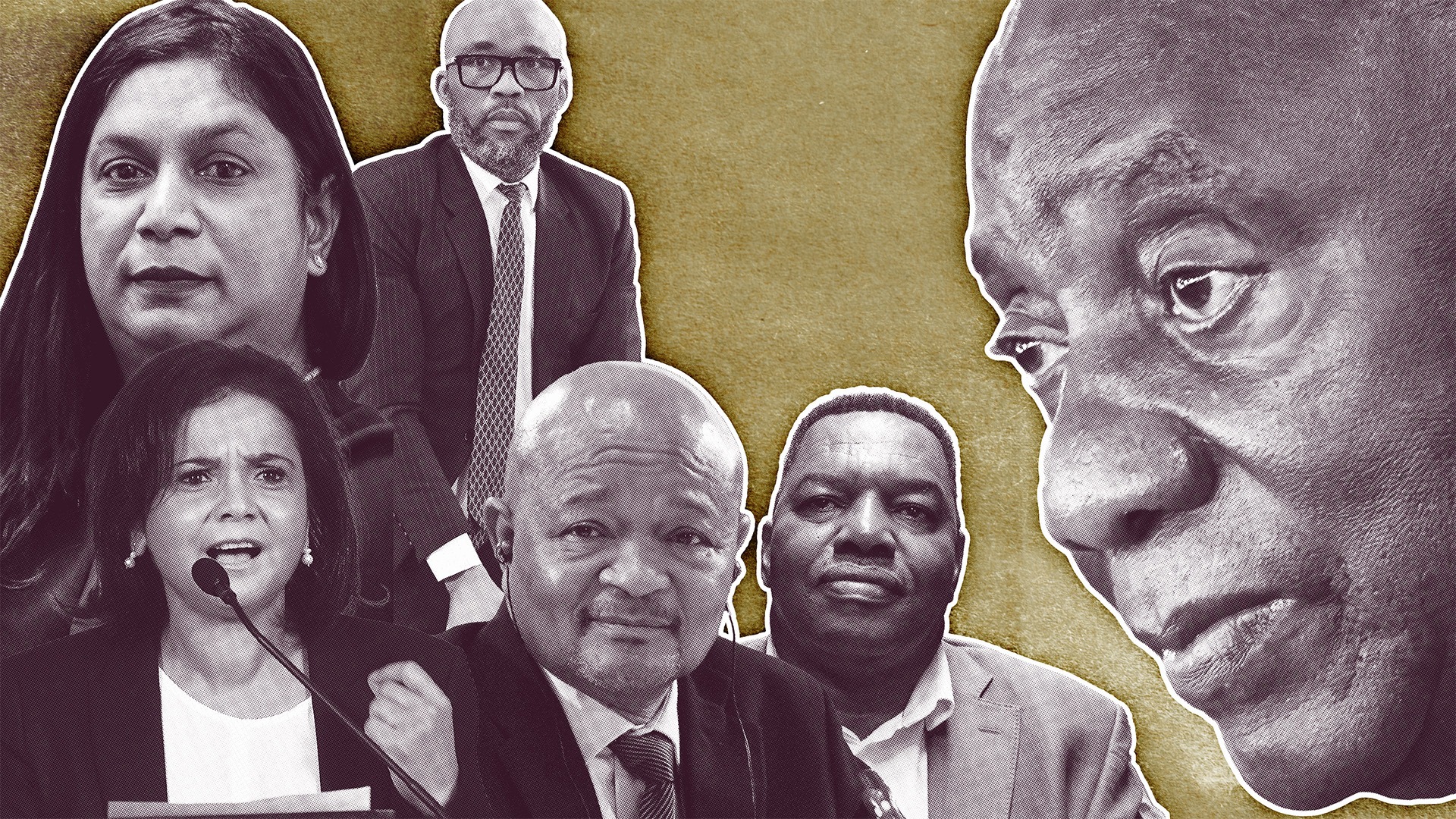
 Illustrative image (from left): Idac head Andrea Johnson. (Photo: Felix Dlangamandla) | Vusimuzi ‘Cat’ Matlala. (Photo: Gallo Images / Frennie Shivambu) | Suspended Police Minister Senzo Mchunu. (Photo: Gallo Images / Frennie Shivambu) | Former national director of public prosecutions Shamila Batohi. (Photo: Gallo Images / Netwerk24 / Felix Dlangamandla) | Suspended National Police Commissioner Fannie Masemola. (Photo: Reuters / Stringer) | President Cyril Ramaphosa. (Photo: Reuters / Adriano Machado)
 When Cyril Ramaphosa was elected President on the Friday after former president Jacob Zuma’s Valentine’s Day resignation in 2018, it was the end of a momentous week.
He promised at the time, and several times since, to repair the criminal justice system. In particular, he promised a departure from the days of State Capture, when people in the leadership of the SAPS and the NPA used their powers to help people, including Zuma, steal from the state.
Importantly, he had the legal power to make appointments to many of the positions that were vital to this job. So many of them have ended in disaster.
Shamila Batohi, appointed head of the NPA with so much fanfare, amid hopes that for the first time in our democratic history the institution would be properly independent, left under a massive cloud.
Her illegal act, as I understand it, in leaving the inquiry into the fitness for office of Joburg prosecutions boss Andrew Chauke (an inquiry she requested) still defies public explanation.
/file/attachments/orphans/ED_604122_841022.jpg "Former National Prosecuting Authority head Shamila Batohi testifies at the Khampepe Commission in Johannesburg on 15 April 2026. (Photo: Gallo Images / Fani Mahuntsi)")
The person Ramaphosa appointed to lead the police, Fannie Masemola, has been suspended as he faces charges for his alleged role in the tender involving the SAPS and Vusimuzi “Cat” Matlala.
Ramaphosa’s appointment as police minister after the 2024 elections, Senzo Mchunu, is currently on “special leave”. And, after the testimony heard at the Madlanga Commission and in Parliament’s ad hoc committee about his role in disbanding the Political Killings Task Team (PKTT), there is no prospect of his return.
As Daily Maverick’s Ferial Haffajee has reported, Ramaphosa is now watching developments around another of his appointments, head of the Investigative Directorate Against Corruption Andrea Johnson. Last week, the Madlanga Commission heard testimony linking her to Major-General Feroz Khan, himself implicated in serious wrongdoing.
Amazingly, on the day she was supposed to testify, she rushed to hospital, while Matlala was withdrawing from a plea deal overseen by her unit.
Even Ramaphosa’s appointment as head of the Hawks, Godfrey Lebeya, has not been spared.
KwaZulu-Natal Police Commissioner Nhlanhla Mkhwanazi claimed Lebeya had intervened to stop a raid on Katiso “KT” Molefe, who is also implicated in criminality. Lebeya has strongly denied the claims, saying Mkhwanazi was mistaken.
Ramaphosa’s responsibility
As the person who appointed all these people to these positions, Ramaphosa has to take responsibility for what has happened, and not just in the way that, as President, he has overall responsibility, but in the sense that he was the person who made these appointments every step of the way.
In other words, this is a result of his deliberate, and presumably, considered, actions.
But part of this is also because he did not act at critical times.
Mchunu has said he consulted Ramaphosa before disbanding the Political Killings Task Team. Ramaphosa denies this and says he was told only afterwards.
But there was nothing to stop him from ordering Mchunu to reverse that decision. Ramaphosa, being a lawyer and having a history of drafting our Constitution, must have known that Mchunu had acted illegally. Why did he not just tell him that, and order him to turn back the clock?
/file/attachments/orphans/ED_589590_398646.jpg "Sidelined police minister Senzo Mchunu at the Madlanga Commission in Pretoria on 4 December 2025. (Photo: Gallo Images / Frennie Shivambu)")
While the head of the NPA has an important level of independence, Ramaphosa does not escape blame for what happened with Batohi either.
One of the reasons the inquiry into Chauke began when it did was because Ramaphosa had waited, for two years, for Batohi’s request to suspend Chauke.
There has been no public explanation for this. What explanation could there possibly be?
This inaction has had a huge impact on the NPA. When Andy Mothibi was finally appointed to succeed Batohi in May this year, it appeared that all four of the deputy NPA head posts were vacant.
How could this have been allowed to happen? While Ramaphosa may have to wait for other processes, it is still a hallmark of our state institutions that so many people are appointed in an “acting capacity”.
Not taking action, not making an appointment, allowing someone to not make an appointment, all these are political actions, with consequences for the institutions themselves.
And yet Ramaphosa, who has claimed to be determined to rebuild the state, and in particular this part of it, has actively allowed, perhaps even encouraged, this situation.
Cop boss failure
Then there is the situation around Masemola.
While there is obviously a shortage of senior police officers to choose from, surely Ramaphosa would have been aware of the long-term cultural issues around crime in the SAPS.
Would he not have wanted to ensure the person who would be appointed by him would be completely free of those issues? And yet he has presided over the suspension of our third national police commissioner.
Even if Masemola is ultimately found not guilty by a court, it is clear that he is not suitable for the post.
/file/attachments/2992/ED_604870_145714.jpg "Suspended National Police Commissioner Fannie Masemola appears at Pretoria Magistrates’ Court over a controversial R360m SAPS tender. (Photo: Gallo Images / Frennie Shivambu)")
How did Ramaphosa feel when he realised the police commissioner he had appointed was so small a person that he simply accepted Mchunu’s illegal instruction to close the PKTT when the commissioner believed it to be “encroachment”? That the person he appointed to such a senior position didn’t go against Mchunu because it would be “career-limiting”.
In the process, a national police commissioner allowed the fight against crime and political killings to be sabotaged by a politician.
How can such a person be judged to be fit and proper to lead the SAPS, never mind be trusted to lead the fight against crime?
Last chance missed
There is a series of tragedies as a result of Ramaphosa’s failure to live up to his promise.
The first is that it was the centre plank of Ramaphosa’s presidency. This was to be the issue that defined his presidency. Instead, it is an abject failure.
The second is that it extends a long line of politicians failing to create the independent and effective criminal justice system that South Africans deserve and have a constitutional right to.
From Thabo Mbeki’s appointment of Bulelani Ngcuka at the NPA, who insisted on prosecuting Schabir Shaik, but not Zuma, despite “prima facie” evidence of corruption against him, through to Zuma’s appointment of Shaun Abrahams and others who aided and abetted him, this institution has been almost destroyed by our presidents.
Ramaphosa appears to have allowed this tradition to continue.
But perhaps the biggest tragedy is that this was probably our last chance.
/file/attachments/orphans/ED_609026_453799.jpg "Former National Director of Public Prosecutions Shaun Abrahams testifies at the Khampepe Commission in Johannesburg on 14 May 2026. (Photo: Gallo Images / Fani Mahuntsi)")
Ramaphosa is the leader of the ANC only until December next year. The processes that are unfolding now, including the court cases that will follow, will probably keep most of the roleplayers, Mchunu, Masemola, Johnson and so on, in their positions long past that date.
Mothibi’s term at the NPA will expire just before Ramaphosa’s term as president.
Whoever takes over as ANC leader, perhaps Deputy President Paul Mashatile, will want a say in who leads that institution, and the SAPS and Idac, and all the other criminal justice positions.
The results of Ramaphosa’s failure to live up to his promise to fix the criminal justice system will live with all of us.
Probably for generations to come. DM
Comments
Scroll down to load comments...