



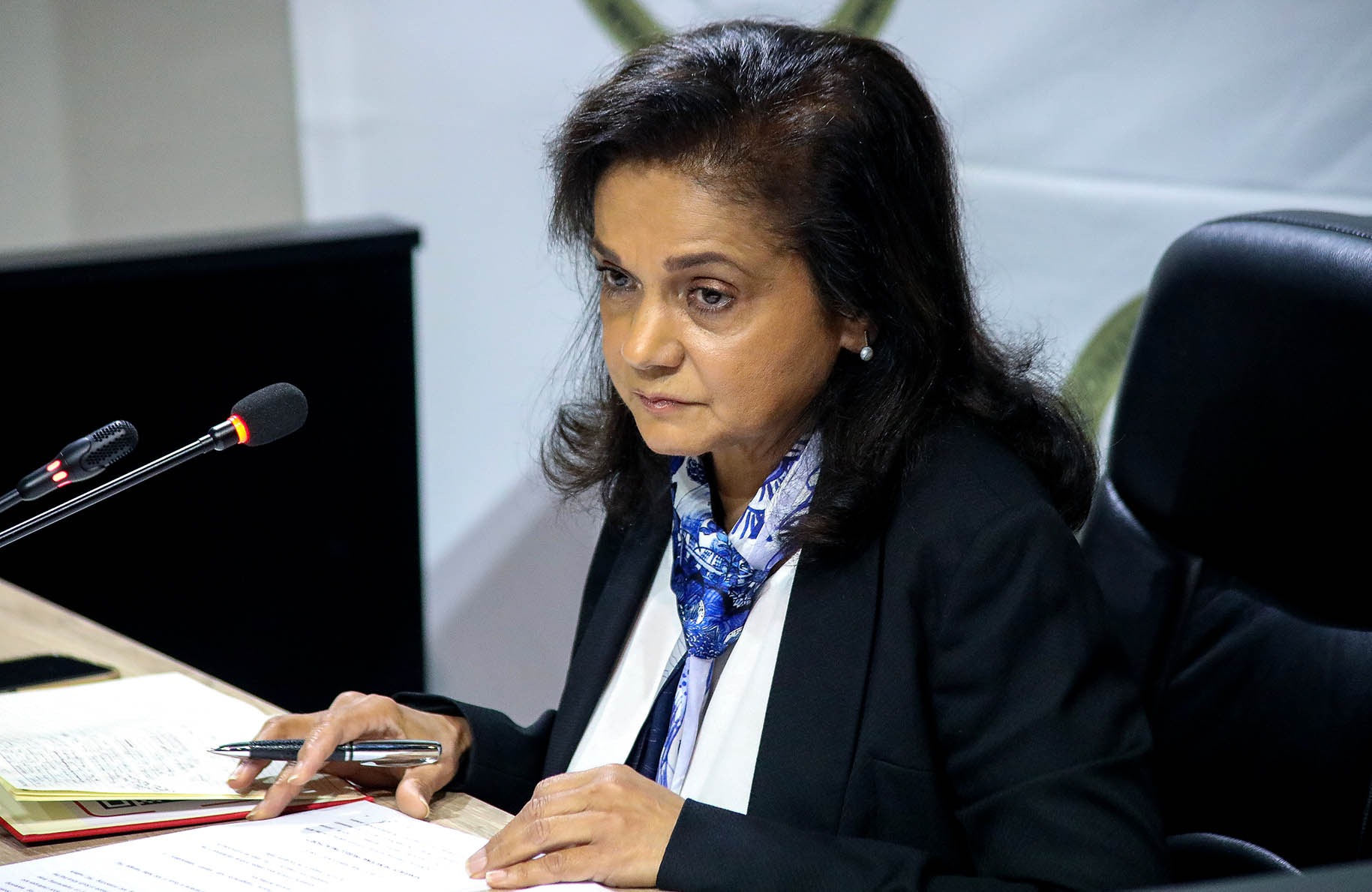
 Former NPA head Shamila Batohi has formally withdrawn as a witness at the Nkabine Commission. (Photo: Fani Mahuntsi / Gallo Images)
Former head of the National Prosecuting Authority (NPA), advocate Shamila Batohi, has written to the Nkabinde Commission of Inquiry formally withdrawing her participation in the inquiry, which is investigating the fitness of Gauteng’s Director of Public Prosecutions, advocate Andrew Chauke, to hold office.
The inquiry, headed by retired Constitutional Court judge Jess Nkabinde, was set up at the insistence of Batohi, who had written to President Cyril Ramaphosa requesting a probe into Chauke. In December, Batohi walked out of the inquiry claiming she had faced “a hostile and accusatory” process.
On Thursday, 23 April, Batohi, who ended her tenure as head of the NPA in January and is currently abroad, requested that her statement be read into the record by her legal representative and explained that her decision had been reached “after significant thought and reflection”.
Compromised
She said the hostile territory she found herself in had compromised her right to a fair proceeding while she had faced serious allegations without adequate protection or the ability to give meaningful instructions to her attorneys.
Batohi asserted that continuing to testify without proper legal advice was “untenable and undermined the integrity of my evidence”. Batohi “walked out” after the panel refused to allow her to consult with her own legal representatives, Harris Nupen Molebatsi Inc.
She said she had considered it “neither appropriate nor tenable” to continue providing evidence without this legal advice, particularly as she remained under cross-examination. She argued that this refusal “materially impacted the fairness of the process and her constitutional right to legal assistance”.
Limitations
Batohi said she had in fact lacked “effective legal representation” throughout the inquiry, and while advocate Garth Hulley had represented the NPA, there were limitations to protecting “individual interests as opposed to those of the office of the NDPP [National Director of Public Prosecutions]”.
Batohi clarified that while she did not suggest any fault on Hulley’s part, the procedural requirement for him to act through the neutral evidence leaders meant her interests were not “adequately advanced or protected”.
Furthermore, any questions or objections from counsel had to be channelled through the evidence leaders, who were neutral and did not provide legal advice to her, as a witness.
Robust and hostile
Batohi said she had been subjected to “robust” and “hostile” cross-examination and labelled an “accuser” or “complainant”.
Additionally, serious allegations were put to her – including that she had suppressed evidence, had lied to the panel and defeated the ends of justice – without intervention from the panel or evidence leaders.
She argued these labels were “incorrect and inappropriate” as she was not acting as a private accuser but was discharging her legal duties as the NDPP at the time.
Her actions were taken in accordance with the NPA Act, which provided the framework for such referrals to the President, she said. She viewed the nature of proceedings as an “inquisitorial fact-finding investigative inquiry” rather than “an adversarial trial where she would be a complainant”.
Batohi stated that being labelled as such contributed to an environment she experienced as “hostile, accusatory and discouraging” and which had ultimately influenced her decision to withdraw.
Exception
Batohi took “serious exception” to a statement by the chairperson on 22 April 2026 claiming to “verily believe” Batohi was still in South Africa when she had already departed for Japan.
“This was an unfair attempt to question my integrity and bona fides,” Batohi said, adding that this had also informed her decision to decline further participation. The allegations that were put to her were serious and of “considerable gravity”, Batohi said.
On 9 February, Batohi’s legal representatives had addressed a letter to the panel seeking leave to consult with their client. This had led to a further legal process, as the panel had required a formal application for the request, which was subsequently opposed by Chauke’s legal team, led by advocate Tembeka Ngcukaitobi.
Batohi noted that this had led to the panel dismissing her application on a lack of “sufficient grounds relating to procedural fairness” and also that “no constitutional imperative” had arisen. Ngcukaitobi’s assertion that providing legal advice to a witness under cross-examination was not a requirement “for a fair hearing in this context”.
This ruling, Batohi said, had contributed to the adversarial environment. DM
Comments
Scroll down to load comments...