



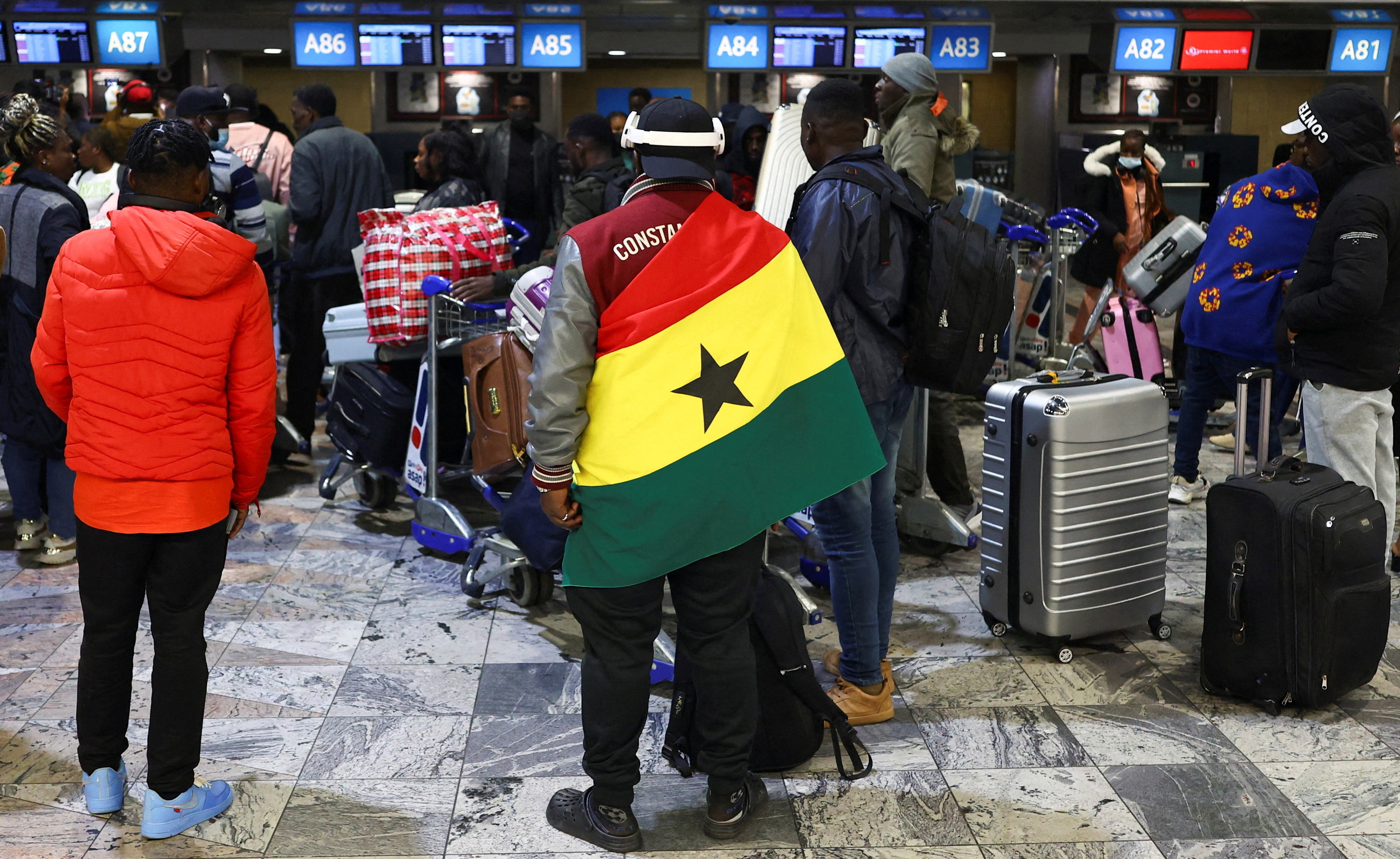
 A man draped in a Ghanaian flag at Johannesburg’s OR Tambo International Airport on 27 May 2026, as Ghana repatriates hundreds of its citizens from South Africa amid a wave of protests against illegal immigration. (Photo: Reuters / Siphiwe Sibeko)
 South Africa has accused Ghana and Nigeria of mounting a sustained campaign to isolate South Africa from the rest of Africa under the guise of criticising xenophobic attacks on its citizens.
“This campaign has sought to create an impression that South Africa is now a pariah state, which must be referred to international courts,” President Ramaphosa’s spokesperson Vincent Magwenya said at a media briefing in Pretoria on Wednesday this week.
/file/dailymaverick/wp-content/uploads/2025/06/009A5281.jpg "Presidential spokesperson Vincent Magwenya. (Photo: Jairus Mmutle / GCIS)")
“This is despite numerous official government communications condemning acts of vigilantism against foreign nationals, asserting the state’s primary role to enforce immigration laws and the commitment to the supremacy of our Constitution,” he said.
“More concerning has been the peddling of false information by a diplomatic representative of a country that has become central to this campaign. Even ordinary diplomatic exchanges over meetings have been deliberately misrepresented to create an impression that South Africa is being isolated.”
In answer to questions, Magwenya later made it clear that the campaign was being “primarily driven by Ghana and to a lesser extent Nigeria”.
Public criticism
Diplomats and other officials of those countries have publicly criticised Pretoria, including accusations that it failed to properly investigate the alleged murders of some of their citizens in South Africa during anti-immigrant protests and unrest.
He also appeared to be referring specifically to the postponement of a South Africa-Ghana Binational Commission meeting in Ghana, which a Ghanaian government spokesperson said was because of attacks on Ghanaians, but which Pretoria insisted was because of a clash of schedules.
Magwenya said the campaign was “faltering” as South Africa was not isolated and remained “firmly engaged with our African continent and the rest of the world”.
He mentioned Ramaphosa’s recent engagements to demonstrate this point, including his meeting last Friday in Paris with French President Emmanuel Macron; his co-chairing of the Leaders Group meeting of the High-Level Steering Committee on Education alongside the Director-General of Unesco; and his attendance at the Transforming Education Summit +4.
Magwenya also cited Ramaphosa’s meetings or other conversations this year with African leaders, including Botswana President Duma Boko, the other leaders of Southern African Customs Union (SACU) countries, Kenyan President William Ruto and the presidents of Malawi, Mozambique, Zimbabwe and the Democratic Republic of Congo, which South Africa was helping to fight an Ebola outbreak.
“This is a South Africa that is engaged with the African continent and that can never be isolated”, he said, adding that “the view that South Africa’s voice of authority is waning is quite far from the truth as well as the reality.”
/file/attachments/orphans/6799100407c4e1738084356_392358.jpg "Ghanaian High Commissioner Benjamin Quashie. (Photo: peaceFM online / Wikipedia)")
Magwenya said Pretoria had expressed its concerns directly to the Ghanaian High Commissioner Benjamin Quashie about spreading fake news about South Africa.
He said the high commissioner “needs to put in an effort in verifying the information he puts out and to do so via the authorities…”
Magwenya said there was no evidence that Ghanaians were disproportionately affected by the recent wave of anti-illegal migration protests in South Africa.
“There was an incident involving one citizen, and it was not a fatal incident.
“And so it’s surprising why we are continuously experiencing this anti-diplomatic and unconstructive posture coming from some in Ghana.”
Magwenya said there were political leaders in Ghana’s parliament who recognised the challenge South Africa was facing and who were not happy at the posture of the Ghanaian high commissioner and foreign minister Samuel Okudzeto Ablakwa.
/file/attachments/orphans/GettyImages-2211439477_805783.jpg "Ghanaian minister of foreign affairs Samuel Okudzeto Ablakwa. (Photo: Ernest Ankomah / Getty Images)")
Magwenya was also asked if South Africa was expecting reprisals from countries such as Nigeria and Ghana as some leaders of those countries, particularly lawmakers, had said that the assets of South African businesses in those countries should be nationalised to punish the country.
“There is no reason whatsoever that Ghana, for example, will opt for the nationalisation of South African company assets,” he replied, though asserting that if Pretoria received any official information, it would respond.
He said the economic and trade relationship between the two countries was mutually beneficial and that, for example, “the majority, if not all, of the employees of SA’s cellphone company MTN in Ghana were Ghanaians.
Appropriating SA company assets in any country would be counterproductive. “It would signal that those countries are now closed for trade and business.”
Goldfields concerns
Magwenya did not refer to the South Africa-based mining company Goldfields. In April, Ghana failed to renew its lease on its Damang gold mine and transferred it to Engineers & Planners, a Ghanaian mining firm founded and led by Ibrahim Mahama, President John Mahama’s brother.
Goldfields and the Ghanaian government are now negotiating the renewal of Goldfields’s lease on the more lucrative Tarkwa gold mine, with concerns being raised that it could go the same way as Damang.
Magwenya was also asked if the government believed Israel might be behind the campaign to isolate South Africa.
“I can’t talk to that except it is on record by some authorities in Israel that South Africa must be punished,” he replied. “We anticipated that there will be some form of reprisal coming from not only Israel, but some countries that are allied to Israel against South Africa for the action we’ve taken in taking Israel, or referring Israel in its genocidal behaviour against Palestinians, to the International Court of Justice.”
Magwenya said he did not know if a discussion about illegal migration would be on the agenda of the summit of the Southern African Development Community (SADC) which South Africa would host in August. However, he added that it should be part of the discussions, for example in meetings with other leaders on the sidelines of the summit.
These discussions should be constructive and should acknowledge the challenge SA faces. “Let’s not scream at each other, let’s not point fingers,” he said.
African Union
Ghana has asked the African Union to add the question of xenophobia in South Africa to the agenda of the African Union’s mid-term summit, which will be held in Egypt in October, preceded by a meeting of the AU foreign ministers in July in Addis Ababa.
But Magwenya said, “As far as we know, there’s no issue on the AU agenda on the so-called xenophobia, even though there is no xenophobia. That’s our information.”
He was also asked when Ramaphosa would despatch the team of envoys to African countries to explain SA’s position on the xenophobia issue. Ramaphosa announced this initiative last month as one of the five pillars of his strategy to deal with illegal migration.
Magwenya replied that “ that process is under way. We’re just finalising an administrative process that is necessary before the envoys are despatched.”
He said Ramaphosa had already been in touch with several of his counterparts. The diplomatic effort was already under way and was not entirely dependent on despatching the envoys, Magwenya said.
He declined to comment on the controversial enactment by Zimbabwe last week of a law which amended the constitution to allow President Emmerson Mnangagwa to extend his term in office by two years, from 2028 to 2030.
Zimbabwe’s political opposition and large parts of civil society are protesting that the amendment violated the constitution, which requires a national referendum to be held if the president’s term is extended beyond the two terms prescribed by the constitution.
“We understand it to be a process that has been undertaken within the laws of the country,” Magwenya said.
“It is not for us to judge whether the process was appropriate or not.
“Our interest will be that our neighbours still remain committed to the rule of law…
“Number two, our interest will be that Zimbabwe remains stable.” DM