



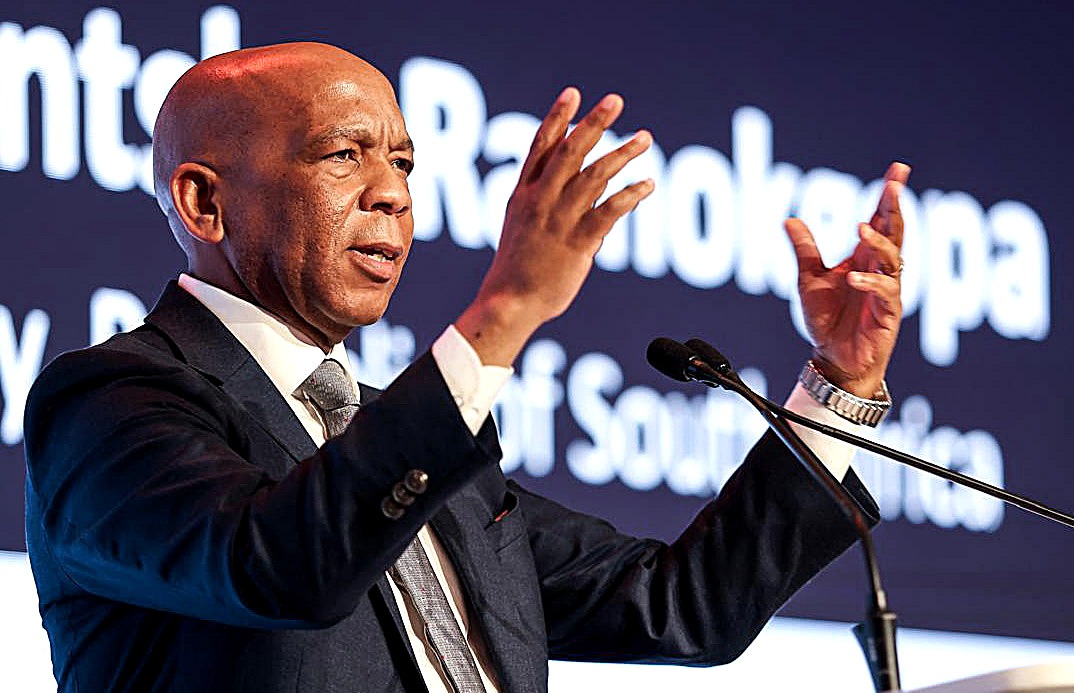
 Minister of Electricity and Energy Kgosientsho Ramokgopa. (Photo: Steven Booth / Manufacturing Indaba)
The South African government plans to more than double the country’s energy generation capacity as part of efforts to reindustrialise the local economy, while also expanding transmission infrastructure through R430-billion in expenditure.
Electricity and Energy Minister Kgosientsho Ramokgopa outlined the plans in a speech at the 13th Manufacturing Indaba in Johannesburg on Tuesday, 14 July 2026.
“We are going to grow exponentially,” Ramokgopa said.
To support growth, he said the government planned to more than double South Africa’s electricity generation capacity, adding 105 GW over time, of which 67 GW is planned to be renewable energy. This is in line with the Integrated Resource Plan (IRP) 2025, which plans to add 105 GW of new generation capacity by 2039.
South Africa’s installed electricity generation capacity is presently 51 GW.
Wind, solar and nuclear
Most of the new capacity will come from wind and solar renewable energy with additional contributions from other energy sources such as nuclear. The expansion will require a major upgrade of the electricity grid.
The minister highlighted the Transmission Development Plan, under which South Africa intends to build about 14,500km of new transmission lines over the next decade. The cost of the new transmission lines is estimated at R430-billion over 10 years, according to Ramokgopa’s presentation at the Manufacturing Indaba.
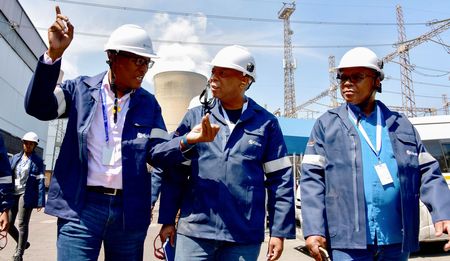
“[The estimated figure] includes transformers, pylons and anything in the value chain,” Ramokgopa told Daily Maverick after his speech.
The expansion plans come after the manufacturing sector’s contribution to GDP fell from around 22% in 1994 to about 12% today. Load shedding and logistics bottlenecks have been major obstacles to growth.
“We have barely grown as a country, and the casualty of that, amongst others, is the manufacturing sector.”
‘Era of growth’
However, he argued that South Africa had now moved beyond the load-shedding crisis.
“Now we are entering the era of growth.”
Ramokgopa said the infrastructure programme represented a significant opportunity for South African manufacturers. It would require large quantities of transmission towers, transformers, cable products and batteries, creating demand for the domestic industry.
The expansion programme needed about 520,000 tons of steel and fabricated steel.
He warned that the success of the expansion depended on ensuring manufacturers had sufficient production capacity and that South Africa developed the engineering and technical skills needed to deliver the programme.
“At the peak of this build programme, we need a significant number of technical people to support the build programme.”
Manufacturing
Highlighting the importance of the manufacturing sector to the national economy, Deputy President Paul Mashatile and Deputy Minister of Trade, Industry and Competition John Steenhuisen also addressed the indaba.
/file/dailymaverick/wp-content/uploads/2025/09/WhatsApp-Image-2025-09-24-at-13.38.12.jpeg "Deputy President Paul Mashatile. (Photo: Jairus Mmutle / GCIS)")
Mashatile, in a prerecorded speech, said manufacturing was key to South Africa’s and Africa’s long-term economic growth, job creation and competitiveness.
“Few sectors are as central to South Africa’s future as manufacturing,” pointing out that manufacturing remained the backbone of a resilient economy.
“It strengthens national reliance, creates quality employment, drives innovation and positions countries to compete in an increasingly technology-driven global economy,” Mashatile said.
“Africa possesses the talent, natural resources and entrepreneurial energy required to become a global manufacturing force.”
Mashatile said what had been missing in the manufacturing sector was sufficient investment in value addition, technology, infrastructure and deeper African regional integration.
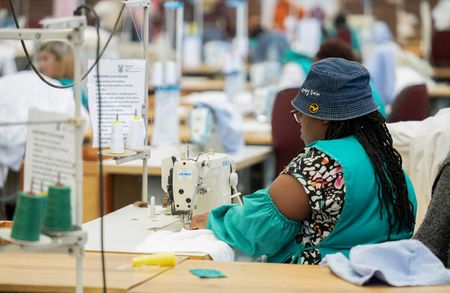
“For too long, our continent has exported raw materials while importing finished products at a premium,” he said.
Mashatile highlighted the need for modern infrastructure for industrial growth, including efficient transport corridors, reliable logistics systems, railway networks and well-functioning ports.
Mashatile also emphasised the need for industrialisation to be supported by capital, confidence and collaboration.
“We must continue to mobilise private sector investment, improve access to industrial finance and deepen partnerships between governments, developmental finance institutions and investors,” adding that public-private partnerships remained fundamental to sustainable industrial development.
He stressed that finance alone was insufficient, arguing that Africa had to embrace new technologies, including artificial intelligence, automation and advanced manufacturing.
Long-term prosperity
In his first address as Deputy Minister of Trade, Industry and Competition, John Steenhuisen argued that manufacturing was central to South Africa’s economic recovery and long-term prosperity.
/file/attachments/orphans/WhatsAppImage2026-07-14at160747_649868.jpeg "Deputy Minister of Trade, Industry and Competition, John Steenhuisen. (Photo: Steven Booth / Manufacturing Indaba)")
Steenhuisen moved from Minister of Agriculture to his new role after a Cabinet reshuffle at the end of June.
He said growing the manufacturing sector was essential for creating jobs, raising productivity, increasing exports and driving innovation.
He noted that manufacturing directly employed more than 1.6 million people and supported many more through supply chain linkages.
“Every single manufacturing job has a multiplier [effect], creating additional opportunities in local supply industries.”
Steenhuisen said manufacturing was the engine room that transformed raw materials into higher-value products, strengthened South Africa’s domestic capabilities and built economic resilience.
He argued that government support for manufacturing should be viewed as an investment rather than a cost, as no successful industrial economy had developed without deliberate industrial policy.
Steenhuisen said South Africa faced significant challenges, including slow economic growth, declining industrial capacity, infrastructure backlogs, geopolitical uncertainty and the rise of artificial intelligence. Rather than intervening directly in industry, he said the government’s role was to create an enabling environment that allowed businesses to invest, innovate and compete.
He outlined three pillars of the government’s reindustrialisation strategy:
- Diversification: Expanding beyond traditional resource extraction into higher-value manufacturing sectors such as machinery, chemicals, pharmaceuticals, automotive components and electrical equipment.
- Decarbonisation: Developing green manufacturing, renewable energy and green hydrogen while making the industry more climate-resilient.
- Digitalisation: Increasing the adoption of advanced technologies and digital manufacturing to improve productivity and create future-ready jobs.
He highlighted the importance of Special Economic Zones in attracting investment and strengthening export competitiveness.
The minister also argued that South Africa had to look beyond domestic markets.
“We must recognise that South Africa’s industrial future cannot be built solely on domestic demand. Regional and continental markets represent one of our greatest growth opportunities.” DM
Comments
Scroll down to load comments...