




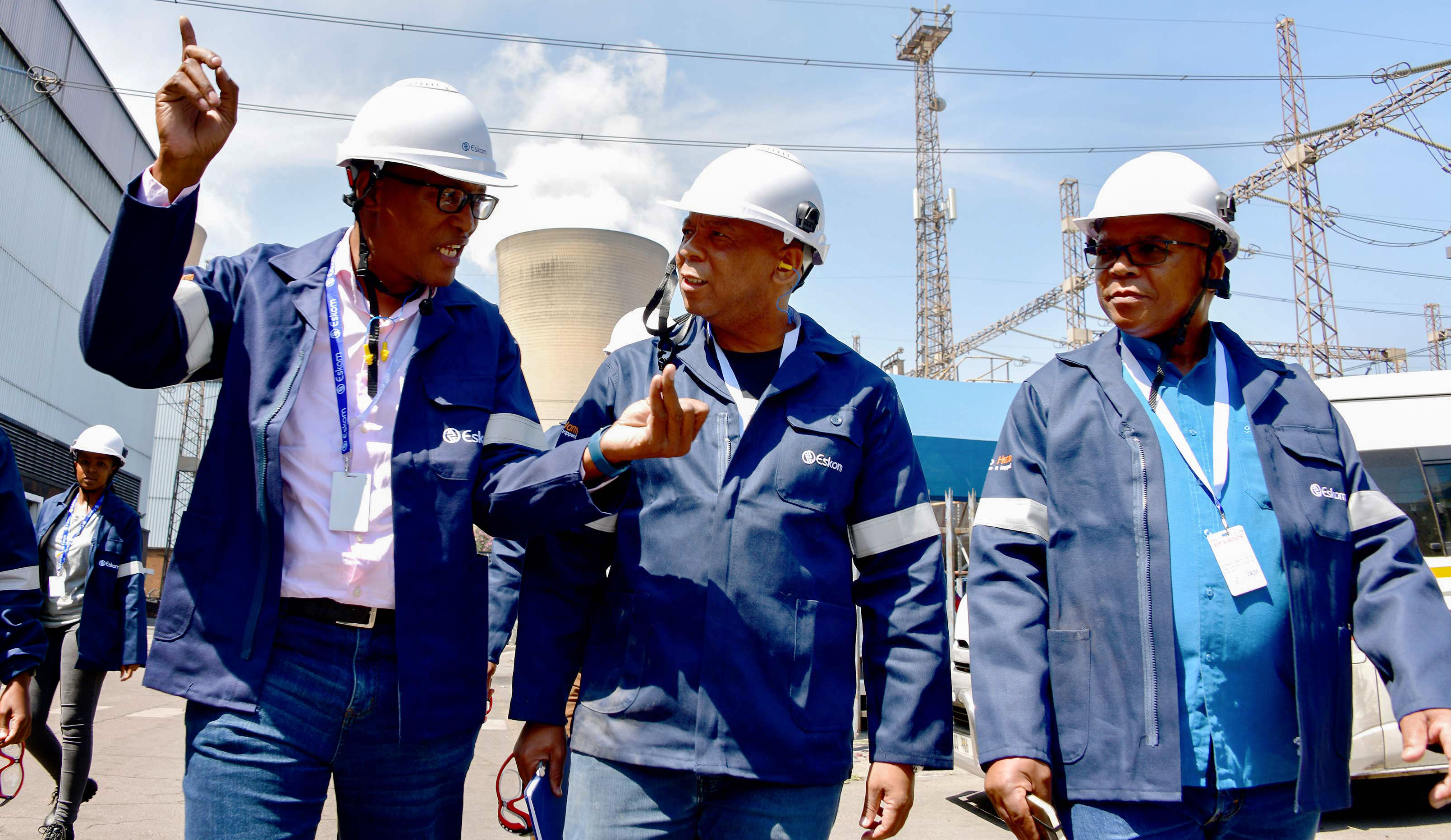
 Minister in the Presidency responsible for Electricity, Dr Kgosientsho Ramokgopa (centre), accompanied by his adviser Silas Zimu (right) and other senior officials on an inspection of Eskom coal-fired power stations in Mpumalanga. (Photo: GCIS)
After years where the country’s energy debate was dominated by load shedding, emergency generation and renewable energy procurement, the debate has moved on to the next binding constraint – the grid. The National Transmission Company South Africa’s (NTCSA’s) Transmission Development Plan is supposed to add about 14,500km of new transmission lines over the next decade, along with substations, transformers and other grid infrastructure.
At an Africa Energy Forum panel on SA’s grid resilience and expansion this week, hosted by Mulilo and moderated by Avra Moodley, general counsel at Mulilo, the discussion was not about whether transmission is needed. The question is whether SA can build fast enough, finance the roll-out without leaning too heavily on the sovereign balance sheet, and use the programme to rebuild domestic industrial capacity.
The NTCSA Development Plan is a R440-billion programme over 10 years, and one that will test whether the government, Eskom, the NTCSA, financiers and private developers can move from talk shops to implementation.
/file/attachments/orphans/Monde-Bala-3130-NEW-portrait_754428.jpg "Monde Bala. (Photo: NTCSA)")
Monde Bala, CEO of the NTCSA, said its priorities were execution of the Transmission Development Plan, opening the electricity market and ensuring the system remained reliable while expansion took place.
“The Transmission Development Plan itself is an ambitious programme that the NTCSA and its partners are executing on behalf of the country,” Bala said. “It aims to connect some 56GW of largely renewable energy.”
The pace required is far beyond SA’s recent track record. Bala said the country had been delivering transmission infrastructure at about 250km a year over the past decade. To meet the plan’s requirements, that needed to increase seven to 10 times.
/file/dailymaverick/wp-content/uploads/2025/03/Presentation-12.jpg "Silas Zimu, energy adviser in the Presidency. (Photo: ESI Africa / X)")
Silas Zimu, ministerial adviser in the Department of Electricity and Energy, said the immediate policy focus was transmission, not distribution.
“If we try to do everything at the same time, we’re going to fail,” he said. “At the moment, that reprioritisation after load shedding is transmission.”
Zimu said the independent transmission programme was intended to bring the private sector into the build-out, but the assets would still have to be built to NTCSA specifications and ultimately transferred back.
“We need to do a minimum of about 2,000km a year. It’s a huge task,” he said.
Capital meets grid
The opportunity for the private sector is not abstract. Peter Venn, CEO of Seriti Green, said his company had already handed over R1.2-billion worth of transmission infrastructure to Eskom at the end of November last year.
“We built our main transmission substation in 17 months with 100% South African companies,” Venn said. “If you want to hit the Transmission Development Plan target, let’s empower project managers and the private sector to really do this.”
/file/attachments/orphans/1723713871003-Firefly-Upscaler-4x-scale_398390.jpg "Peter Venn. (Photo: LinkedIn)")
For Venn, the main problem is not necessarily finance. It is permitting, sequencing and trust between developers, Eskom and the government. He said Seriti Green planned to spend between R4-billion and R5-billion on transmission infrastructure over the next three years, and was not asking for a guarantee. What it wanted was certainty that it would receive fair access to the grid capacity it unlocked.
“Let’s get in a room. Let’s build R10-billion, R20-billion. Let’s give it to Monde to run properly. We need generation, we need transmission, and it’s totally possible,” Venn said.
Financing remains central to the debate. Lungelo Nkwanyane, Acting Director: Energy and Telecoms at the National Treasury, said Eskom and the NTCSA balance sheet could fund part of the build-out, but both the utility balance sheet and the sovereign balance sheet were constrained.
“Given the fact that they are constrained and also the sovereign is constrained from continuous guarantees, we are looking at bringing in private capital,” Nkwanyane said.
This is where the Credit Guarantee Vehicle comes in. It is intended to bridge a confidence gap in infrastructure finance without relying only on sovereign guarantees. Nkwanyane said the vehicle was not only for the independent transmission programme.
“It’s really just an infrastructure broader vehicle. We are just starting with the Independent Transmissions Projects because they are sort of way ahead in terms of the development,” he said.
The missing link
Mpho Mokwele, Group Executive: Coverage and Origination at the Development Bank of Southern Africa, noted that transmission was now the missing link in the energy system, not only in SA but across the continent.
“For years I’ve been coming to the Africa Energy Forum, and we’ve been talking about energy generation capacity, but transmission and distribution has been elevated,” Mokwele said. “It’s a key discussion point, a key missing link.”
/file/attachments/orphans/Mpho-Mokwele-562x789-Firefly-Upscaler-2x-scale_492037.jpg "Mpho Mokwele. (Photo: dbsa)")
Mokwele said the Credit Guarantee Vehicle could be replicated across the continent, where governments and utilities also faced limited borrowing capacity. He added that the Development Bank of Southern Africa was looking at taking a 10% shareholding in the vehicle and had set up a project implementation unit to support its roll-out.
The financing question links directly to local industrial capacity. In May this year, the NTCSA and the Industrial Development Corporation signed a memorandum of understanding to support investment in SA’s transmission infrastructure and localisation. The joint media statement at the time said the Transmission Development Plan included about 14,500km of transmission lines, substations, 210 transformers and other key components, with network strengthening particularly needed in the Western Cape, Eastern Cape and KwaZulu-Natal.
The statement quoted Bala as saying: “The Transmission Development Plan will create a substantial demand for manufactured inputs and components, placing a strong emphasis on ensuring the development of adequate local manufacturing capacity and capability to deliver.”
Industrialisation opportunities
Asanda Tshambula, Business Development Manager in the Industrial Development Corporation’s Infrastructure SBU, said the corporation was already supporting engineering, procurement and construction contractors in the transmission space through working capital facilities and guarantees.
“The Industrial Development Corporation has a very strong project development team that can support projects,” Tshambula said. “We are actively involved in working with the different stakeholders to see how we can help promote industrialisation in the country.”
Tshambula said the corporation had looked at supply and demand in the market and accepted that there was not enough capacity across all components. It had, however, identified manufacturing companies that could be supported to scale up.
Zimu was more direct about the localisation target.
“Unlike the Independent Power Producers space, one is very confident that the transmission side, 100% of components must come from SA,” he said. “It must be South African.”
That ambition will need a credible project pipeline. Dershin Govender, Owner’s Engineer and Project Management Consultant Lead for Africa at Arup, said the first phase of the Transmission Development Plan should be treated as an industrialisation phase, giving the market time to build capacity and skills.
“The private sector would like to see a more market-enabling framework, and the market has geared up to support the Independent Transmission Projects programme,” Govender said.
Permits bite hard
The other delivery risk involves the issue of permits. Transmission projects can be delayed by environmental approvals, water licences, aviation approvals, servitudes and landowner disputes long before engineers get to site.
Venn said Seriti Green’s project took years to get permits.
“For our 155MW wind farm, the permits took eight years, and it took two years to build. That’s unacceptable. It’s far more about the sequencing of these permits rather than getting the permits,” he said. “It’s not acceptable to take four years for budget flow, paperwork, but it takes 17 months to build.”
Zimu agreed that this was a valid point and told the conference there was a committee in place to review bottlenecks, particularly when it came to environmental issues. He added a word of caution though.
“To our planners, let’s try to avoid places that we know are going to be challenging. We’ve seen horrible things out there. Why would you build a line over a cemetery?” Zimu appealed for common sense from planners and a move away from the practice of drawing up plans in offices without sight of the actual geography.
The grid expansion debate also opened another commercial risk for renewable energy developers: curtailment. For now, that issue sits beside the larger Transmission Development Plan question rather than inside it. As more private generation connects to the grid, the rules on when power can be reduced, who carries the cost and how this is done fairly will become a separate fight for investors, lenders and the system operator.
The Transmission Development Plan is therefore more than an electricity plan. It is a test of SA’s ability to align departments, unlock private capital, rebuild manufacturing, speed up approvals and keep the grid stable while changing the energy mix.
If it works, it opens the way for more renewable energy, more industrial activity and regional electricity trade. However, if it stalls, generation projects will keep queuing at a grid door that cannot open fast enough. DM
Comments
Scroll down to load comments...