




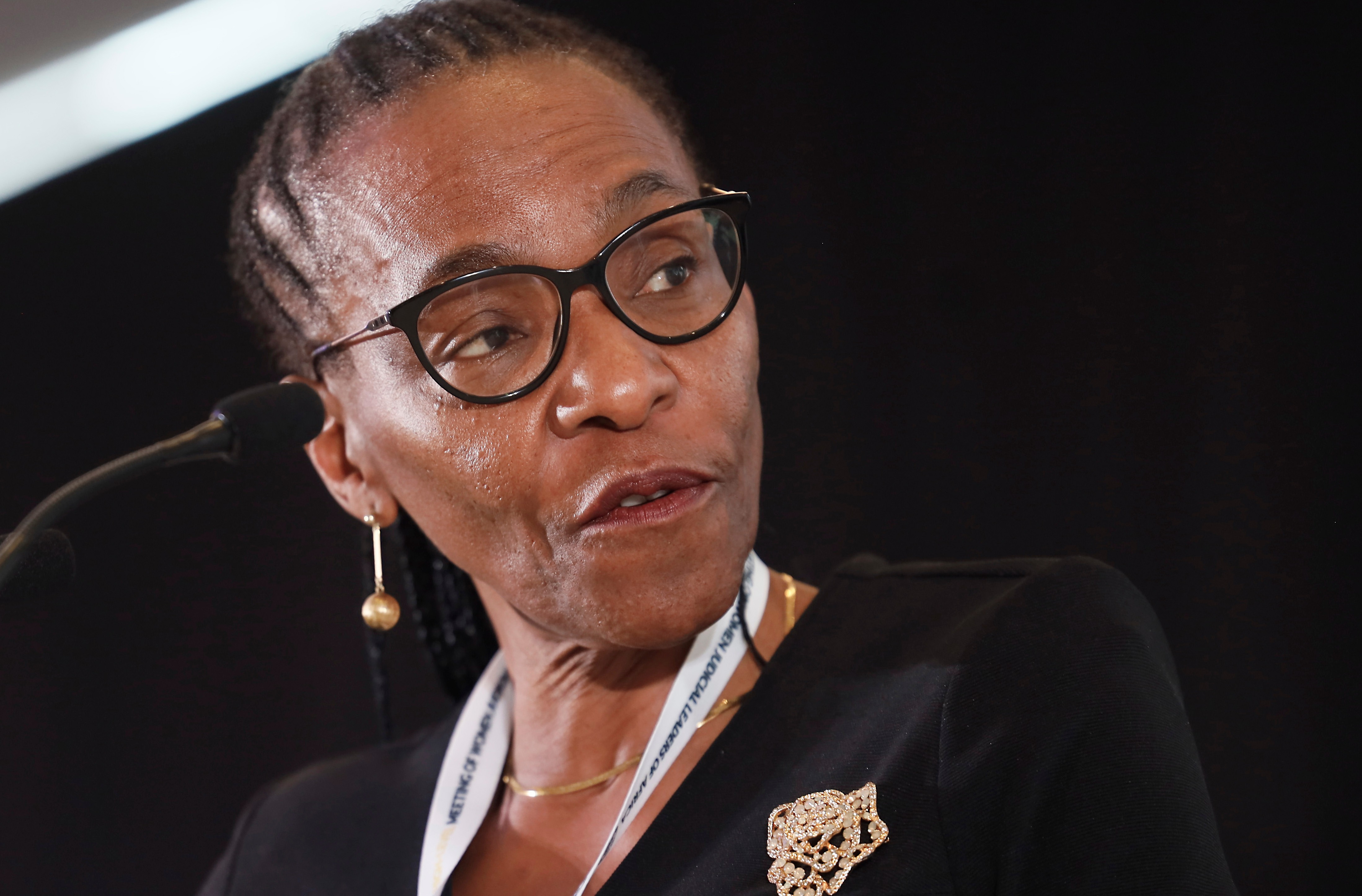
 Chief Justice Mandisa Maya. (Photo: Gallo Images / Sharon Seretlo)
Nearly 30 years into South Africa’s constitutional democracy, the country’s judiciary remains only partially independent, Chief Justice Mandisa Maya has warned, as courts struggle to deal with the pressures of chronic underfunding, staff shortages and failing infrastructure.
The Chief Justice was opening the 2026 Judiciary Conference on Tuesday, 14 July, where she said that institutional weaknesses were no longer simply administrative shortcomings, but constitutional failures that threatened access to justice.
Addressing delegates comprised of judges, magistrates and legal practitioners, Maya said that although the Constitution guaranteed judicial independence, South Africa had yet to establish a judiciary that could fully govern and resource itself without reliance on the executive.
“The South African judiciary enjoys only adjudicative independence, and institutional independence remains an unfulfilled goal.
“And judicial officers carry the heavy burden of case adjudication, and operate in a system whose governance and resourcing, and their conditions of service, are not aligned with a single judicial authority contemplated by our Constitution,” Maya said.
Her remarks come as the government is implementing legislation that gives the judiciary greater control over its administration. But Maya revealed that negotiations over the institutional model had already encountered some difficulties.
“The pressing task now, which has hit a snag, is to agree on the institutional model and its precise terms to build the institutional, administrative and financial systems that will give full effect to this independence,” she said.
Courts crack under strain
While the debate over judicial independence was often looked at as a constitutional issue, Maya said the consequences were felt daily in courtrooms across the country.
She painted a picture of a justice system grappling with deteriorating infrastructure, inadequate support staff, unreliable digital systems, poor security and fragmented administration.
“Our courts are cracking under the strain,” she said.
“They are battling failing infrastructure, inadequate translation services, limited or no research support at all, digital systems that do not function, inadequate security, records that cannot be accessed with efficiency, and administrative authority is divided in ways that render accountability unclear,” Maya said.
The result of these failures was delayed justice for ordinary South Africans.
“If courts cannot function effectively, the vindication of rights is delayed. Rights are weakened and public confidence in the courts is compromised, and the rule of law is weakened,” Maya said.
Perhaps the most recent and high-profile example of the delay is the Economic Freedom Fighters’ constitutional challenge to Parliament’s decision to reject the Section 89 independent panel report on the Phala Phala scandal, on which, more than a year and three months after the Constitutional Court heard arguments in the matter, judgment had not been delivered.
The case is one of several in which litigants have waited months for a final decision. As Daily Maverick has reported, a paper published in the 2025 Constitutional Court Review found that the apex court took an average of 214 days — about seven months — to deliver judgments in 2024. The longest wait was 414 days, according to the paper by legal scholars Nurina Ally and Leo Boonzaier.
Mbekezeli Benjamin of judicial monitoring organisation Judges Matter said Maya’s concerns reflected the state of the judiciary.
“Indeed, the judiciary is woefully under-resourced for the large mandate it carries, especially in recent times.
“Court infrastructure is not keeping up with the demands, with some courts either being too small to carry increased caseloads, leading to delays in cases. Similarly, judicial capacity in terms of people to do the work is falling behind,” Benjamin said.
There has been no increase in judicial posts since 2009, while a National Treasury-imposed freeze on filling legal researcher posts has left judges increasingly stretched despite significant population growth and rising caseloads, Benjamin said.
“It is no longer uncommon to hear a judge has taken medical leave because of burnout. All of this is leading to delayed hearings, and delayed judgments.”
Judges Matter said one practical intervention that could provide immediate relief would be to ensure the government’s planned expansion of the Bench was fully funded.
“The Minister of Justice announced in June 2026 that there will be 50 more judicial posts created. If all those posts could be funded by the 2027/28 financial year, it would be a massive boost in judicial capacity and would alleviate some of the delays we see in finalising cases, as some judges could operate in virtual courts while brick-and-mortar courtrooms are being built,” Benjamin said.
A constitutional problem, not an administrative one
Maya rejected the notion that the challenges facing the courts could be dismissed as routine operational issues.
Instead, she argued that dependence on the executive for budgets, procurement, staffing and infrastructure undermined the constitutional principle of judicial independence.
“Financial and operational dependence may not always appear as direct interference…It may appear as delayed procurement, uncertain staffing, inadequate security, poor maintenance, fragmented ICT systems, lack of control over infrastructure, or an inability to direct resources where judicial need is greatest.
“These may look like administrative problems, but in truth, they are constitutional infractions,” Maya said.
She stressed that the campaign for institutional independence was not about elevating the status of judges.
“The project of a single institutionally independent and accountable judiciary is therefore not a project of status. It is a project of constitutional functionality.
“It is not about the comfort of judicial officers. It is about the people of South Africa.”
She said the consequences of institutional weakness were borne by those who used the courts.
“It is about the litigant who waits for a trial date. It is about the accused person whose liberty is at stake. It is about the child whose maintenance matter must be heard. It is about the small business waiting for a commercial dispute to be resolved,” Maya said.
Progress, but reforms remain incomplete
Despite her concerns, Maya acknowledged that the government had taken significant steps over the past year.
She described President Cyril Ramaphosa’s June 2025 commitment to strengthening judicial independence as a watershed moment.
“The watershed pronouncement by the President of the Republic ... [that] committed the executive to taking the necessary steps towards the realisation of judicial independence, provides renewed hope that the judiciary will finally take its rightful place as an equal arm of the state.”
The first phase of reforms came into effect on 1 April 2026 when shared services supporting the Superior Courts were formally transferred from the Department of Justice and Constitutional Development to the Office of the Chief Justice, backed by funding from National Treasury.
The next phase involves legislation to establish a fully institutionally independent judiciary and create a single judicial system.
According to Maya, the Department of Justice intends introducing draft legislation to the Cabinet early next year before it is tabled in Parliament during the 2027/28 financial year.
However, Judges Matter cautioned that while institutional independence was necessary, it should not be viewed as a quick fix.
‘Massive culture shift’
“Judicial institutional independence is a massive undertaking requiring legal and policy amendments, institutional re-engineering, but also a massive culture shift,” Benjamin said.
“It also might not entirely be the solution for all of the challenges of court administration and infrastructure, as government as a whole is battling with balancing competing demands on the public purse.”
The organisation said difficult questions remained about accountability within a more autonomous judiciary.
“There are still questions about where accountability and authority will lie between the elected arms of government, versus the judiciary, which is not elected. While full institutional independence for the judiciary will assist in insulating judges from the inefficiencies of government bureaucracy, it’s a fraught process getting there,” he said.
A central feature of the reforms is bringing magistrates’ courts under the governance of the Office of the Chief Justice.
“We have a Constitution that establishes judicial authority as one authority,” Maya said.
“Yet in practice, the administration of the Superior Courts and the magistracy remains fragmented. We speak of one judiciary when in reality, our systems do not yet operate as such.”
She warned that divided authority weakened accountability because responsibility for the justice system was dispersed across multiple institutions.
“We speak of accountability, but accountability becomes difficult where authority is divided, where responsibility is dispersed, and where institutional arrangements obscure who must act when systems fail,” Maya said.
Independence with accountability
Maya also stressed that greater independence had to be matched by stronger accountability.
“An institution that seeks autonomy must be able to govern itself credibly,” she said.
“It must account for its use of public resources, set sensible priorities, measure its performance, respond to complaints, treat judicial officers and personnel fairly, protect court users, manage risk and communicate responsibly with the public.”
She rejected suggestions that judicial independence would place the courts beyond democratic oversight.
“It is not a claim that the judiciary should operate outside the Constitution’s systems of checks and balances ... or become a state within a state.”
Instead, she said institutional independence was essential to ensuring courts could fulfil their constitutional mandate without unnecessary reliance on the executive.
As the conference explores the next phase of reforms, Maya urged delegates to focus on tangible outcomes rather than ambitious declarations.
“The measure of this conference will therefore not be the loftiness of our resolutions…It will be whether those resolutions improve the administration of justice and provide means of their expeditious implementation,” said Maya. DM
Comments
Scroll down to load comments...