




 Justice Mbuyiseli Madlanga delivers the introductory remarks at the book launch of Legal Ethics in South Africa at the Wits School of Law on 18 June 2026. (Photo: Supplied by Wits communications team)
Retired Gauteng Deputy Judge President Roland Sutherland and former Deputy Chief Justice Mbuyiseli Madlanga have called for tougher action against Stalingrad litigation tactics, warning that the abuse of court processes is undermining the administration of justice and eroding public confidence in the legal system.
Speaking at the launch of a new book on legal ethics at the University of Witwatersrand on Thursday, 18 June, the retired judges argued that lawyers, judges and legal regulators must do more to prevent court processes from being manipulated to delay proceedings.
Sutherland warned that Stalingrad tactics were a direct threat to the functioning of the courts. “Stalingrad has the capacity to emasculate the courts,” he said.
“It cannot be allowed to continue to contaminate our proceedings. And the members of the profession cannot be allowed to perpetuate it. It must be brought to an end.”
Just last month, Judge Nkosinathi Chili, who is presiding over former president Jacob Zuma’s long-running arms deal corruption case, warned about the impact of repeated legal challenges that delay court proceedings.
The arms deal case has spent years tied up in applications, appeals and reviews, with the criminal trial still yet to begin despite Zuma first being charged in 2005.
In Chili’s ruling that dismissed Zuma’s latest bid to delay the start of the trial, the judge said that prolonged litigation often favours those who have the financial means to keep fighting legal battles.
“I need hardly add that this is of particular benefit to those who are well resourced and able to secure the services of the best lawyers,” Chili said.
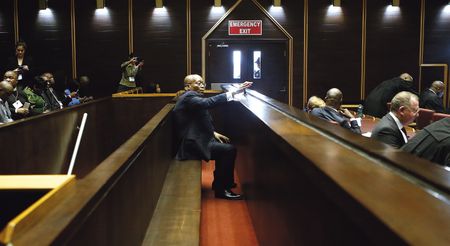
His remarks echo concerns raised by both Sutherland and Madlanga that court processes should not be used to delay the administration of justice.
While litigants are entitled to pursue different legal remedies, Sutherland said there must be a clear distinction between robust legal representation and abuse of the judicial process.
“There must be norms that stand as a barrier between abusing the court process and being zealous in the representation of one’s client,” Sutherland said.
/file/dailymaverick/wp-content/uploads/2025/06/0000266557.jpg "Former president Jacob Zuma appears in court in 2025 in yet another instalment of the long-running arms deal case. (Photo: Felix Dlangamandla / Netwerk24 / Gallo Images)")
Judiciary ready to act
Sutherland said there appeared to be a growing willingness among judges to take a firmer stance against litigation abuse.
“Generally speaking, I think it’s fair to say that one can discern an appetite on the part of the judiciary to put the foot down,” he said.
/file/attachments/orphans/BooklaunchwithJusticeMadlangaatWits-35_117856.jpg "Retired Gauteng Deputy Judge President Roland Sutherland at the book launch of Legal Ethics in South Africa at the Wits School of Law on 18 June 2026. (Photo: Supplied)")
However, he expressed concern that professional bodies responsible for regulating lawyers, such as the Legal Practice Council (LPC) and Law Society, had not shown the same commitment.
Sutherland argued that legal regulators need to play a more active role in enforcing ethical standards and disciplining practitioners who misuse court processes.
“The LPC, the Bar, the Law Society need to up their game in regard to enforcement of the rules and of the norms of ethical practice,” he said.
“There’s a lot of catching up to do.”
Abuse is the real test, says Madlanga
Responding to questions from the audience, Madlanga said the fact that a litigant pursues multiple legal avenues should not automatically be regarded as Stalingrad litigation.
Instead, he said, the critical question is whether the conduct amounts to an abuse of the court process.
“I think what one should consider to be the determinant should not necessarily be the several steps that a litigant takes or chooses to take… In my view, I think the operative word should be abuse,” he said.
According to Madlanga, South African courts already possess the legal tools needed to halt abusive litigation.
“If what the litigant does amounts to abuse of the court process, there are legal principles for judicial officers to bring that to an immediate halt. All that needs to be done is to apply those legal principles,” Madlanga said.
He urged judges not to be intimidated by legal arguments that appear persuasive on the surface but are deployed primarily to create delay.
“What Stalingrad tactics really are about is to try to raise as many points as possible, in particular, in succession and that is where the abuse may very well come from.”
“Judicial officers should not shirk their duty in this regard.
“They should not be overwhelmed by the fact that this looks like a very good legal point and so on and so on,” he said.
Madlanga said one of the defining characteristics of Stalingrad tactics is the repeated raising of successive legal objections.
“What Stalingrad tactics really are about is to try to raise as many points as possible, in particular, in succession and that is where the abuse may very well come from.
“So, you just apply the legal principles, and I think the judges should try to be firm in this regard,” added Madlanga.
Integrity deficit affecting the profession
Sutherland linked the problem to what he described as a wider crisis of integrity in South African society.
“Our country is afflicted by an integrity deficit. And it affects everyone from the top to the bottom, lamentably. And it also affects the practice of law.”
He said lawyers entering the profession should understand that they will spend their careers navigating difficult ethical terrain.
“One of the first acknowledgments a proper lawyer needs to make about him or herself is that you’re about to navigate, for the rest of your practice, for the rest of your career, in a terrain of moral uncertainty and of moral challenge,” Sutherland said.
Delayed judgments
The discussion also turned to delays in the delivery of court judgments, another issue Madlanga said requires stronger enforcement of existing rules.
“Fortunately, in that regard, there is something in black and white, and all that should be done is just to apply that very strictly,” he said.
Reflecting on his time as a member of the Judicial Service Commission, Madlanga said he was surprised that only one judge president consistently raised concerns about judges who failed to deliver judgments on time.
“I remember when I sat on the Judicial Service Commission years back. I used to be surprised that only one judge president throughout the country used to take his judges to the Judicial Service Commission for delaying the writing of judgments.”
That judge president, he said, was Bernard Ngoepe, then head of the Gauteng High Court.
“I used to tell myself that it cannot be that it’s only Gauteng judges who delay judgments.”
/file/dailymaverick/wp-content/uploads/Craig-cricketMatchfixing-inset.jpg "Former Gauteng Judge President Bernard Ngoepe. (Photo: Mabuti Kali / Sunday World / Gallo Images)")
Madlanga said the existing rules should be applied uniformly across the judiciary.
“It should just be applied across the board, all courts, all judge presidents.”
However, he acknowledged that strict deadlines are not always realistic in complex Constitutional Court matters.
Perhaps the most recent example is the Economic Freedom Fighters’ challenge in the Constitutional Court to Parliament’s decision on the Phala Phala matter, in which judgment had still not been delivered more than a year and three months after arguments were heard.
That case, as Daily Maverick reported, is just one of several in which litigants have waited months for a decision. A paper published in the 2025 Constitutional Court Review found that in 2024 the court took an average of 214 days, about seven months, to deliver judgment. The longest wait in 2024 was 414 days, according to the authors, Nurina Ally and Leo Boonzaier.

However, that record appears to have been surpassed by the Phala Phala case, where judgment had been outstanding for more than 474 days as of 16 March.
“I will immediately admit that yes, there are delays,” Madlanga said about Constitutional Court judgments.
But he cautioned against rigidly applying the commonly cited three-month benchmark.
“What I will take issue with is people then saying that the black and white that I referred to says judgments must be out within three months. With a Constitutional Court that is simply not practical,” Madlanga said. DM
Comments
Scroll down to load comments...