




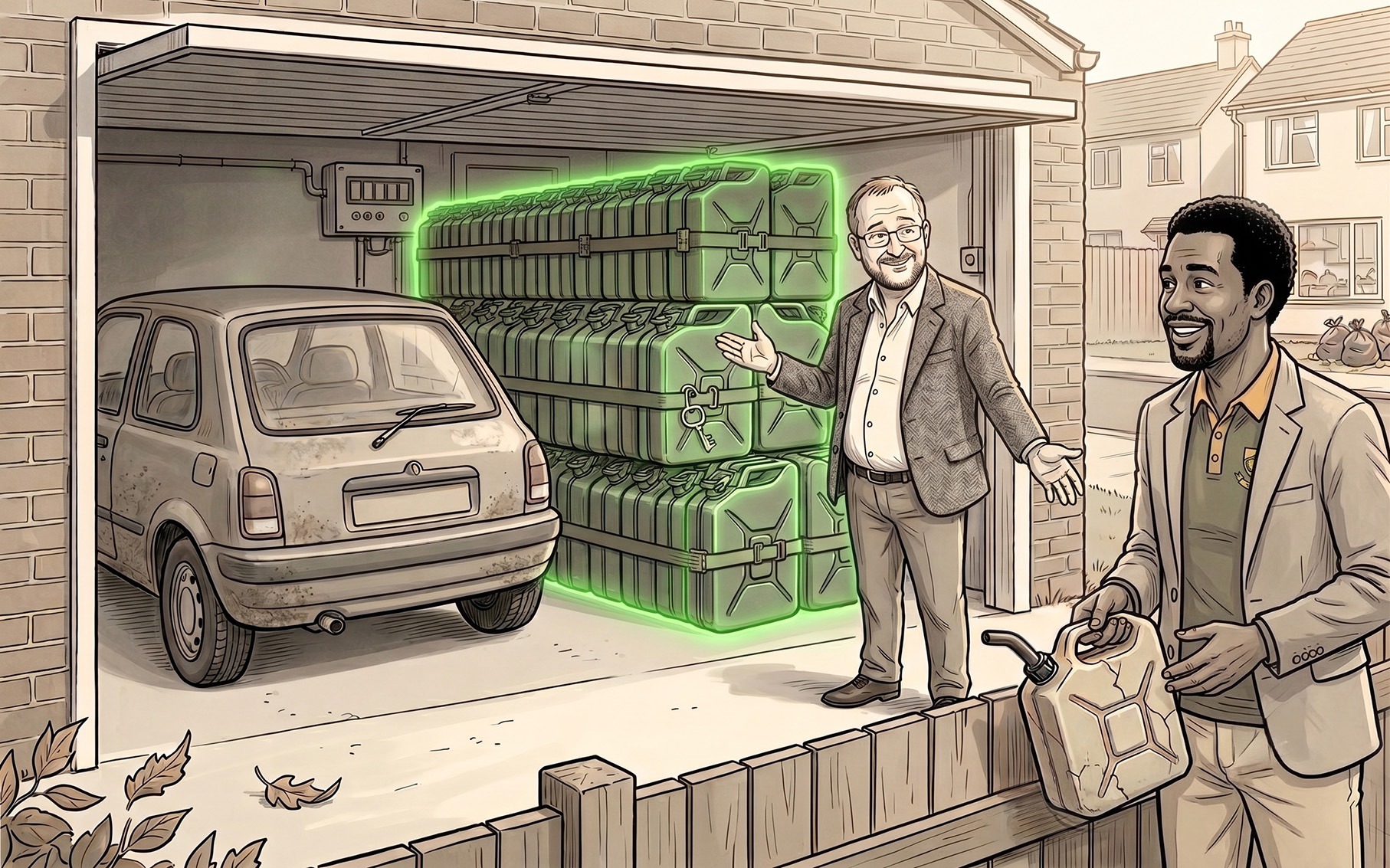
 Illustrative image: Generated with Google Gemini Flash image 2.5
As I finally throw off the bedclothes, reach to my feet and stumble over my normal routines following my more-intense-than-I-thought bout with flu, I’m realising that not a lot has changed during the few days last week when I was out of it.
Donald Trump is claiming victory over Iran while Iran is being amazingly successful in keeping the Strait of Hormuz closed.
I do notice though that the government, through Mineral and Petroleum Resources Minister Gwede Mantashe, is acting pretty quickly on its promise to bolster our fuel stocks. In my slightly fevered flu dreams I’ve wondered slightly about what would happen if we really did run out of fuel.
And while it’s not quite as exciting as it might sound (mainly because Sasol produces about 30% of what we need – which means there would always be enough to keep our agricultural and food industries going) it would be economically Armaggeddonous.
The current plan is for the government to hold about 60 days’ worth of net reserves, just two months’ worth of supply. I have no idea how you go about doing all of that, because I suspect building the capacity to store that amount of fuel does not come cheaply.
And there is all sorts of other infrastructure, because oil and fuel and diesel do not stay in one state. A bit like last week’s milk, it changes over time no matter how you store it. Which means you have to rotate the stocks from time to time. And each time you do that there is a cost.
Famously, at the height of the State Capture era, during the traditional looting time of the annual holiday season, a group of officials sold the stocks we had when oil prices were at record lows. That meant we stood to lose a huge amount of money when oil prices rose.
All of this means that the way we manage a much bigger oil supply is going to require some very careful management.
But I am pleased that we are planning ahead. So many of the problems we see, including the fact that my rubbish bin has not been collected for weeks, are because we just don’t plan properly.
Despite having “Disaster Management” offices and officials and even a “National Disaster Centre”, we still sometimes appear to be caught entirely by surprise when something goes wrong.
Planning for disaster is something so many companies spend money doing.
But it’s not easy to know how much money you should put aside. If a firm requires a working IT system (and I don’t know any firm that doesn’t), how much money do you put aside in the case of another disaster?
If you put too little aside you could find your company is just one SAP upgrade away from catastrophe.
But there is also a cost to putting too much away. When you put too much money into resources that you probably won’t use, there is a cost. Some of that cost is not obvious, it is just money sitting there, doing nothing.
Over time, however, having money do nothing is a huge opportunity cost. For a company, it’s the cost of not investing in something else that could have made a lot more money for the firm.
This presents you and me with questions too. How much money do we put away to access quickly if the worst happens?
If you have some savings, you want to put them somewhere where the money works for you. This is the point of the entire investment industry. You don’t just keep money in a bank account. It needs to grow.
The guru I look to with questions like this is Galileo Capital’s Warren Ingram. He always says you should put away enough money to cover your expenses for three months, somewhere where you can access it quickly.
I think for many of us with bonds that we’re still paying off, the best place is probably an access bond. Then the money is paying back debt but is also available quickly.
But, like the country’s Strategic Fuel Fund, it is not without temptation.
You might look at the money, look at the hot, cross children in front of you and decide to invest in your own underground facility for storing cooling liquid this summer.
Which means you need to put it somewhere you can get it quickly, and then forget it.
The other problem, obviously, is how you decide what is an “emergency”.
Is it just when we can’t get any oil? Is it when Sasol has a supply problem? Is it about price?
The temptation problem is huge.
Imagine if we had had three months’ supply when prices moved from $70 a barrel to $100. It would have been rational to argue that the price hike was temporary and we should just use the oil we had to keep prices, and thus our inflation, under control.
After all, it appears that is what China did with its immense storage.
Which is why our planning needs to include a very clear process of determining when we can access what we have stored and when we can’t.
And why you and I should probably do the same for our emergency funds... DM
Comments
Scroll down to load comments...