




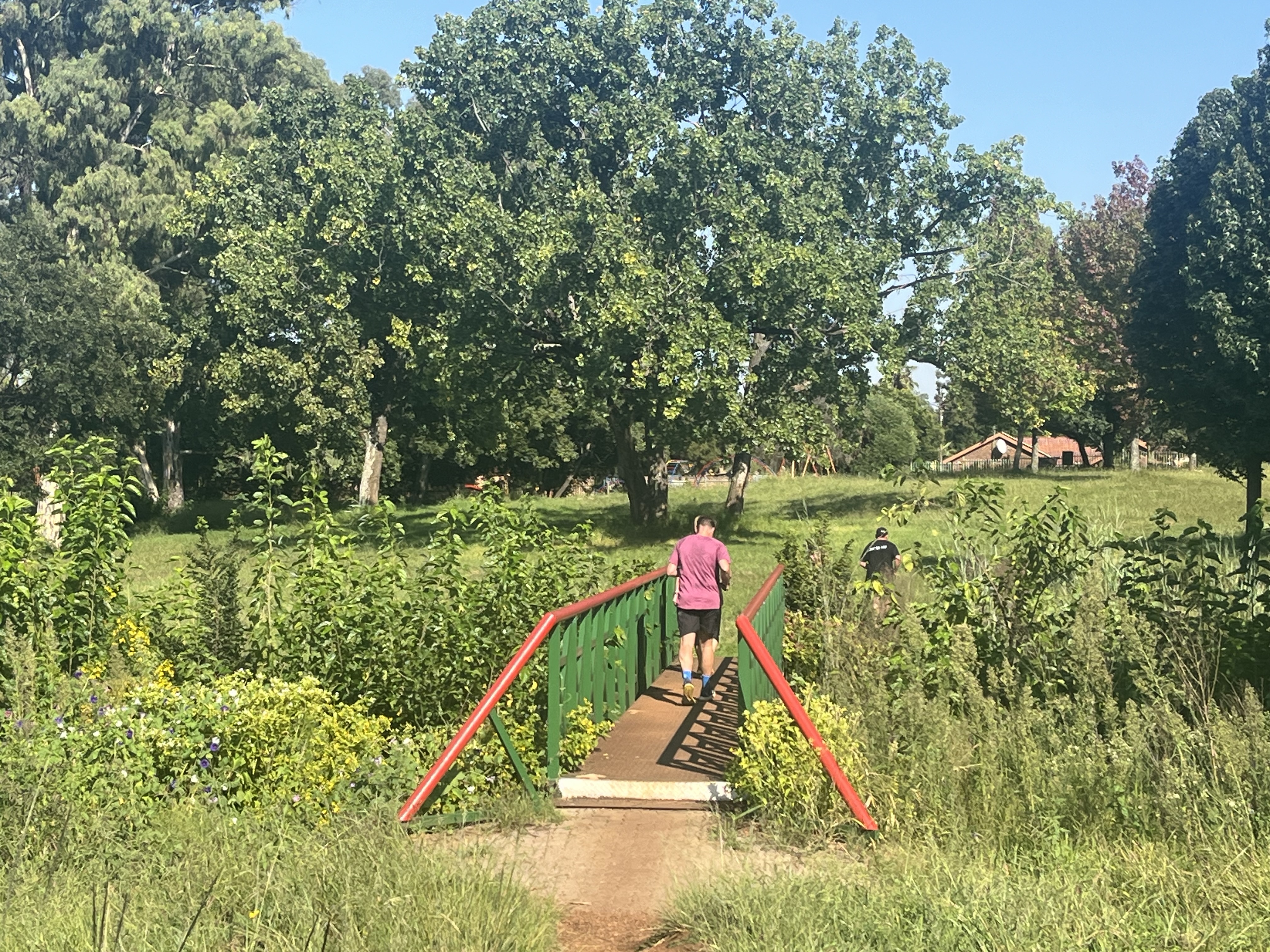
 Valhalla parkrun: a bridge to the finish in the middle of a profusion of green. (Photo: Mark Heywood)
The world is awash with parkruns. The numbers grow every week.
Once they get the bug, parkrunners can be quite OCD about their weekly run-fest.
I started parkrunning in 2019 and I hope to hit 200 this year. I go back week after week because the rapid infusion of community, exercise, fresh air and social interaction is just what’s needed to set the mood for the weekend.
But don’t be intimidated.
The Parkrun is a space where you can run as fast as your legs can carry you, or where you can come with Gogo, the dog and the kids. In fact, dogs are a feature of parkrun. You see them in all shapes, sizes and breeds. A well-run parkrun accommodates their needs with water bowls at the finish.
In return a public-spirited parkrunner complies with etiquette by bagging and binning their poo, keeping them on a short lead and following the rules of no more than one dog per person.
If you want, the parkrun is a place to compete against yourself and/or your peers; or it’s a space where you can just chill, wake up, smell the overnight rain and observe the ever-changing seasons. And if you don’t want to run you can be a volunteer and get pleasure from helping other people to get their pleasure.
Which is why parkrun is about much more than running. It’s also about community building.
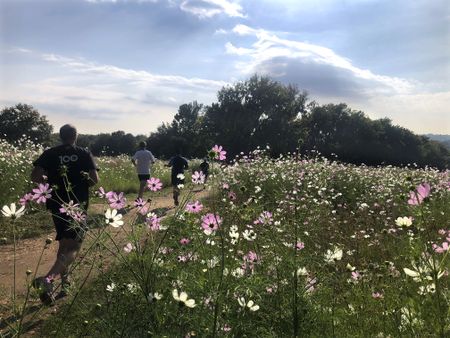
Every week, there are more than 2,000 volunteers on our 200+ parkruns in South Africa. They are what makes parkrun go on and on and on.
I do most of my parkruns in Gauteng, SA’s smallest but most populous province. It has at least one advantage over other provinces – it is raining parkruns, close to 50 at my last count. Given that greater Johannesburg boasts more than 2,000 parks (read about them here), there’s still plenty of room for growth.
Yet the wonder is that each parkrun is different from the other. Each one teleports you temporarily into a different community – testament to the diversity of people and places in Egoli.
/file/dailymaverick/wp-content/uploads/2024/07/IMG_8125.jpg "The legendary Bruce Fordyce, founder and CEO of parkrun in South Africa, on the parkrun in Alberts Farm. The 500 shirt indicates that he has completed 500 parkruns… and is still going. (Photo: Mark Heywood)")
In this Guide to 42 of Gauteng’s parkruns I don’t grade the parkruns, or even tell you which are my favourites.
Each parkrun – like human beings – has an individual character and has something different about it. In my view the way we relate to parkruns is like the way we should relate to people: look for and find the beauty in each and every one and never prejudge.
It’s up to you to feel it.
So, I proceed in alphabetical order and will add new parkruns to this Users’ Guide as and when I encounter them.
Alberts Farm parkrun
Alberts Farm is a little park with a big history.
Strictly speaking it is a nature Conservancy, a hidden jewel of history and biodiversity in the west of Johannesburg. I am told that the Alberts, from whom it takes its name, were German Protestant emigres to SA in the early nineteenth century. The graves of the family still stand upright in the conservancy, the oldest being that of the patriarch, Nicolas Frans Albert, who died in August 1881.
Once upon a time the Alberts’ farm was one of the largest farms in Johannesburg and fed the nascent mining city. When the family divided the farm up and sold parts of it to the City in 1946, their names went with it. Sophiatown, a suburb which apartheid gave a tragic history, is named after Sophia, one of their daughters.
Alberts Farm is a parkrun with a view. Its high point is known as Rocky Ridge and from there you have a silhouette of the inner city, its tall buildings and three towers (Hillbrow, Brixton and Ponte City), as they rise above the Melville Koppies. If you airbrush out the modern cityscape you can imagine the natural landscape before Johannesburg was born.
/file/dailymaverick/wp-content/uploads/2024/07/IMG_8114.jpg "The view of Johannesburg from Rocky Ridge in Alberts Farm. (Photo: Mark Heywood)")
Alberts Farm is also challenging. In fact, it’s more trail-run than Parkrun. But if you are careful of foot, it’s easy enough to navigate.
It starts with a climb. Up the famous Rocky Ridge (pause at the top and take in the view), before descending through what locals call Shrek’s Forest, passing the one and only natural spring that still spouts pure(ish) water out of the quartzite belly of our city. Then you run across the park’s big open heart and down, crossing a bridge over a rivulet (sadly terribly polluted, as are all the once-white waters of the Rand) that runs into the Braamfontein spruit. Thereafter you arch back to the finish at the carpark.
This is my home parkrun. I’ve done it 44 times and it has always been fun. Since 2019, I’ve only known the run to be cancelled once due to bad weather.
The volunteers who run it are always welcoming. Last week the wonderful Kimberleigh completed her 350th parkrun there as a volunteer!
Atholl parkrun, North Joburg
Atholl parkrun is South African ingenuity at its best. Scratched out of a sliver of small parks, squeezed between suburbia, Melrose Arch and the Ben Schoeman highway to Pretoria, it’s a wonder that it even exists. But it does, and it thrives.
You are going to go round it three-and-a-half times, but that’s what makes it unusual. Front runners will catch up with the tail. There have been 225 runs, thanks to the volunteers and the community that keep it alive.
Bezuidenhout parkrun, East Joburg
Bezuidenhout park, just below the Linksfield ridge, and to the east of central Johannesburg, is one of the grand dames of Johannesburg’s parks.
In the days of apartheid, it was a playground for white people. You can sense the ghosts of its former privilege if you walk around the park, the old railway lines and other amusements slowly giving way to the rewilding of nature.
Today, it’s sadly neglected and insufficiently visited, unlike the city’s other big parks at Zoo Lake, Delta and Emmarentia. Nonetheless it’s a beautiful space, surrounded by Joburg’s eastern ridges. The Jukskei runs through it.
It’s also a heritage site. The Bezuidenhout’s were settlers. In their days it was called Doornfontein Farm. It accommodated British soldiers during the South African War and a sandstone monument built in 1902 to honour some of those who died, is still there. The family donated the land for the park and stipulated that the house and cemetery be maintained.
Bezuidenhout parkrun offers a beautiful run around and through the park, with a route that zigs, zags and snags from one corner of the park to the other.
It was the home parkrun of a friend of mine, the great South African sociologist and activist Eddie Webster, who at the age of 80 completed his 200th run there just a few weeks before he died in March 2024.
Boksburg parkrun
Ordinarily Boksburg is not my cup of tea, as far as the suburbs of Joburg go. But Boksburg parkrun made me confront my prejudices.
It’s high in spirit and efficient in operation. They had a water point for dogs (well, a water bowl) about halfway through. And it’s a fast, cross-country type route, with some gentle ups and some drawn-out gentle downs.
It starts at Boksburg stadium and then carves a point-to-point route around the stadium, passing what appear to have once been a collection of municipal rugby and soccer fields, touching the edge of a small dam and then back to the start.
Bosmont Stadium parkrun, West Joburg
Bosmont is a “coloured” community squeezed in between Soweto, Joburg’s ubiquitous yellow mine dumps and the industrial areas to the west of the city.
It’s a community with a proud history. But today pride is blighted by social problems, especially youth unemployment, drugs and gangsterism. The volunteers who organise the Parkrun do so for the love of their community, a defiant assertion of social cohesion against despair, an attempt to show young people that a better life is possible and that the community can still rally itself for hope.
The Bosmont Stadium parkrun is carved out of one of the few green spaces in the area.
Starting on fields adjacent to the famous Bosmont Local Soccer Association grounds, it runs alongside and then crosses the Bosmont Spruit and the densely reeded wetlands that border it. The wetlands and the spruit are heavily polluted by uncontrolled effluent runoff from the industrial area. But a group of valiant local environmental activists, the Community Green Project, work tirelessly for their vision of a safe, cleaned-up green space.
The route is a flat out and back, with a few crisscrosses of the soccer field at the start and finish.
/file/dailymaverick/wp-content/uploads/2024/07/IMG_7651.jpg "The volunteers of Bosmont parkrun. This is where I recently completed my 100th parkrun, welcomed at the finish with koeksisters and coffee! (Photo: Mark Heywood)")
A great group of local community volunteers will welcome you home.
Blades Hotel parkrun
Blades Hotel takes its name from the oars that are used in competitive rowing and sit on the banks of the Roodeplaat dam north of Pretoria. It boasts being the host of the first international rowing regatta on African soil and the sometimes training ground of SA’s first black rowing Olympian, Sizwe Ndlovu, who won a gold medal at the London Olympic Games in 2012.
In 2025 it also started to host a parkrun, which was 16 runs old by the time I did it.
Tucked onto a corner of the dam it’s a lovely spot for a parkrun. A double lapper that winds and rises through the thick bushveld, down to the water’s edge, through tunnels of bush and in the midst of local buck. A contender for one of the most bucolic of Gauteng’s parkruns.
Botanical Garden, Pretoria
Parks come in many shapes and sizes. The national Botanical Garden in Pretoria is a park’s park. Beautifully maintained, biodiverse, bursting with indigenous flora, boasting grassland and a beautiful set of sculptures by Anton Smit.
With 79,000 registered runners, Botanical Garden parkrun can boast of having the largest number of registered parkrunners of any parkrun in the world. So, it’s not surprising that it exudes community and diversity. How Pretoria and the botanical gardens are changing!
The route is a lovely one, paved all the way, winding round the gardens, giving you a mix of shade, sun and a million shades of green. For some reason its website suggests that it is relatively flat, hiding the fact that it has a few sharp, short hills that will take the wind out of you!
When you have finished your parkrun make sure you stick around and take a walk. After a run has settled your senses and revived your ability to see the world around you, you will be surprised at what you didn’t see when you started the run!
Bronberrick parkrun, Centurion
Bronberrik Parkrun sounds like it ought to be located in Scotland. Instead, it’s hidden away in a green lung in Centurion, the urban sprawl that now occupies the countryside between Johannesburg and Pretoria and turned it into one overgrown conurbation.
Only a few defiant little patches of green masquerading as parks are left between Pretoria and Johannesburg. Bronberrik is one of them.
On the day I ran Bronberrik, the organisers had combined it with a clean-up of the park. After and during the run, parkrunners spent some time picking up rubbish. Another good use for a parkrun, I thought; take nothing away and, when you can, give something back.
The run itself is another example of public spaces snatched from the jaws of urban creep. It’s a double-lap, T-shaped route that runs along a spruit (whose name I haven’t been able to find out yet), a little bit of woodland and a climb up Dumb Bell Hill.
There’s nothing very remarkable about Bronberrik, but for the locals it’s home, it’s well attended and you can feel how they love it.
Bryanston parkrun, northern Joburg
Johannesburg may be one of the few great cities in the world that is not built on a major river. But despite that there’s water everywhere. It’s a city of natural waterways – “spruits”, as we call them – that crisscross our urban geography.
Think back 100 years and picture a landscape free of concrete and tar. Imagine instead the gushing springs of its many hills and how they would have excited the poet within you. That’s why the area was named the Witwatersrand, meaning “white waters ridge” in Afrikaans.
Apart from iGoli, the plentiful supply of amanzi may have been why people settled permanently here.
Sadly, over the past 100 years neglect and pollution have darkened the white waters. But against all odds nature struggles on: our spruits often offer up quiet and beautiful spots in the middle of urban formal and informal sprawl.
I tell you all this because the Bryanston parkrun is a spruit run, run in the shade of trees overhanging the Braamfontein spruit as it winds its way to the edge of the city. It’s an out and back, in the dip of a valley whose contours have long been blurred in Joburg’s man-made forest. It is fast, flat and popular! Basically, you run north for a couple of kilometres and then turn and head back, the fast runners briefly intersecting with the walkers and slow runners in a loose figure of eight, before the paths diverge again.
Another well run, well established member of the parkrun family, and worth an outing.
Delta Park parkrun, central Joburg
For me, Delta Park is like Johannesburg’s Hampstead Heath (where a few weeks ago I ran my 99th parkrun), a big park with many changing moods and views, some oldish trees, fragments of forest, ponds, biodiversity and abundant bird life.
Delta Park is where Parkrun SA started when Bruce Fordyce, the Comrades Marathon King and now CEO of Parkrun SA, organised the first local park run with 26 people in November 2011. Today it regularly attracts up to 500 runners and many of their four-legged friends.
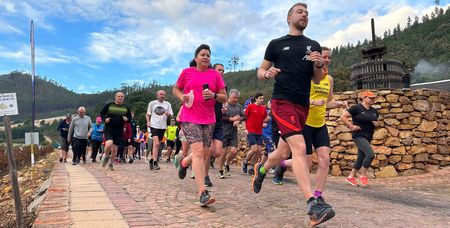
The Parkrun starts at the former sewerage plant built in 1931, according to the Johannesburg Heritage Foundation, “in the International Style which London chose for its underground and power stations at that same time”. It is an unusual building, now a heritage and conservation site.
The run itself is fairly demanding, following the circumference of the park which, given that it’s on a hill, means a short down to the Braamfontein Spruit, then a long slow, steady climb to the top of the park, past ponds and the Linden stream, with their large overhanging trees, before a fast last kilometre to the finish.
/file/dailymaverick/wp-content/uploads/2024/07/IMG-9752.jpg "Running through the Cosmos in Delta Park in March 2020, a few days before the Covid-19 lockdown started. (Photo: Mark Heywood)")
What is most memorable about Delta Park, which is ever changing with the seasons, is its big meadows of pink and white Cosmos which blossom around March and April every year.
A sight to behold.
Dorothy Nyembe parkrun, Soweto
Dorothy Nyembe is a parkrun in Dobsonville, Soweto. It’s the youngest of Soweto’s three parkruns, having only started in late 2025. Its namesake was a women’s leader over many decades in the liberation Struggle and one of the first MPs of the democratic SA, until her death in 1998.
Reminding us of the geography of apartheid spatial planning there is a paucity of parks in Soweto, and those that exist are a fraction of the size of those in Joburg’s once whites-only suburbs. Even today (for no good reason) they are not as well maintained as the big parks of historically advantaged Joburg.
But the community spirit shines through and it’s a must-run for the parkrun tourist.
It’s flat and fast. The route winds around football fields, the outer edges of the park, crossing a polluted stream and passing a wonderful set of statues whose origin and meaning I have been unable to establish.
Three times and then you are home to the warmth of the community of volunteers who host it. Just do it!
Eldorado Park parkrun, South Joburg
Eldos is one of the friendliest parkruns I have had the privilege to run. Its dedicated team of volunteers, several of them local school teachers, see their parkrun as a precious asset offering some hope in a troubled and poverty-stricken community, out on the southern edges of Johannesburg, which often feels as if it has been forgotten.
I was struck by the number of young children running and the volunteers along the course, every one of whom thanked me for coming to their parkrun (they thanked every parkrun tourist)! It wasn’t that I’m anyone special; that’s just what they do.
Warmed by their kindness, I managed to raise a few thousand rand to contribute to buying running shoes for the kids.
The run takes place at the Eldorado Park Stadium, which has seen better days. It’s a flat, two-lap course, around the fields that border the stadium. You are not going to go there for the beauty that some of our parkruns offer, but for the sense of community.
Make sure you stick around and talk to the organisers afterwards. You will leave with a sense of hope and the intention to come again.
/file/dailymaverick/wp-content/uploads/2024/07/8888.jpg "With volunteers and runners at the Eldorado Park parkrun. (Image: Mark Heywood)")
Ennerdale Stadium parkrun, southern Johannesburg
Ennerdale Stadium parkrun is the southernmost parkrun in greater Johannesburg.
To get to it you must take the N1 across the swathes of land beyond the Winchester Hills, land increasingly occupied by informal settlements that sprout from the edges of communities like Lenasia, Ennerdale and Eldorado Park.
After a drive through a sea of impoverishment a parkrun becomes a magnetic island of hope. That was certainly my feeling after my trip to Ennerdale.
The parkrun takes place within the walls of a dilapidated and vandalised sports complex, rescued and walled off before its buildings were completely stripped and demolished by desperate people seeking building materials for their shack homes.
The carefully marked route, with colourful little cones and white painted wooden signs, meanders you around the soccer fields and basketball courts, behind the broken spectator stands. You go round twice, and it’s fast and fun.
My running companion, Dog Marley, and I did it in 28 minutes, which was a fairly reasonable time for a soon-to-be 60-year-old. That left me with time to talk to Ingrid Brown, the run director.
Ingrid is a runner, local teacher and longtime resident of Ennerdale. She founded the parkrun, believing it would be a way to provide activity and hope to both the elderly and youth in the community, who are starved of recreation facilities.
Setting it up was a struggle. But she credits the direct hand of Bruce Fordyce in eventually overcoming bureaucratic inertia and disinterest in doing something good for the community.
Now, like me, the run is almost in its sixties.
Ingrid, a one-woman band but with the support of family, church and residents, gets to the park at 6.30am every Saturday. She prays that volunteers will materialise and pays a local homeless person R100 to clean the route. Shortly before run-off time at 8am, she welcomes the runners – a diverse crowd of young and older, and the occasional tourist like me.
It was a fun run. I watched different shapes, sizes and ages chase each other over the last 50m and felt the very joy that Ingrid wanted to unleash.
Ennerdale Stadium bears out my contention that a parkrun is only partly the 5km you run or walk. It’s also the community, the people, the volunteers and the spirit.
I urge you to visit it.
Ernest Ullman parkrun
I would never have heard of Ernest Ullman Park, tucked into the folds of Johannesburg’s northern suburbs, if it wasn’t for the parkrun.
It takes place along the banks of another of Joburg’s many rivers, the Sandspruit, a river jealously protected by Friends of Sandspruit. They have good reason – it’s a beautiful spot.
The birdlife is abundant: an Egyptian goose lolled on the water’s edge and further up a group of African sacred ibis picked for food on the riverbank, their relative the hadeda keeping up it cacophonous cawing somewhere just out of sight.
Ernest Ullman parkrun integrates well into these surrounds, in a mutually beneficial symbiosis.
The route is soft, flat and satisfying. It’s a two-lapper, out from the main open area of the park and along the bank of the Sandspruit before turning round after about a kilometre, heading back to the park and then doing the same thing again.
I ran in midwinter, the browning time of year, but I can imagine the summer greens and the way the whole route would be in the shade of the indigenous trees that litter the riverbank. As an aside, the trees reflect beautifully in the still eddies of the river. It almost reminded me of Christ Church Meadow in Oxford.
Run complete, it’s also a lovely place to pause and contemplate. The park and recreation centre are well maintained by Johannesburg City Parks and Zoos with some lovely statues and a little tea-room.
Gillooly’s Farm parkrun, East Joburg
Gillooly’s Farm parkrun is beautiful and unusual.
Unusual because of its shape – a long, fairly straight route out, leaving the farm (well, it was a farm once!) and following a narrow strip of green, before then a 180-degree turn and heading back in the direction you came from. All the way you run parallel to the banks of the Jukskei River (a bit further downstream from when you encounter it on the Bezuidenhout parkrun), with a loop taking you through a romantic little wood and then out alongside the lake.
Like Bezuidenhout Park, Gillooly’s been neglected, but the neglect can’t hide the original beauty of the area.
It’s beautiful because the Linksfield koppie and ridge rises sharply from its perimeter; it’s beautiful because the lake and its surrounds, once carefully tended, are home to birdlife; it’s beautiful because it comes with a sense of tranquillity, making it possible to imagine you are in a rural area far from the city’s thrum.
It’s a popular parkrun, with lots of parking, a great spirit, a flat route, and another example of a parkrun playing a major part in keeping a green space alive and enjoyable, while corrupt City of Johannesburg politicians fritter away the budgets that should be keeping these spaces vibrant and safe.
Golden Harvest parkrun, North Joburg
Golden Harvest parkrun is a jewel hidden away in the thickets of mostly bland suburbia that spread inexorably northwards from the edges of Johannesburg. The park itself, not widely known like some of the inner-city parks, feels like the green space that got left behind, as the concrete gobbled up the highveld. It’s actually a beautiful spot, with ponds, plentiful trees and lots of open space.
The route is one of my favourites. It manages to have the feel of a trail run. Whoever planned it was creative, meandering it through both the park’s open spaces and wooded areas.
That said, it’s also quite physical, with a sharp rise as soon as you start, a relieving dip, and then a longer, slow-poison climb to the halfway mark. Fordyce thinks it’s one of the toughest of Joburg’s parkruns, but then he’d forgotten about Sterkfontein. More about that below.
Gracepoint parkrun
Once upon a time and not very long ago the rolling hills beyond Lonehill and Fourways were unbroken by human habitation, covered with trees and grasses. Today, they are covered with big houses that seek to maintain a rural and out-of-town feel.
The beauty of the Gracepoint parkrun is that it lets you into a sanctuary that has preserved a little of the original land and a lot of its feel. And, as the proverbial cherry on the cake, the Jukskei River runs through it.
This parkrun was an unusual find. If you are coming from Johannesburg turn left at the entrance to Leeuwkop prison, pass the Prison Break market (née shopping centre) and find your way to the Grace Bible church, for this parkrun is run almost entirely within its bounteous grounds. You’ll know you are at the start when you see the four big letters “LOVE” painted red and looking southwards back towards the Lone Hill koppie. It has a view to die for.
The parkrun has a dedicated team of volunteers and is quite small and intimate. There were 44 of us the day I ran it. It’s a two-lapper that winds its way from the church, through the lush bush down to the banks of the Jukskei, along it, and then back up. But when I say down and up, I mean it: it’s a drop of about 30 metres from start to riverbank, so steel your thighs and lungs for the climb.
Greenstone Hill parkrun
The name Greenstone Hill has a romantic dreamy feel, as if it ought to be on the edge of some ancient heath, surrounded by old buildings, quintessentially English. Instead, it’s a shard of land on the edge of the roaring multi-lane N3 as it cuts a ring around the East of Johannesburg before it launches off towards Durban.
Not only that, it takes place in a “seritude”, the column of land left vacant of buildings to accommodate a pile of giant pylons as they march electricity into our homes. Despite this – or maybe because of it – Greenstone hill parkrun has both gees and character.
It starts on the dead end of a suburban road that ran out of steam. A lack of runway normally found in parks requires that parkrunners set off in single file (“sub-30s to the front” suggests the run director). It then proceeds on a downwards gradient on a series of zigs-zags, short ups and short downs, before a longish straight back up the hill, back into the single file stretch and onwards to the finish.
If you have time to admire the scenery the land you run across is eco-dystopian – on the horizon are the cooling towers of the Isando Power Station. It’s more trail run than parkrun, more wasteland than park but it’s fun and unusual. It’s also quite hard, with a descent and ascent of 40m.
Hazeldean Farm parkrun
This was my 191st parkrun and what a gem. I don’t know how it took me so long to get to it. Maybe because it’s more far flung than most, situated as it is in Pretoria East close to Gauteng’s border.
That it starts and finishes beside a large cowshed is a clue to the fact that it’s on a working cow farm, with names like cow corner and moo mayhem. But, that aside, it’s actually more of a trail run than a farm run or a park run.
It’s a single lap, single track (MTB lingo) through highveld bushveld, gently inclining for the first half, then gently declining all the way home.
Once home you discover that there’s a couple of lovely restaurants and a craft beer bar for those who like to have their first taste of alcohol before 9am.
Hillside parkrun, Pretoria North
The words I would use to describe Hillside parkrun are “quirky” and “idiosyncratic”.
It embodies the spirit of parkrun: community, diversity, commitment from the volunteers and a beautiful geography. It feels loved, and the parkrun director told me how the volunteers don’t only give their time, but also money to keep the path cut and clear.
If I’m anything to go by, Pretoria North West feels like it’s been left behind by time.
On the tail end of the ancient Magaliesberg Mountains, which push into the outer edges of Tshwane, dissecting the edges of the city, there are two distinct lines of hills, rearing up and then slipping down, smatterings of communities on the slopes, some modern and ugly, some more settled.
The parkrun itself is on the location of the abandoned Hillside Golf Course, so overgrown that it gives up no clues about where its greens and fairways may be hidden.
In summer, after the rains (I ran there in early November) it’s lush and green and overgrown. The course is a one-lap squiggle, doubling back on itself, doing little loops, pushing up into the hills and then retreating. You feel like you are in the bush. I thoroughly enjoyed it, especially sitting with the peacocks, feathered glory on display, when I had finished it.
Huddle Park parkrun
Huddle Park, situated near Linksfield in Johannesburg, is another of our city’s life-supporting green lungs. The park itself, at 200 hectares one of the biggest in the city, is on municipal-owned land.
If you are to believe the out of date Wikipedia page I consulted, the park is “underutilised and underdeveloped… a classic story of new South African mismanagement and corruption, with the Johannesburg city council eager to sell the park for a quick buck”.
However, that’s no longer true.
In recent years it has undergone a radical ergonomic transformation. It now boasts a popular multipurpose sports and recreation facility, with golf courses, mountain bike and trail running trails, Padel courts and now the Huddle Park parkrun too! It’s a relatively new member to the family, only 47 runs old on the day I ran there.
It’s popular and very dog friendly, judging by the number and diversity of dogs I saw there.
With the heritage houses of Linksfield Ridge as its backdrop (if you look up), it’s also a novel course. Rather than taking us across or around the park’s 200 hectares (in some ways a pity but presumably so as to avoid collisions with golf balls or mountain bikes), it coils around the western end of the park.
Always on grass, following the runner in front of you, you wind in and out of wooded areas, taking a series of mini switchbacks. It’s like a long snake, with runners crisscrossing each other, doubling back, the head staying in sight of the tail.
Well worth the run and although quite a lot of it involves steady, gentle ascents, it’s a good course for a fast run if that’s what ticks your boxes!
Kwanele parkrun, Katlehong
Kwanele Park is on the edge of the sprawling township of Katlehong, south of Johannesburg. The park encompasses a wetland, a small dam and the ubiquitous spruit, sadly polluted.
The run itself is a flat, two lapper that sets off from the communal jungle gym (well used it seems) and skirts the edge of the wetland.
On the day I was there, the vibe was good, a mixture of local youngsters, elders and speedsters, with me somewhere in the middle. After I’d finished I did a lap of honour (of sorts) and caught up with Gogo Lizzie, the tail walker.
Gogo told me proudly that the parkrun was regularly visited by “your people, whites and Indians” and that I was welcome before kindly directing me to a tap for a thirsty Dog Marley!
Back at the finish, a Pilates session had struck up for the runners. The day was hot, the mood was warm and the sense of satisfaction that flows out parkrunners mixed with the music accompanying the Pilates. I left feeling happier than when I arrived.
Lanseria parkrun
Lanseria parkrun is a little jewel. Just beyond the airport and before the first line of the Magaliesberg hills, it’s a country run in a country estate on the edge of the metropolis.
The Krokodil Rivier (Crocodile River) runs alongside it and it’s a pleasant trail run around a meadow (twice) with a few squiggly bits at the beginning, in the middle and at the end. I enjoyed it, although the dog had to sit it out as no dogs are allowed on this one.
It has one other advantage: a pleasant restaurant at the end for a country breakfast.
Laudium parkrun, Pretoria West
Laudium is a predominantly Indian residential community in the west of Pretoria, another throwback to residential segregation that started under apartheid and has lingered into the present.
Straddled on the hills that abut Pretoria, it has remained a vibrant community marked out by its temples and mosques.
The Laudium parkrun, convened and sustained by a dedicated group of volunteers, has the feeling of a neighbourhood run, occasionally hosting inquisitive parkrun tourists from further afield.
It’s warm and welcoming. It starts and finishes at the Laudium Stadium and is run entirely within the boundaries of its extended sports precinct; that means it’s a tour of its soccer pitches and cricket oval before returning to cross the finish line in the stadium.
Rose parkrun, Lenasia
The Rose parkrun takes place in a park of the same name in the middle of Lens (as this still overwhelmingly Indian community is known). Lens, in the very south of Joburg, is famous as a community of resistance. It was designated as an Indian residential area under apartheid and in time became the home and stomping ground of some of SA’s finest freedom fighters before and after their sentences on Robben Island – Ahmed Kathrada and Laloo Chiba, notably.
The day I went there, Dog Marley and I were warmly welcomed by the local organisers, another bunch of parkrun volunteer diehards who get up early every Saturday first to do a clean-up along the route and then to manage the runners.
The Centre on African Public Spaces (Caps), a project set up by the City of Johannesburg, aims to work with communities to “turn public spaces into public places”. This includes transforming parks into “safe and inclusive public spaces”, or in other words taking places that through neglect may have become dangerous and threatening to communities and bringing them back to life as public spaces. The Lens parkrun does just that for Rose Park.
The route itself is fast, flat and paved. Two laps around the circumference of the park before finishing in its shaded and rosed part. If you are in the business of chasing personal bests (PBs), this is a good place to do it.
Lonehill parkrun, North Joburg
Lonehill is a suburb of Johannesburg close to Fourways. It’s probably most famous for the big boulder that forever squats atop the solitary koppie in the Lonehill Nature Reserve, described as “an important Stone Age site that conserves three stone age furnaces, built around 1600 that were excavated in the 1960s and then covered to protect them”.
The parkrun doesn’t go through the nature reserve, which is kept locked except on weekends.
Instead, it starts and finishes at the lovely Lonehill Park dam, the focal point of a suburban oasis that has held its ground against urban encroachment, and feels like a romantic spot for lovers and thinkers.
On the day Dog Marley and I ran, two black-headed herons, feathered residents of the area, sat quietly on top of the trees, looking down nonchalantly on the runners.
The run is a two-lapper that starts by following the spruit (I’ve discovered that Joburg parkruns hug spruits) and then traces the last vestiges of green around the back of the Lonehill Shopping Centre, a kind of botanic channel running between the suburban houses that leads up to what the parkrun organisers call the “iconic happy rock”, which you run round (twice) before setting off down the hill again.
It’s a popular and well-established parkrun, and worth the trip.
Mapetla Park parkrun, Soweto
Mapetla Park is on the southern edges of Soweto, squeezed between Lenasia and Eldorado Park.
It’s reasonably well kept, born out of the wetlands that stretch out on both sides of a pollution-strangled spruit that runs through the park on its way to join the Klip River further downstream. Cows graze, sharing this public space alongside local football teams, people chipping golf balls and the parkrun.
/file/dailymaverick/wp-content/uploads/2024/07/IMG_8994.jpg "A stream runs through it. Mapetla Park looking alluring in its Saturday best. (Photo: Mark Heywood)")
The creators of the park clearly had some imagination: it was revamped in 2010 at the time of the Soccer World Cup. But its flower beds and gardens are now empty and untended.
The Mapetla Park parkrun is small but enthusiastic.
“Count down M-A-P-E-T-L-A” shouted race director Lwandile Phaledi, assisted by his two enthusiastic and talkative daughters, to the fewer than 20 runners, several of them children, on the day I went there in March 2024.
Then we were off, three times around the perimeters of the park, diving back into the centre, as if following the spokes on a wheel and then out to the edges again.
At the end of the race Lwandile asks that we wait until all the runners had finished so that he could take the weekly “family photo”. I willingly obliged.
This is a parkrun to add to your bucket list.
Meyers Farm parkrun, Alberton
Meyers Farm parkrun is a jewel hidden in plain sight. It’s a testament to the diversity of parkruns and thus to the diversity of life and how much living, beauty and history we can find in Johannesburg.
The parkrun takes place on the land of a working farm, mainly horse breeding, crunched between the forested koppies that border southern Johannesburg and the fast and furious N12 Southern Bypass. It’s a location with a history, the Klipriviersburg farm literally having once belonged to one of the founding Afrikaner patriarchs of Johannesburg, Jan Meyer, and probably laden with historical artefacts and stories.
What’s beautiful about the route is that it’s all off road.
The day I ran it the grasses were long after the January rains. The race director quipped in his pre-run briefing at the start that parents should hold onto their children or risk losing them in the shoulder-high grass.
The route winds in and out of woods, skirts ancient rock formations and crosses and recrosses a spruit. It’s a demanding run, the first half mostly up and the descent free flowing back down, passing the farm. At the end, a little climb back to the start, and it’s done!
Meyerton parkrun, South Gauteng
And while we’re on the subject of the Meyers: If you live in Johannesburg or Pretoria, Meyerton parkrun may seem like a long way to get up and go for on a Saturday morning. But it’s well worth the journey even if it does feel as if you are in another province, or even another country.
However, it’s a lovely little parkrun.
Starting in a local rugby stadium it quickly dips down to meet the bank of the Klip River and then runs alongside it, before turning back and traversing several meadows and a wood (as you enter it, there’s a tree with a sign saying Boomstraat), before you get back to the start and then do it all over again.
The day I ran it there were November storms in the air. We started in a shower, but soon the sun came out and the green grass felt rich and resonant underfoot. I felt for a few minutes as if I could have been running along the banks of the River Cherwell in Oxford.
As I drove back to the Big Smoke, I felt again what a wonderful invention the parkrun is and I was ready for the weekend.
Mofolo South parkrun, Soweto
It is sad that 30 years after democracy SA’s most famous township, Soweto, home to two million people, is still as much a symbol of spatial apartheid as it was in the bad old days.
The Mofolo parkrun (and its twin, Mapetla) is an opportunity to puncture that by bringing people of all races and colours into Soweto.
It should be much better supported than it is, and I recommend that it be on the to-do list of all parkrun tourists in SA and internationally.
The run takes place in the Mofolo South Park in central Soweto and has been hosted since it was started in 2016 by race director Sam Skeva and his small team of dedicated volunteers.
It’s a small, intimate race.
Sam says that’s mainly because parkrun has not yet taken off big time among the communities in Soweto, and that Saturday mornings are used by dedicated runners to train over longer distances.
The route runs alongside the wetland beside the Klipspruit River, another of the many water arteries that crisscross Johannesburg. But because the park is small it’s a three-and-a-half lapper, following the park’s circumference.
/file/dailymaverick/wp-content/uploads/2024/07/IMG_9206.jpg "Parkrunners gather before the Mofolo Cultural Bowl in Soweto. (Image: Mark Heywood)")
This allows you three opportunities to pass the once-famous Mofolo Cultural Bowl decorated in the colours of the rainbow.
It looks tawdry now, but it’s an iconic venue first constructed in 1976 and host to many arts festivals, gospel choir competitions and the annual Pale Ya Rona Carnival. Greats artists who put South African music on the global music map have all performed there, including musicians such as Hugh Masekela, Sibongile Khumalo, Philip Tabane and Sipho “Hotstix” Mabuse.
If you pause as you run past the bowl, you can almost feel their spirits.
Noordwyk parkrun, Midrand
I can remember a time, not so long ago, when the drive between Johannesburg and Pretoria was mostly through a stretch of countryside, broken by the big Reserve Bank building and later the Vodacom building sitting then in isolation on the rolling hills between the two cities. No more.
Noordwyk is about equidistant between the two cities, one of the suburbs that has spread out on either side of the highway. It’s mostly housing-complex land, uniform rows of concentrated housing for the new middle classes. Not particularly endearing, but functional and boasting a quick jump onto the highway.
Fortunately, within these human settlements there are little green lungs and corridors. Noordwyk parkrun, now into its second centenary, has settled in one of them.
It’s a good-natured friendly neighbourhood parkrun, shaped a little like a star fish, its two laps squeezed into a park, its car park and the unused leftover lands that feed into it.
Rietvlei parkrun, South Joburg
Rietvlei Zoo Farm in the south of Joburg is a sort of all-sports, multi-activity mecca: it has trail runs, mountain bike paths, an animal farm and wedding venues.
Rietvlei parkrun is also one of Joburg most popular park runs. I was surprised by the queue of cars into the venue and then a stream of families and dogs heading to the start, 891 in all.
It’s a great course, mostly flat, taking in a bit of woodland, a bit of wetland and a bit of grassland. The numbers and the location give it a carnival atmosphere, and with more than 40,000 people having run it at one time or another it’s a parkrun confident of its stature and place in the world.
Roodepoort parkrun
When I think Roodepoort, I generally think of grey and uniform suburbia, a community on the west of Johannesburg, hanging off Ontdekkers Road, one of the ancient arteries of the city that led out to Krugersdorp and beyond. But the Roodepoort parkrun is anything but grey.
According to Fordyce, it’s one of the oldest parkruns in Johannesburg: it turned 547 (runs!) on the day I ran it, compared with the 579 of Delta Park, SA’s oldest parkrun. And for that reason you get the feeling that this is a parkrun that is well loved and looked after by its volunteers.
It takes place in the Len Rutter Park in Florida Park, another jewel of a park that you will probably never have heard of unless you are from the area.
It’s a foot- and eye-friendly course, with some climbing, but nothing serious, across the park’s open spaces, through its wooded areas, over another of Johannesburg’s ubiquitous spruits (name not yet known to me) and then round for a second lap.
One of the features that marks out Roodepoort parkrun is an old steam engine and a miniature railway track for model train enthusiasts.
/file/dailymaverick/wp-content/uploads/2024/07/IMG_9117.jpg "Toot toot no more: runners pass an old steam engine. (Photo: Mark Heywood)")
On the day I ran it was early autumn, the old trees were beginning to brown, the rising sun threw relief into their colours and an overnight rain had given the green grasses of summer one of their last waterings before winter.
Ruimsig parkrun, West Joburg
The Ruimsig parkrun may be one of the lesser-known parkruns of Johannesburg, but that doesn’t make it any less beautiful.
The first time I tried to run it I tripped on a stone and pulled my hamstring. Try as I might to continue, my leg wouldn’t work. A kind parkrun volunteer had to car-lift me back to the start. That was the only parkrun I didn’t finish, and after that there were no more parkruns for a month.
But I returned a few months later: the Ruimsig Stadium sits at the bottom of the ridge of hills that run all the way from Northcliff to Krugersdorp (the West Rand) and the run provides you with an unbroken view onto the hills.
The hills are scarred by a rash of houses. Nevertheless, with most of the city behind you, it feels like you are out in the big open spaces, and indeed you (nearly) are. It’s only a (few) stones’ throw from the Walter Sisulu Botanical Gardens, and the Cradle of Humankind lies only a few kilometres further down the road.
The parkrun also has a pleasant and moderately challenging course. It starts and finishes in a grove of trees at the Ruimsig Stadium, dips briefly and then climbs a long, slow hill… much more pleasant on the way down.
My advice: Keep your eyes on the path!
Sterkfontein parkrun, Krugersdorp
Legend has it (confirmed to me by Fordyce) that Sterkfontein parkrun is one of the most physically challenging parkruns in SA, so take your normal finish time and add 10 minutes! But it’s equally one of the most unusual and beautiful.
From the regulars, the people for whom Sterkfontein is their local, you get a feeling a bit like being in a family run pub. There’s a kind of intimacy that comes with familiarity. For parkrun tourists, prepare for a run with a descent, an ascent and a view!
The race is hosted at the Sterkfontein Heritage Lodge on the edge of Krugersdorp, where it starts. You could plan to make a morning of it after the run because the Lodge has other walks, a zip line and a bungee jump, as well as a quiet restaurant.
From its start the route descends steeply and quickly, takes you through a forest, before a grudging steady rise of over 100m up a rocky path. Roll with the ridges of the ancient highveld beneath your feet. When you reach the high point you have a spectacular northerly view out over the Cradle of Humankind stretching all the way to the Magaliesberg Mountains. Stop and gulp it in, take a selfie, then turn around and make the descent back to the finish, passing other runners still on their way up.
Reeds parkrun, Centurion
This parkrun was a pleasant surprise.
On a coldish Saturday morning in May, at 5am, my choices were either to sleep in, go to a familiar parkrun nearby or take another leap into the unknown. I chose the latter. After clicking on “parkruns near me” on my parkrun app, I opted for the Reeds parkrun.
I admit, I didn’t have high expectations. The Reeds is one of those suburbs that have gobbled up most of what remains of unspoilt, unbuilt land between Johannesburg and Pretoria. Humans have to have their homes, and the bigger the better (or so they are taught to think).
Yet somehow, a wetland – a large hillside space with views onto the encroaching suburban sprawl – has held out. It’s penned in by the South African Mint on one side and more suburbs on the other. I must have driven at speed down the N1 highway past this spot 1,000 times and not noticed it.
But on parkrun Saturday it was special.
What surprised me was that it’s more like a trail run. The route is a path cut between dense, high highveld grass and a few stubborn Acacia trees. It winds and it climbs, holding nature’s own while competing against the ugly, incessant roar of traffic on the N1. In early winter the low, slanting sun gets in your eyes, casts long shadows, and makes the yellowing grasslands glow. For a few minutes you can imagine you are running free in the bush.
For all these reasons I finished it on a high, with a quick chat with its welcoming race director, Mfundo Jacobs.
Valhalla parkrun, South Pretoria
Valhalla parkrun is in the southern suburbs of Pretoria. It feels off the beaten track, unless you live in the area, and yet with the help of a GPS it’s easy enough to find.
It’s another of those surprising parkruns, in an area squeezed by suburbs of what was once known and feared as Voortrekkerhoogte, it sits in the shadow of the Zwartkop hills, just beyond the Pretoria basin.
Yet somehow its founders have managed to invent a 5km route that is interesting and makes you feel as if you are out in the country.
The route is fairly flat and, seen from above, looks a bit like a crochet pattern. It starts at a baseball pitch and ends by a children’s playground after you cross a small spruit (name unknown to me).
Victoria Lake parkrun, Germiston
Germiston is run-down and neglected suburb in the east of Johannesburg. Once a thrumming industrial area, today it feels bruised and battered.
On the autumn morning that I drove to the Victoria Lake parkrun, following the directions on the unfailable parkrun app, I counted the empty factories, potholed roads and informal settlements squeezed into spaces the city has forgotten about.
A Google inquiry told me Victoria Lake is a “natural perennial pan” formed by the flow of water from six different streams.
It’s been a centre of recreation for Johannesburg’s residents for more than a century and has felt the tides of time. Yet the park still feels like a hidden jewel: palm trees, wetland and an expanse of water shared by birdlife and early morning rowers.
I assumed that the lake’s name is a relic of colonial influence. I was right. It’s named after Queen Victoria, a name it assumed after the lake was donated to the Victoria Lake Club by the Victoria Falls and Transvaal Power Company in the 1930s. Sounds complicated. It is; read this article in the Germiston City News if you want to try to make more sense of it than I could.
The parkrun takes place in the public park on the shoulder of the eastern side of the lake, amid outdoor gyms, braai areas and the lakeside walkway. It’s a simple route, twice around the park, fast and relatively flat, shaded and with the lake as a backdrop.
It’s an enthusiastically organised and popular run, middle-aged in terms of Joburg park runs (it’s in its 300s). Its lively and dedicated organisers call it “the best parkrun in the universe”. To their credit it was the first time I’d come across pacers on a parkrun (for sub-30 and sub-35-minute finishes), as well as a length of string hung up at the finish line with ribbons signed by all parkrunners who had completed parkrun landmarks there: 50, 100, 250 and 500 runs. Nice!
Finally the diversity of its participants (human and canine) reflected the diversity of its catchment communities. It shone a light on its tawdry suburbs and spoke of hope for future renewal.
The Voortrekker Monument parkrun, Pretoria
Sadly, Dog Marley couldn’t join me at the Voortrekker Monument parkrun. That’s because it takes place at a location that is both a heritage site and a nature conservancy.
Sans canines, it’s still a parkrun with a difference.
The monument is an austere slab of granite (40m by 40m by 40m, according to Wikipedia) that guards the entrance to Pretoria. It was built to honour the Voortrekkers, Dutch-speaking people who migrated by wagon from the Cape Colony into the interior from 1836 onwards, in order to live beyond the borders of British rule.
Building started in 1937 and was completed in 1949; it became a national heritage site in 2011 despite – or maybe because of – its contested history. Granting it that status is an act of reconciliation in itself, given the movement that would develop a few years later against the retention of hurtful colonial and apartheid monuments. It probably survived because it is too big a structure to have gone down with the #Rhodes-Must-Fall and other protest movements.
/file/dailymaverick/wp-content/uploads/2024/07/IMG_8334.jpg "The Voortrekker Monument parkrun. (Photo: Mark Heywood)")
/file/dailymaverick/wp-content/uploads/2024/07/IMG_8340.jpg "A parkrunner and an unknown soldier at Fort Schanskop on the Voortrekker Monument parkrun. (Photo: Mark Heywood)")
However, history aside, its beautiful location makes for a wonderful parkrun.
The route starts and finishes on the steps of the monument itself. Sticking to a tarred road, it first descends towards the main entrance and then commences a slow ascent to and through the gates of Fort Schanskop, a place I recall as the redoubt where the diehard right-winger Willem Ratte holed out for a few days in 1993 to try to resist the advent of democracy.
You run through the middle of the 120-year-old fort passing a statue of an unknown Boer soldier, with a memorial stone taken from the site of the Battle of Magersfontein, laid in 1968 by the “Groot Krokodil” PW Botha when he was minister of defence in the apartheid government.
After that it’s a swift (if you like that type of thing) run back down the koppie and a short rise to the finish.
Overall, Voortrekker Monument parkrun is a fast route with a view, offering changing perspectives and angles on the monument as it pops in and out of your vision. It also gives you eyefuls out over the Pretoria bowl, over the Freedom Park heritage site (built on the neighbouring koppie) and down onto the University of South Africa (Unisa) campus.
Don’t rush it, this parkrun rewards slowness.
The Wits University parkrun
The Wits parkrun takes place on the West Campus of Wits University in central Johannesburg.
The course is fast, mostly flat (-ish), with a few little surprises. It’s a chance to tour the far-flung fields of Sturrock Park, with a view of the lovely old Johannesburg Gas Works, built in 1892, on to better known parts of the campus and around the Tower of Light and the new Science Stadium, before a gallop back to finish at the Wits club.
Because the Wits parkrun takes place on a university campus, unfortunately dogs have to sit this one out.
(They are also not allowed at the Voortrekker Monument, Lanseria, Pretoria Botanical Gardens, Meyers Farm and Woodlands parkruns.)
Waterfall parkrun
If you didn’t know better you might think from its name that Waterfall parkrun has as its centrepiece a waterfall. It doesn’t! Instead, it takes its name from the residential estate that now covers a whole hill side on the northern reaches of Johannesburg as you approach Midrand. In fact, its most visible defining feature is the large Ferris Wheel on the skirts of the Mall of Africa, where the parkrun starts, and the apparently lopsided PWC Tower that leers above it.
Although PWC’s 26 stories of concrete have trumped nature, the parkrun is more than pleasant. With views back over Johannesburg, it starts with a 3km gentle down run, tracing the big wall of Waterfall City, before you turn round and head back up on a two-kilometre climb. It’s a fast, fun parkrun with a feeling for space and great community spirit.
One thing to be aware of – it ought to be easy to find, but it isn’t! Follow the instructions on the Waterfall parkrun website closely. You have to park in parkade G of the shopping mall on the 5th floor if you want to make sure of an easy find. DM
This article is a work in progress written for the love of the parkrun. I will add more Gauteng parkruns to it as I continue my parkrun odyssey. For any corrections, suggestions or useful bits of information, write to me at: markjamesheywood@gmail.com
Comments
Scroll down to load comments...