




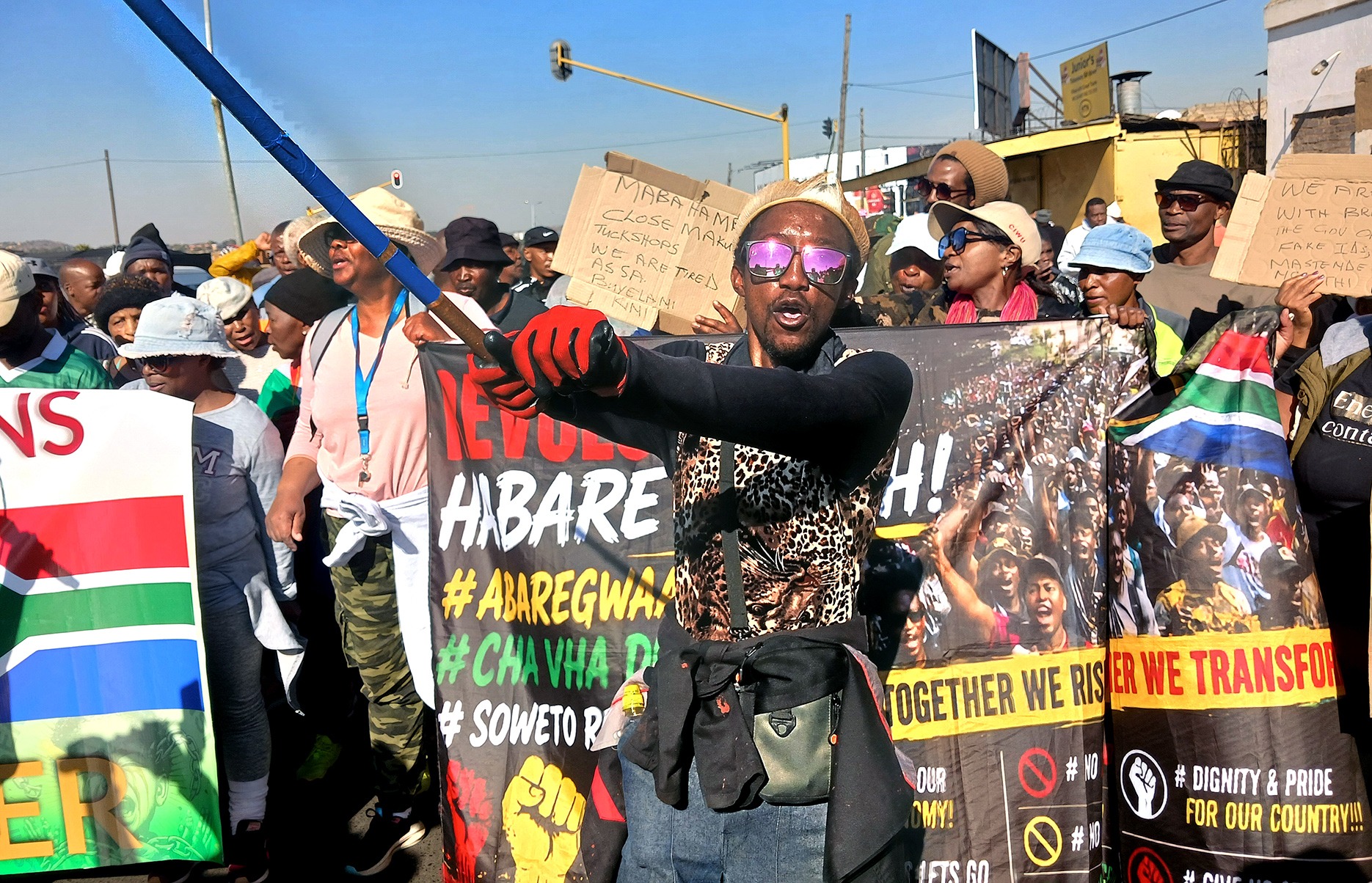
 Soweto demonstrators protesting against undocumented migrants march to the Diepkloof Police Station on Thursday, 9 July 2026. (Photo: Bheki Simelane)
As the second phase of weekly Thursday anti-migrant protests begins, a new trend has emerged. The broad coalition of March and March, the Labour and Civic Organisation (Laco), the All Truck Drivers Forum and others have become labour inspectors.
This phase of the protests includes factory visits by march organisers to inspect for foreign-nation employments, the closure of spaza shops and meetings with managers to insist that South Africans are hired instead.
The government has repeatedly said such actions are illegal, but the marches are now so regular and so dispersed that the police seem unable or unwilling to stop inspections and forced meetings organised under a broad umbrella movement to support a six-month campaign running up to the national election.
On Thursday, 9 July, marchers in Alexandra went factory-to-factory, visiting the light industrial area of Marlboro, insisting on in-loco inspections. Factories were forced to close and images showed nervous employees behind shut gates. Marchers armed with traditional weapons were threatening, but not visibly violent.
In the lead-up to the 30 June protests, marchers in Ekurhuleni’s industrial hubs, including Boksburg, Springs and Benoni, staged multiple demonstrations, moving from business to business, carrying golf clubs, knobkerries and sjamboks, demanding they sack foreigners. The practice now appears to be widespread.
/file/attachments/orphans/MARCH21_817653.jpg "Anti-foreigner protesters marched to companies alleged to be employing foreign nationals in the Boksburg and Benoni areas on Monday, 8 June 2026. Some companies refused to open their gates. (Photo: Leon Sadiki)")
From the streets to the boardroom
In one video posted on Facebook on Tuesday, 7 July, by Laco leader Mlungisi “Inkinga KaMancinza”, members of the organisation can be seen in a boardroom speaking to people who appear to have managerial roles in a company. In it, Laco members say that they don’t want any of the stands in the lot being let to foreign nationals.
“We will bring South Africans who are willing to work at those stands. We don’t want any foreign nationals there because they are not bringing anything. They are here to take, so we don’t want them any more. And we want that to happen as we leave today,” says a man in the video who appears to be Mlungisi.
He adds that they expect the stands operated by foreign nationals to either cease operations or be operated by South Africans instead, by the time they leave. He also wants to know the number of foreign nationals employed by stores in the area.
“To make it clear, we are not extorters of money. We don’t want your money. We just want this thing to be about South Africans that will take over any business to make sure they are working and feeding their families. Whoever is not a South African, we don’t want them,” he says.
Daily Maverick contacted Laco secretary-general Nhlanhleni Zimu, who confirmed that the video was taken in City Deep industrial park on 17 June at a meeting between Laco and representatives from the Johannesburg Social Housing Company (Joshco), which owns commercial properties in the area.
Joshco is a City of Johannesburg-owned municipal entity. Zimu said Laco visited the site after they had received tip-offs that foreign nationals were being prioritised for employment opportunities over South Africans.
Zimu insists that the action was specifically aimed at undocumented foreign nationals.
“We don’t just say ‘fire people’. We are speaking about people who are illegal in South Africa and who should not be found in any place of work. So any employer who’s harbouring them is on the wrong side of the law,” she said.
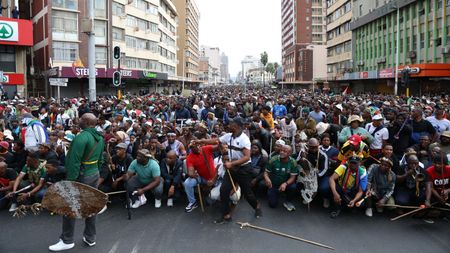
When asked how Laco verified whether foreign nationals were documented or not, she said that they didn’t check documents, as they believed their legal status was already known to the community.
“We don’t need to check. These people are part of different communities. They are renting in townships where they are integrated with South Africans, and they are dating our sisters. They have kids with our sisters. So we already know. Before we visit the company, we even get to know the names of the foreign nationals who should not be there in the company.”
Zimu said that Laco had been targeting companies once they received numerous tip-offs from community members that the companies were hiring undocumented migrants. They use the information they received from tip-offs to inform their next course of action.
With some businesses, their actions are limited to phone calls and sending emails demanding the firing of any undocumented migrants employed at the company. With others, Laco marches to offices. If the company doesn’t comply, the organisation takes their action a step further, including blocking allegedly undocumented employees from accessing the premises.
The companies are also reported to the Department of Labour, although Laco does not consult the department or Home Affairs during their engagements with businesses.
/file/attachments/orphans/IMG_2921_732432.jpg "Anti-foreigner marchers in Alexandra head to Marlboro during a protest on Thursday, 9 July 2026. (Photo: Salim Nkosi)")
The South African government has repeatedly clarified that only authorised officials, including police officers, may enforce immigration law. Zimu agrees that enforcement is the government’s responsibility, but argues that the institutions responsible for enforcing the law repeatedly fail to do so.
When Laco tried to report a Sandton-based businessman for allegedly employing more than 100 foreign nationals, the police refused, telling them to go to the Department of Home Affairs. She says Laco had submitted a memorandum to both Home Affairs and the Department of Labour and was still waiting for a response.
“We were not supposed to be on the ground in the first place, because there are institutions that are supposed to be dealing with such problems.
“But because these institutions are not working, they are taking bribes. That is why now we are confronted with this situation,” she said.
Daily Maverick asked Joshco for comment, but had received no response at the time of writing.
Assault in Alex
A march through Alexandra that began under strict instructions to remain peaceful on Thursday had, within hours, descended into mob violence. Residents stopped and interrogated street vendors, assaulting them and scattering their stock.
Homes were broken into, with at least one man beaten until he bled from the head, as marchers forced out people they identified, often wrongly, as undocumented foreign nationals. Marchers defended the action by saying foreign nationals had no right to sell goods in the community and should return to their countries of origin.
Law enforcement joined the march hours after it had already begun, by which point multiple street vendors had been assaulted, their stock scattered on the ground.
/file/attachments/orphans/IMG_3197_217501.jpg "Marchers in Alexandra on Thursday, 9 July 2026, broke into a house and manhandled someone they believed was an undocumented foreigner committing crimes. (Photo: Salim Nkosi)")
/file/attachments/orphans/IMG_2902_998958.jpg "Anti-foreigner marchers in Alexandra dismantled informal traders’ stalls during a protest on Thursday, 9 July 2026. (Photo: Salim Nkosi)")
Among them was a woman selling cooked food alongside her daughter. Marchers surrounded the pair and concluded, on the basis of her accent, that she was foreign. They tore down her stall without giving her a chance to explain herself. Her pots were thrown on to the pavement, her table confiscated, and she was warned not to return.
Speaking to Daily Maverick on condition of anonymity, she described the panic of the moment: “I feel humiliated and helpless. We were not given a chance to explain ourselves. My daughter is crying and scared because she saw her mom being grabbed violently. We are making an honest living.”
The violence escalated further. Morris Musa Mukhari, 40, originally from Tzaneen in Limpopo, was heard speaking Xitsonga, a language common in both Limpopo and Mozambique. Mukhari said a group of marchers carrying sticks and chanting that “all foreigners must return home” forced their way into his house, demanded to see his identity document to prove his citizenship, and manhandled him when he could not immediately comply.
“They forcefully entered my house where my child and wife were and intimidated my family,” Mukhari told Daily Maverick.
“My wife and daughter are now scared because of how they grabbed me by my clothes and took me outside the house. They want to see my identity document because I don’t speak their language. I’m being labelled a foreigner whereas I am South African from Limpopo. The police are not even doing anything. When I demand the names of the leaders, no one wants to reveal themselves. No one has a right to come inside a person’s house and do as they please.”
/file/attachments/orphans/IMG_3129_939118.jpg "Marchers break into a house they suspect houses an illegal foreign national. (Photo: Salim Nkosi)")
/file/attachments/orphans/IMG_2935_673777.jpg "Protesters loot a stock of fruit owned by a street vendor as they march to the shopping centre in Alexandra. (Photo: Salim Nkosi)")
Osvaldo Covane, a 29-year-old man from Mozambique, said, “I was walking to the mall when I was approached by the crowd. They asked my name and started chasing me around the neighbourhood. One guy knocked my head with an iron stick, and I started feeling dizzy,” he said, bleeding from the head.
Covane confirmed that he was in the country legally and held his passport up to prove this to the marchers as they continued to assault him.
Marchers continued to knock on doors throughout the neighbourhood and, in several cases, break into homes outright, forcibly removing residents they identified, using criteria that remain unclear, as undocumented.
Some were taken directly from their homes and handed to police vans stationed nearby, raising a pointed question about the extent to which law enforcement was cooperating with, rather than policing, a process that had by then involved assault and forced entry into private homes, carried out by civilians.
Eviction in Soweto
In Soweto, marchers delivered a memorandum to the Diepkloof Police Station on Thursday before they began removing foreign spaza shop owners from the area. They first targeted a shop near the police station.
The South African landlord who lets the shop to a migrant said he had been trying to evict his tenant. He then went to the police station and submitted an affidavit that said he “hereby declare[s] that I requested the tenant at the spaza shop to vacate and he is not complying. I therefore request the assistance of the SAPS and the community to remove him with immediate effect”.
The marchers then began removing stock from the store. The store owner, who gave only his first name, James, said, “They just come here and break into my store. They break into my shop. They break my door…”
He complained to SAPS about the situation.
/file/attachments/orphans/20260709_134313_956802.jpg "A foreign shop owner identified only by his first name, James, registered a complaint with the police after he was ousted from the spaza shop he operated and had his stock removed during a march in Diepkloof, Soweto, on Thursday, 9 July 2026. (Photo: Bheki Simelane)")
As stock was being removed from the store, a group of about 25 foreign shop owners, mostly from Somalia, gathered metres away, saying they were afraid and wanted to see what happened to their fellow store owner.
A leader of the march warned that the action should be orderly, adding, “This is our first operation.” DM
Comments
Scroll down to load comments...