




 Illustrative image | Ogalaletseng Gaarekwe, Deputy Director-General of Intergovernmental Relations. | Jan Hattingh, Chief Director Local Government Budget Analysis. | Khensani Makaneta, Director of Municipal Finance Management Act Regulatory Oversight. (Photos: Ntswe Mokoena / GCIS)
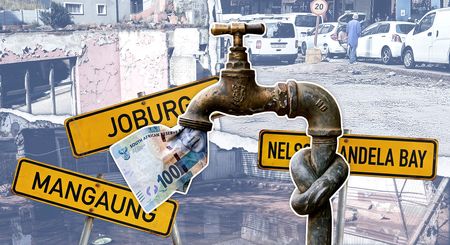
A follow-up briefing following the Treasury’s announcement this week that it would withhold R13.5-billion in July equitable share transfers from 69 municipalities made clear that it is trying to walk a narrow line: force municipalities to pay Eskom, water boards, pension funds, SARS and the Auditor-General, without becoming the villain that residents blame when services fail.
The department’s senior officials insisted the decision was not a punishment, but a last-resort compliance measure under section 216(2) of the Constitution. This follows the Treasury’s statement on Monday, 6 July 2026, that the affected municipalities had persistently failed to comply with the Municipal Finance Management Act, despite repeated support, circulars, training and direct engagements.
“With regards to how much, we’ve only withheld R13.5-billion, and you can imagine obviously the overall equitable share of municipalities is for this new financial year R110-billion,” Ogalaletseng Gaarekwe, the Treasury’s deputy director-general of intergovernmental relations, told journalists.
The money was due to flow on Wednesday, 8 July. The Treasury said the next equitable share transfers were scheduled for December and March.
Gaarekwe clarified that the Treasury was not saying the money was gone. The message was more along the lines of Treasury wanting to see paperwork, payment plans and proof of payments before further funding flows.
The affected municipalities fall into several broad categories. Some have adopted unfunded budgets. Some owe bulk suppliers and statutory creditors. Others have failed to address unauthorised, irregular, fruitless and wasteful expenditure, or have failed to implement consequence management.
The July action follows letters sent to 99 municipalities on 22 and 23 June. The Treasury said 30 municipalities responded in a way that satisfied the department, leaving 69 on the final withholding list.
Government debt
The Treasury is also pushing back against the argument that national and provincial departments are themselves guilty of failing to pay municipalities.
Gaarekwe confirmed that national departments were sent letters in February, while provinces were sent letters in April, warning them to pay municipal accounts or face similar withholding action. She said provinces had responded by 29 May, but many amounts were disputed.
The Treasury’s position is that disputed debt cannot be allowed to sit indefinitely in the municipal financial statements.
“What the minister has made clear [is] that even with the disputed amounts they need to deal with that within three months, so we cannot be disputed forever,” Gaarekwe said.
/file/attachments/orphans/OgalaletsengGaarekwedeputydgintergovernmentalrelations_274948.jpg "Ogalaletseng Gaarekwe, Treasury’s deputy director general for intergovernmental relations. (Photo: Ntswe Mokoena/GCIS)")
For municipalities that owe Eskom, water boards, pension funds, SARS or the Auditor-General, the condition is fairly simple: submit a signed payment agreement with the creditor. The Treasury will then release a portion of the withheld money so that the municipality can make the agreed payment. Once proof of payment is provided, the balance can be released.
Jan Hattingh, chief director for local government budget analysis, said the action was partly aimed at preventing the collapse of critical bulk suppliers.
“I’m sure that you’ve seen in the media, and the minister of water and sanitation has reported this, as a result of this action that we’ve done jointly with the Department of Water and Sanitation, two water boards that [were] on the brink of being closed… this process has helped and facilitated that those two water boards are still operational now,” Hattingh pointed out.
Strongest argument
This is the Treasury’s strongest argument – if municipalities do not pay water boards, the risk to service delivery is not theoretical.
Hattingh also pushed back against suggestions that the withholding was based only on the Auditor-General’s latest local government audit report. He said the AG’s report was important, but arrived after the financial damage was already done.
“When the Auditor-General report is released, the general report, it’s after the event. So, what we are trying to facilitate as part of this process… [is] that the municipalities must table a funded budget,” Hattingh said.
He said adopting a funded budget was a legal requirement under section 18 of the Municipal Finance Management Act. In practice, an unfunded budget meant there was not enough cash to back the spending side of the budget.
/file/attachments/orphans/JanHattinghchiefdirectorlocalgovernmentbudgetanalysis_706198.jpg "Jan Hattingh, Treasury’s chief director of local government budget analysis. (Photo: Ntswe Mokoena/GCIS)")
Hattingh said the Treasury already published municipal financial performance, conditional grant performance and cash-flow information quarterly under section 71 of the act.
“As part of a section 71 quarterly publication, we publish… the financial performance as well as conditional grant performance… the cash flow statements [are] included as part of that publication,” he said.
Khensani Makaneta, director for Municipal Finance Management Act regulatory oversight, focused on consequence management, saying that unauthorised, irregular, fruitless and wasteful expenditure should be referred to disciplinary boards, which must investigate whether officials acted intentionally or negligently.
“Consequence management is supposed to be implemented by the municipal council based on the recommendations of the disciplinary board,” Makaneta said.

While the Treasury could withhold funds, demand payment plans and issue circulars and warnings, the reality was that municipal councils remained responsible for acting against mayors, municipal managers, CFOs, officials and councillors implicated in financial misconduct.
Makaneta said the Treasury had been running provincial roadshows to help councils and municipal public accounts committees understand how to reduce unauthorised, irregular, and fruitless and wasteful expenditure and process it legally.
“We just concluded a few provincial roadshows… where we [took] councillors, particularly your municipal public accounts committees [and] officials, through the process of actually, from the start, how do you reduce unauthorised, irregular, fruitless and wasteful expenditure?” she said.
She added that in cases where fruitless expenditure resulted from something as basic as a duplicate payment to a supplier, recovery must take place so that the money could be redirected to service delivery.
What about the service delivery impact?
The service delivery question remains the sharpest one.
The Treasury says it does not expect the temporary withholding to affect residents because municipalities raised the bulk of their money from own revenue. Gaarekwe said local government budgets were about R750-billion in the previous financial year, while national transfers were below R200-billion.
That may be true across the system, but it will not comfort residents in municipalities with weak cash cover, unpaid creditors and already failing services. In Johannesburg, for example, the Treasury confirmed that R3.6-billion is being withheld. Questions were raised during the briefing about the City’s limited cash cover and whether the hit could affect its credit rating.
The Treasury’s answer was that municipalities must comply quickly. The faster they did, the faster the money flowed.
This is the hard truth. The National Treasury is trying to correct a culture in which councils adopt budgets they cannot fund, deduct money from workers and fail to pay it over, ignore creditors, delay payment to bulk suppliers and then ask residents to believe the crisis is someone else’s fault.
The risk is that ordinary residents become collateral damage in a fight between the Treasury and councils that have had years to do the basics.
The counter-risk is worse: if the Treasury backs down, municipalities walk away believing that non-compliance still has no consequences for those failing to meet their responsibilities. DM
Comments
Scroll down to load comments...