




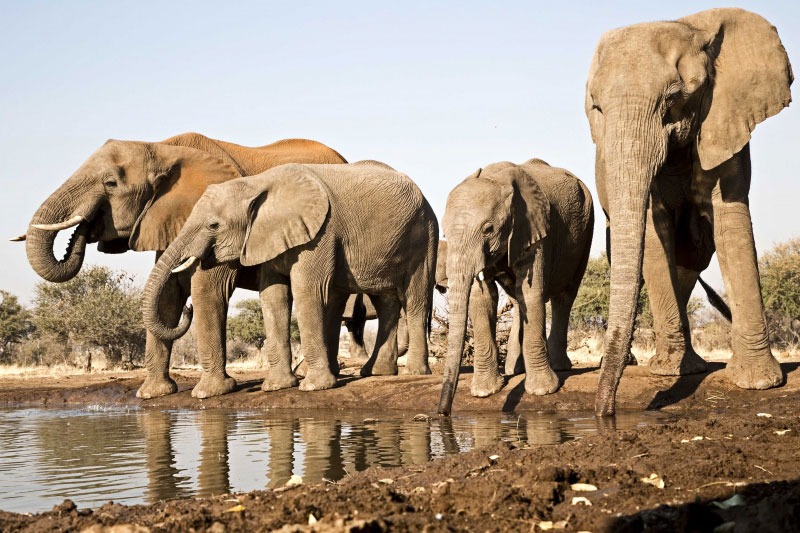
 Recent mortality records hard won from the Kruger Park provide the first comprehensive glimpse into elephant deaths recorded between January 2020 and December 2025. (Photo: Mike Kendrick)
For more than a century the African elephant has occupied a unique place in South Africa’s conservation imagination. It is our largest land mammal, a keystone species that shapes ecosystems, a major drawcard for tourism and perhaps the single most recognisable symbol of the Kruger National Park. Few animals have generated as much scientific debate or public emotion.
That debate has often centred on numbers. Are there too many elephants? Are they transforming woodlands? Should populations be controlled? Should culling ever return? These questions have divided scientists, conservationists and policymakers for decades.
/file/attachments/orphans/Elephant-baby-and-family-Francis-Garrard_767027.jpg "The grudging release of previously undisclosed mortality data from the Kruger National Park offers a rare glimpse into how elephants are dying. (Photo: Francis Garrard)")
What has received remarkably little public attention is a different question: how many elephants actually die in Kruger every year, and why?
Until now, the answer has been surprisingly difficult to obtain.
Recent mortality records hard won from the Kruger Park provide the first comprehensive glimpse into elephant deaths recorded between January 2020 and December 2025. The database, maintained as part of the international Monitoring the Illegal Killing of Elephants programme under the Convention on International Trade in Endangered Species, documents 951 elephant mortalities over the six years.
These figures entered the public domain only after a formal request was submitted under the Promotion of Access to Information Act in March this year. Four months later, SANParks has provided only a partial response, with significant portions of the requested information still outstanding.
Yet the published figures are revealing.
Of those recorded deaths, 535 were classified as natural mortalities, while 179 resulted from illegal causes, primarily snares and gunshots. Both findings are perhaps unsurprising. Kruger supports one of Africa’s largest free-ranging elephant populations, and deaths from old age, drought, disease and natural conflict are expected. Likewise, despite significant anti-poaching efforts, illegal killing remains an ever-present reality.
But another figure deserves far greater scrutiny. The database records 207 elephant deaths under the category “Management”.
/file/attachments/orphans/AtthewaterholeColinBell_448625.jpg "For much of the 20th century, Kruger actively controlled elephant numbers through culling. (Photo: Colin Bell)")
The category that explains almost nothing
At first glance, “Management” sounds vapidly administrative. Yet the database provides almost no explanation of what the term actually encompasses.
Were these elephants euthanised after catastrophic injuries? Destroyed because they posed an immediate danger to people? Classified as problem animals following repeated conflict? Put down for veterinary reasons? Managed under specific ecological interventions? The records do not say.
Instead, we are presented with a classification, not an explanation. Protected areas are not simply landscapes; they are public institutions exercising public authority. Decisions to deliberately destroy protected wildlife are among the most consequential actions conservation agencies can take. They demand scientific justification, legal authority and ethical scrutiny. Without context, however, “Management” becomes less a description than a placeholder.
/file/attachments/orphans/Elephant-baby-steps-Francis-Garrard_404605.jpeg "Kruger’s elephants are held in trust for the people of South Africa. (Photo: Francis Garrard)")
From culling to adaptive management
The history makes these questions even more important. For much of the 20th century, Kruger actively controlled elephant numbers through culling. Managers believed that reducing elephant populations was necessary to protect trees and maintain biodiversity. Between the 1960s and 1994, many thousands of elephants were culled in what became one of the largest lethal wildlife management programmes in Africa.
That policy ended in 1994 amid growing ethical concerns and changing ecological understanding.
Since then, South African elephant management has shifted towards adaptive management – recognising that ecosystems are dynamic, that elephant populations fluctuate naturally and that intervention should be exceptional rather than routine.
At least in principle. Today, debates around elephant management have returned with renewed intensity. Across southern Africa, proposals for renewed culling, expanded trophy hunting and greater utilisation of wildlife are once again being advanced as conservation tools. Against that backdrop, understanding how and why elephants die becomes more important than ever.
/file/dailymaverick/wp-content/uploads/2025/11/pinnockZimtourism.jpg "The newly disclosed mortality records offer an important glimpse into one of Africa’s most significant elephant populations. (Photo: Vince O’Sullivan / (flickr)")
Numbers without reasons
Mortality statistics are valuable. They help scientists understand patterns, identify threats and assess long-term trends. But numbers alone cannot explain decisions. A spreadsheet recording 951 elephant deaths tells us what happened. It does not tell us why particular management interventions occurred, who authorised them, what alternatives were considered or whether independent oversight was exercised.
Those questions are not academic. Kruger’s elephants are held in trust for the people of South Africa. Decisions affecting them are exercises of public power and should therefore be open to public scrutiny.
Transparency does not mean reluctantly releasing partial data in isolation. It means providing sufficient information for citizens, scientists and policymakers to understand how decisions were made and whether they were justified.
The value of asking difficult questions
None of this implies that the 207 management deaths were inappropriate. Indeed, many may have been entirely justified. Injured elephants sometimes require euthanasia. Veterinary interventions are occasionally unavoidable. And it could also mean culling.
However, the point is not to presume wrongdoing. The point is that public confidence in conservation depends not simply on good decisions, but on decisions that can be understood and, where necessary, challenged.
Conservation has changed profoundly over the past three decades. Increasingly, it is recognised that managing wildlife is not simply a biological exercise but a democratic one. Public institutions no longer enjoy unquestioned authority simply because they invoke science. They are expected to explain themselves. That expectation is neither unreasonable nor hostile to conservation. It is essential to it.
Beyond the spreadsheet
The newly disclosed mortality records offer an important glimpse into one of Africa’s most significant elephant populations. They reveal the scale of natural mortality, the continuing toll of illegal killing, and the existence of a substantial number of management-related deaths that have received little public discussion.
But they also reveal something else. They remind us that conservation is ultimately about more than counting animals. It is about the decisions made in their name, the values that shape those decisions, and the willingness of public institutions to explain them.
The database tells us that 951 elephants died. The more important question is whether South Africans will ever be told the full story of why. DM


Comments
Scroll down to load comments...