




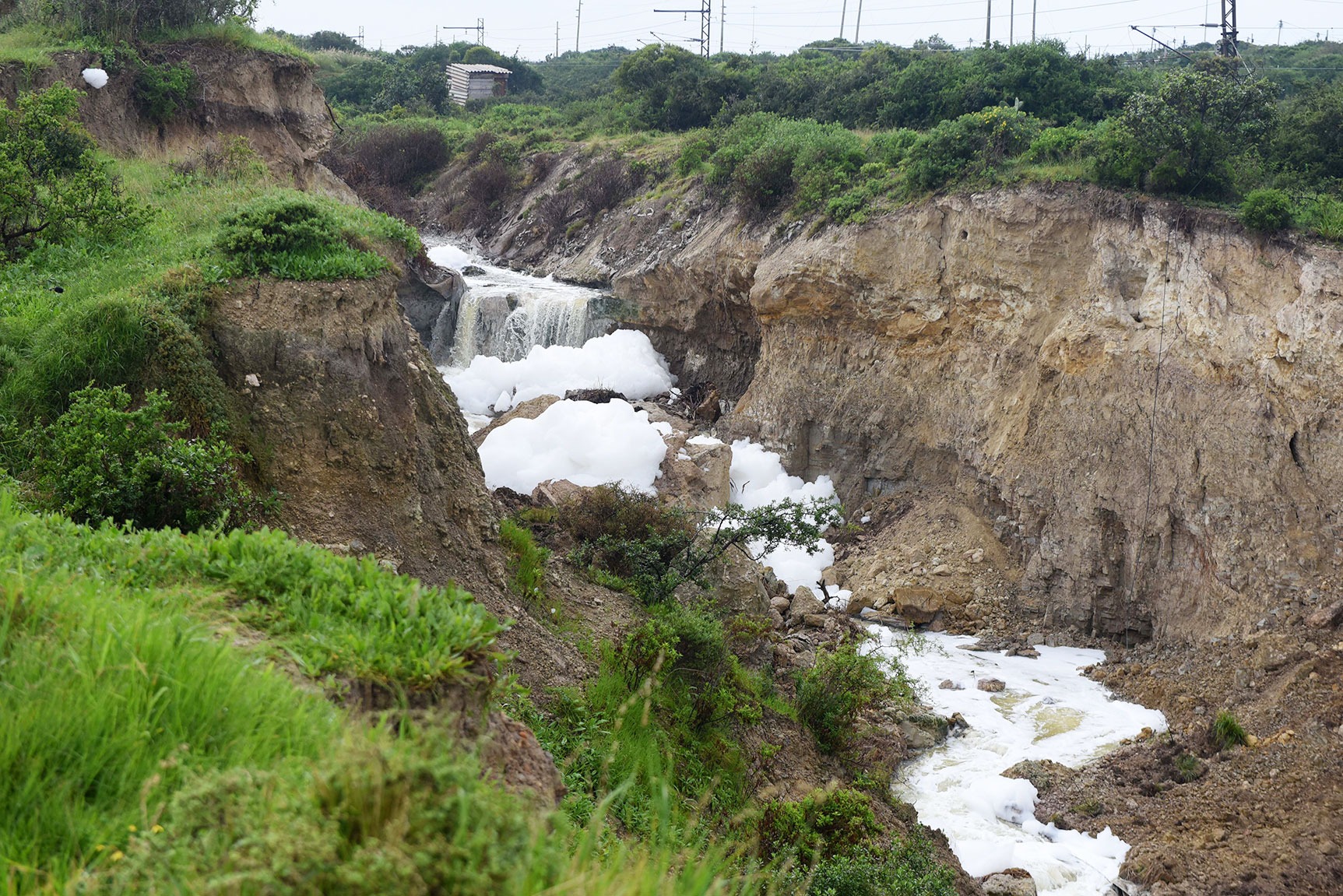
 Gqeberha residents believe this area could be the source of a suspected sewage leak in the Markman Canal. A strong, foul odour hangs over the area. (Photo: Deon Ferreira)
 For the residents of the Aloes community in Gqeberha, it is a sharp chemical stench that never goes away.
It is there when they fall asleep, and in the morning, the stench drifts through their community from the industrial canal that snakes through the settlement on the northern outskirts of the city.
The persistent smell has residents fearful for their health.
The waterway is the murky Markman Canal, which carries run-off water from the Markman industrial area and empties into the Swartkops Estuary.
Families suspect the foul odour is being caused by suspected pollution and repeated sewage contamination.
“When we go to bed the strong smell is there, and when we wake up in the morning it is also there,” said resident Eileen Leander, whose kitchen door opens on to the canal.
Leander and her neighbour, Patricia Olifant, say they have been fighting for answers from the Nelson Mandela Bay Municipality, their ward councillor and environmental authorities. They believe the canal is making people sick.
/file/attachments/orphans/Photo-5-1_552115.jpg "Eileen Leander crosses a footbridge over the canal, which residents say reeks of sewage. During periods of strong flow, schoolchildren and other residents are often unable to use the bridge. Leander and members of her community are worried about the potential health risks posed by the suspected sewage leak. (Photo: Deon Ferreira)")
Leander and Olifant describe a “forgotten” community where residents suffer persistent coughing, headaches, respiratory illnesses and unexplained skin conditions. No authority has confirmed that these illnesses are linked to pollution in the canal.
“Our health is in jeopardy. Many people complain about severe headaches because of the strong smell. Children have to be kept away from the water,” said Leander.
She recalled a child developing painful blisters and sores after entering the canal. “Dogs also get sick and die after drinking that water. If a dog can die from it, what could happen to people?”
Leander said she had never suffered from asthma before moving to the area. “I never had an asthma pump, but now I have one. I wasn’t born with asthma. People cough a lot. They complain about TB, chest infections, and people [have] died.”
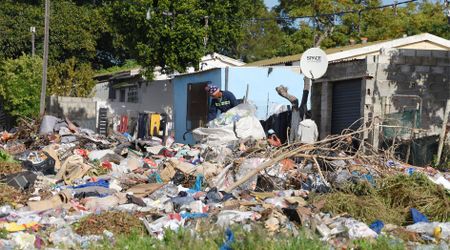
She said many residents regularly complained of chest infections, persistent coughing and tuberculosis – although tuberculosis is caused by a bacterial infection and not linked to pollution.
“People are always sick. Every Wednesday, the clinic is full of people from here. We don’t know what breathing this air every day is doing to us.”
Across the community, Olifant said the smell had become part of everyday life, but that had not made it any easier to endure.
“We have so many problems here, and one of them is this awful smell,” she said.
“The children get very sick and cough a lot. We adults also struggle to breathe because of the foul smell that hangs in the air.
“My grandchild is very sick with the flu. How are we expected to live with this canal?” she asked.
/file/attachments/orphans/Photo-1-1_180702.jpg "Patricia Olifant, a resident of the Gqeberha’s Aloes community in the Swartkops area, says it is unpleasant living next to the canal because a constant foul smell hangs over the area. (Photo: Deon Ferreira)")
During a visit to the area, Leander took this reporter to a discharge point about a kilometre upstream from the settlement, opposite a waste management facility.
There, thick white foam floated across the water’s surface. The canal ran an unusual beige colour and a pungent odour – reminiscent of the one permeating from the Fishwater Flats Wastewater Treatment Works – hung thick in the air. The odour caused my eyes to water, and the smell lingered in my nostrils long after leaving the area.
“What struck me from my previous visit, and still does, was the foam,” Leander said while pointing towards the outlet.
“When I see foam, I get extremely concerned. There are manganese trucks being washed in Markman, and all that waste comes down this canal before passing our homes.”
/file/attachments/orphans/Photo-4-1_632700.jpg "Residents believe this area could be the source of the suspected sewage leak. A strong, foul odour hangs over the site. (Photo: Deon Ferreira)")
The source of the discoloured water remains unknown.
Operations manager at the Zwartkops Conservancy, Femke de Wet, said the organisation had been monitoring both the Markman and Motherwell stormwater canals and conducted water quality testing in the Swartkops Estuary whenever funding permitted.
She said conservancy officials collected water samples in May after noticing unusual discolouration in the Markman canal.
Although laboratory results did not detect heavy metals, they did reveal elevated chloride levels.
According to De Wet, those chloride levels are probably associated with naturally occurring soil conditions rather than industrial pollution.
“However, the testing undertaken was only preliminary, and more comprehensive chemical analysis is required to identify the substance responsible for the unusual appearance of the water,” she said.
She cautioned that it would be premature to conclude whether the canal posed a direct health risk.
“Until more detailed chemical analysis has been completed, it would be inappropriate to speculate. We do, however, encourage authorities to investigate the matter urgently to determine whether any risks exist for nearby communities and the environment.”
/file/attachments/orphans/Photo-3-1_133758.jpg "Residents of the Aloes community in the Swartkops area of Gqeberha again expressed concern on Thursday, 28 June 2026, about a suspected sewage leak flowing into a canal that runs through their community. An overpowering foul smell hangs over the area from where residents believe the contamination originates. (Photo: Deon Ferreira)")
What could be confirmed, she said, was the impact the canal had on residents’ quality of life.
“It is an unacceptable situation.”
De Wet said the “foul odour” was most probably linked to periodic sewage discharges into the Markman stormwater canal rather than the unidentified substance causing the water’s unusual colour.
She said extensive sewer infrastructure failures had affected the Markman area for months, with repair work most recently observed on 24 June.
“Interestingly, during patrols when sewage inflows were not evident, but the unusual water discolouration remained present, the odour from the water itself appeared to be less pronounced.
“This suggests that the sewage pollution and the suspected chemical contamination may be separate issues that require independent investigation.”
Discolouration
De Wet said that since May they had repeatedly observed an unusual white discolouration in the water that was inconsistent with typical sewage pollution.
She said the change in water colour became apparent at a steep, eroded section of the Markman Canal. Upstream of this point, the water appeared to be relatively clear. After flowing down the steep slope, the water turned white.
“However, this does not necessarily mean that the pollutant enters the canal at that exact location. The turbulence created as the water flows down the slope may simply cause a contaminant already present in the water to become visible through foaming or emulsification. A foul odour has also been noted in this area, although it is difficult to determine whether it originates from the water itself or from surrounding activities,” De Wet said.
According to De Wet, they could not at this point identify the substance responsible for the discolouration.
She said they had documented periodic sewage contamination entering the canal. More recently, said De Wet, during periods when no active sewage inflow was observed, they recorded persistent white discolouration, increased foaming and a waxy yellow residue accumulating on rocks within the canal.
‘Additional contaminant’
“These observations suggest that an additional contaminant may be present, but further laboratory testing is required before any conclusions can be drawn,” De Wet said.
She said the source of the suspected contaminant had not yet been identified.
While sewage discharges could usually be traced to specific inflow points, she said the suspected chemical contamination was more difficult to pinpoint through visual observation alone.
Possible sources include industrial effluent, groundwater seepage or runoff from neighbouring industrial properties, but these remained unconfirmed pending chemical analysis and source-tracing investigations, De Wet said.
Municipal response
Responding to questions, the Nelson Mandela Bay Municipality acknowledged residents’ concerns and said recurring sewage spillages were largely linked to severe flooding that affected the metro during May and June this year.
Municipal spokesperson Sithembiso Soyaya said officials had already inspected the affected site and work to address the sewage spillages was under way.
While De Wet said they had urged the municipality to conduct tests and further investigations, the municipality made no indication whether it would.
Soyaya said sanitation teams continued responding to incidents across the metro as resources allowed, with priority being given to spillages affecting residential areas, rivers, businesses and environmentally sensitive sites.
“The Municipality recognises the legitimate health concerns raised by affected residents and wishes to assure the public that these concerns are being treated with the urgency they deserve,” Soyaya said.
He said the municipality was working to minimise the impact of the spillages while longer-term rehabilitation of damaged sewer infrastructure continued across Nelson Mandela Bay.
Comprehensive testing urged
De Wet said the Zwartkops Conservancy’s primary concern was the health of both the Swartkops Estuary and the communities living alongside these waterways.
De Wet said no community should have to live with uncertainty about water quality, adding that the Swartkops Estuary should be safe for recreation and other public use.
She said while recurring sewage pollution in the estuary was well documented and had caused measurable environmental damage, the discoloured water, foaming and residue observed in the Markman Canal remained under investigation.
“We encourage the relevant authorities to prioritise comprehensive water quality testing, identify the source or sources of contamination, communicate findings transparently with affected communities and implement the necessary corrective measures as soon as possible.
“Protecting the Swartkops Estuary requires timely intervention, effective maintenance of public infrastructure and cooperation between government, industry, civil society and local communities.
“The Zwartkops Conservancy will continue to monitor conditions, report pollution incidents to the relevant authorities, and advocate for the protection of the Swartkops Estuary,” De Wet said. DM