




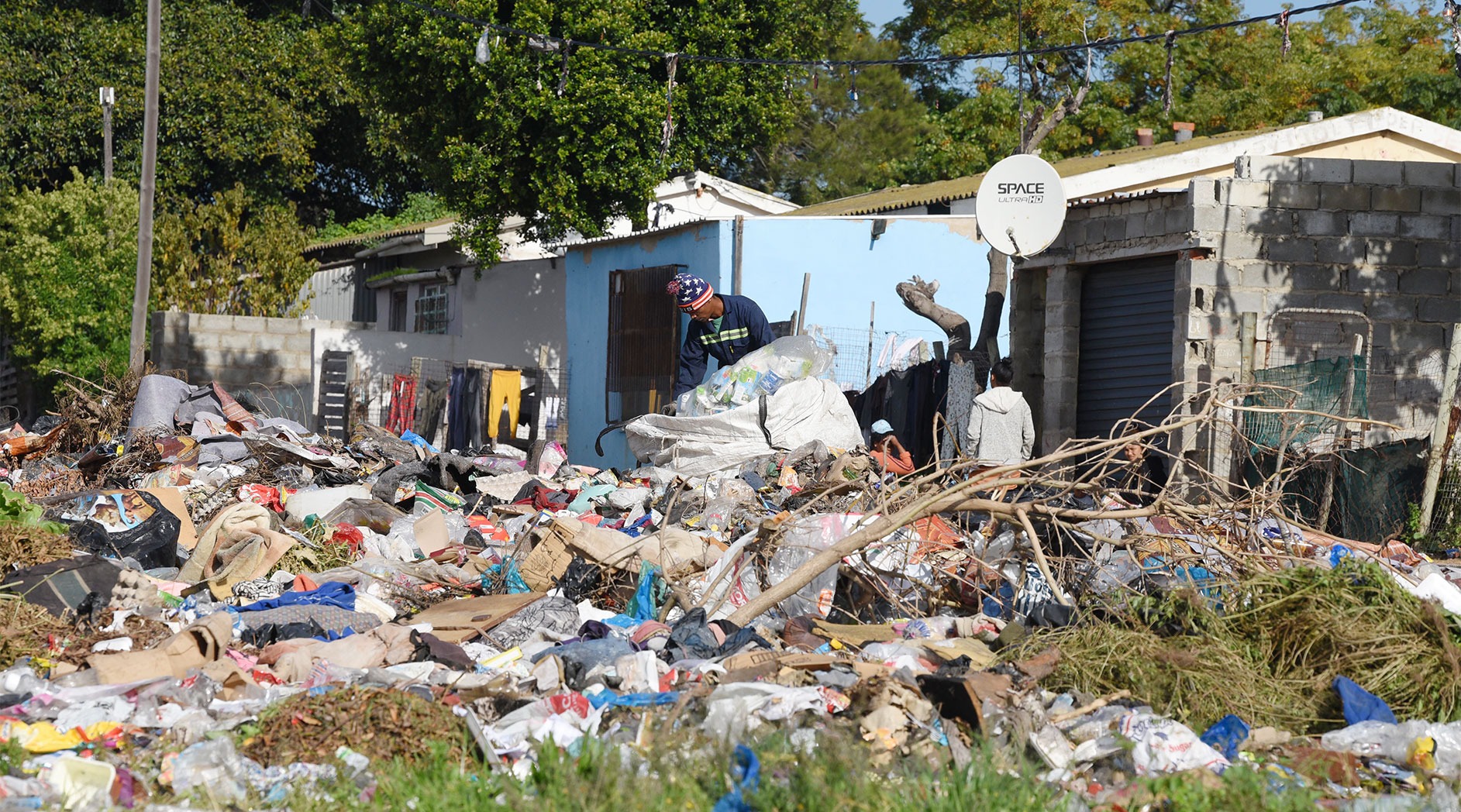
 A man searches through waste at an illegal dumping site in Gqeberha’s northern areas on 11 June 2026. Residents say sporadic refuse collection has contributed to the growing accumulation of waste in some neighbourhoods. (Photo: Deon Ferreira)
The pungent smell of rotting waste hits you before the rubbish comes into view. Then come the flies and gnats, swarming around mounds of uncollected refuse piled just metres from people’s front doors and the spaces where children play.
Residents in parts of Gqeberha’s northern areas, and across the city, say rubbish piles, foul odours and vermin have become part of daily life as illegal dumping and irregular waste collection continue.
For residents in Helenvale, the problem has become far more than an eyesore. They say the mounting uncollected waste poses a threat to their health, undermines their dignity and quality of life and persists despite repeated appeals to City officials for intervention.
/file/attachments/orphans/Photo-4_888577.jpg "Uncollected refuse that residents have been forced to dump illegally encroaches on to Link Road in Helenvale, Gqeberha. Residents say foul odours from the site have become a persistent problem, while waste has also contributed to blockages in the sewer system. (Photo: Deon Ferreira)<br>")
Kobus Road resident Cecily Vosloo, 76, said an illegal dumping site opposite her home has become a permanent neighbourhood feature due to erratic refuse removal.
“We have asked so many times for them to clean it up and for our refuse to be collected regularly to avoid this problem. Sometimes it takes close to three months before the municipality comes [to] do something about this dump. But while we wait, we have to look into this refuse,” she said.
When Daily Maverick visited the area recently, the dump site had been freshly cleared, much to the relief of residents. However, new piles of waste had already begun to accumulate.
Elsewhere, particularly along Gail Road, there were signs that efforts had been made to remove illegally dumped uncollected waste from pavements and open spaces. What was striking, however, was the absence of warning signage discouraging illegal dumping, as well as a lack of public waste bins along sidewalks, which residents say contributes to the recurring problem.
/file/attachments/orphans/Photo-6_483716.jpg "Freshly washed laundry hangs outside a home near an illegal dumping site in Helenvale, Gqeberha. Residents say foul odours from uncollected refuse have become a persistent problem. (Photo: Deon Ferreira)")
However, the problem is not just confined to the city’s northern areas. A drive through Central, Zwide and Motherwell reveals a similar pattern: illegal dumping sites spilling on to pavements and open spaces, stray dogs and livestock scavenging through piles of rotting waste, and rubbish strewn across streets and vacant land.
Vosloo said residents often resorted to dumping waste on open land due to inconsistent municipal refuse collection services.
“People do not have a choice but to dump their rubbish there because the municipality does not come and pick up our refuse. If we keep it on our properties for too long, that creates other problems for us,” she said.
Vosloo said the dumping site attracted rodents and led to constant litter problems for neighbouring households.
“When it is windy, all the papers from the dump blow against my fence. We even had to remove the barbed wire at the back because it looked terrible.”
/file/attachments/orphans/Photo-3_403469.jpg "Uncollected rubbish accumulates on vacant land between homes in Hartebeest Street, Helenvale, Gqeberha. Residents say inconsistent refuse collection has contributed to illegal dumping in the area. (Photo: Deon Ferreira)")
She said residents felt neglected by the municipality. “The municipality is making us live like pigs here.”
A short distance away, Theresa Burrell, 70, said the growing rubbish pile had begun spilling into Link Road itself.
Standing on the pavement with fellow residents just metres from the dump site, where a foul odour hung heavily in the air, she described the situation as increasingly dangerous.
“One day, we will find a dead child on that rubbish heap. It is not right that the rubbish just lies here in front of our houses. The people in the street put out their rubbish with the hope that the municipality comes and collects it, but they do not. That is when people take the rubbish to that dump. And so it goes on week in and week out,” a frustrated Burrell said.
Burrell said residents regularly begged municipal officials to remove the waste and improve refuse collection services, but the pleas were ignored.
She said household waste was not the only material that ended up on the site. “People throw dead dogs and all kinds of things on that heap, and then there is the very awful smell that you do not know if it’s a person or an animal … lying there.”
The consequences become particularly severe during warmer weather, she said.
“The gnats come into our houses when it is hot. When it gets hot, you can smell the foul odour hanging in the air. It can’t be good for our health to live like this. We cannot even open our doors or windows when it is hot. It is also not nice to invite people to your house when things look like this,” Burrell said.
Wildlife and Environment Society of Southern Africa (Wessa) Eastern Cape chair Dr Gary Koekemoer said the city’s waste challenges extended beyond individual dumping sites and pointed to broader systemic problems.
“The problem with waste management doesn’t lie with waste management; it lies with fleet management services,” he said.
Concerns over the City’s refuse fleet have been mounting. In April, Eyewitness News reported that recurring breakdowns and delayed repairs had left the metro with too few operational refuse trucks, prompting a change in procurement policy, requiring new vehicles to have maintenance plans because of fleet management failures.
Daily Maverick asked the municipality how many refuse trucks were operational and what was being done to improve fleet capacity, but these questions went unanswered.
Koekemoer said irregular refuse collection often led to a dependency on informal dumping points in communities, where waste accumulated until it was eventually collected.
He said the environmental consequences were significant.
“Wind and rain move that waste into watercourses. It blocks sewerage systems, stormwater drains and rivers.
“We have found plastic in mussels around the bay, and we know it is going into fish and into the food chain,” Koekemoer said.
He said microplastics entering ecosystems were linked to uncollected and poorly managed waste.
He said the City should place greater emphasis on recycling initiatives and separating waste at source.
While some pilot projects had been introduced, he said that these had not yet been expanded on a meaningful scale.
/file/attachments/orphans/Photo-1_800499.jpg "Expanded Public Works Programme personnel clean a street in Central, Gqeberha, on 11 June 2026. (Photo: Deon Ferreira)")
Koekemoer further raised concerns about the City’s long-term waste disposal capacity, saying Nelson Mandela Bay had only two landfill sites, which he believed were insufficient for a metro of its size.
Municipal spokesperson Mthubanzi Mniki did, however, say the municipality’s waste management programmes, implemented under the Cleaning and Greening Programme introduced by the Department of Environmental Affairs, Forestry and Fisheries, were progressing well.
Mniki said the municipality’s limited budget had to be shared among all departments, with increased focus placed on rebuilding infrastructure damaged by recent floods.
/file/attachments/orphans/Photo-5_537564.jpg "Building rubble and refuse bags on a sidewalk in Central, Gqeberha, on 11 June 2026. (Photo: Deon Ferreira)")
“The competing challenges within the municipality demand that the limited budget be shared amongst all directorates, with greater focus being directed towards rebuilding infrastructure affected by the recent floods.
“Another challenge is persistent threats to the safety and health of residents. We appeal to residents and businesses to stop illegal dumping.
“However, the Cleaning and Greening Programme requires the municipality to explore alternative and sustainable waste management solutions,” Mniki said.
According to Mniki, the municipality was exploring alternative and sustainable waste management solutions through partnerships with the private sector and non-government organisations.
“It must, however, be noted that theft, vandalism of waste management facilities like bins and transfer stations, and illegal dumping, redirect government budgets. The municipality therefore calls on residents to work together with the municipality in protecting these facilities and to] stop illegal dumping,” Mniki said. DM
Comments
Scroll down to load comments...