




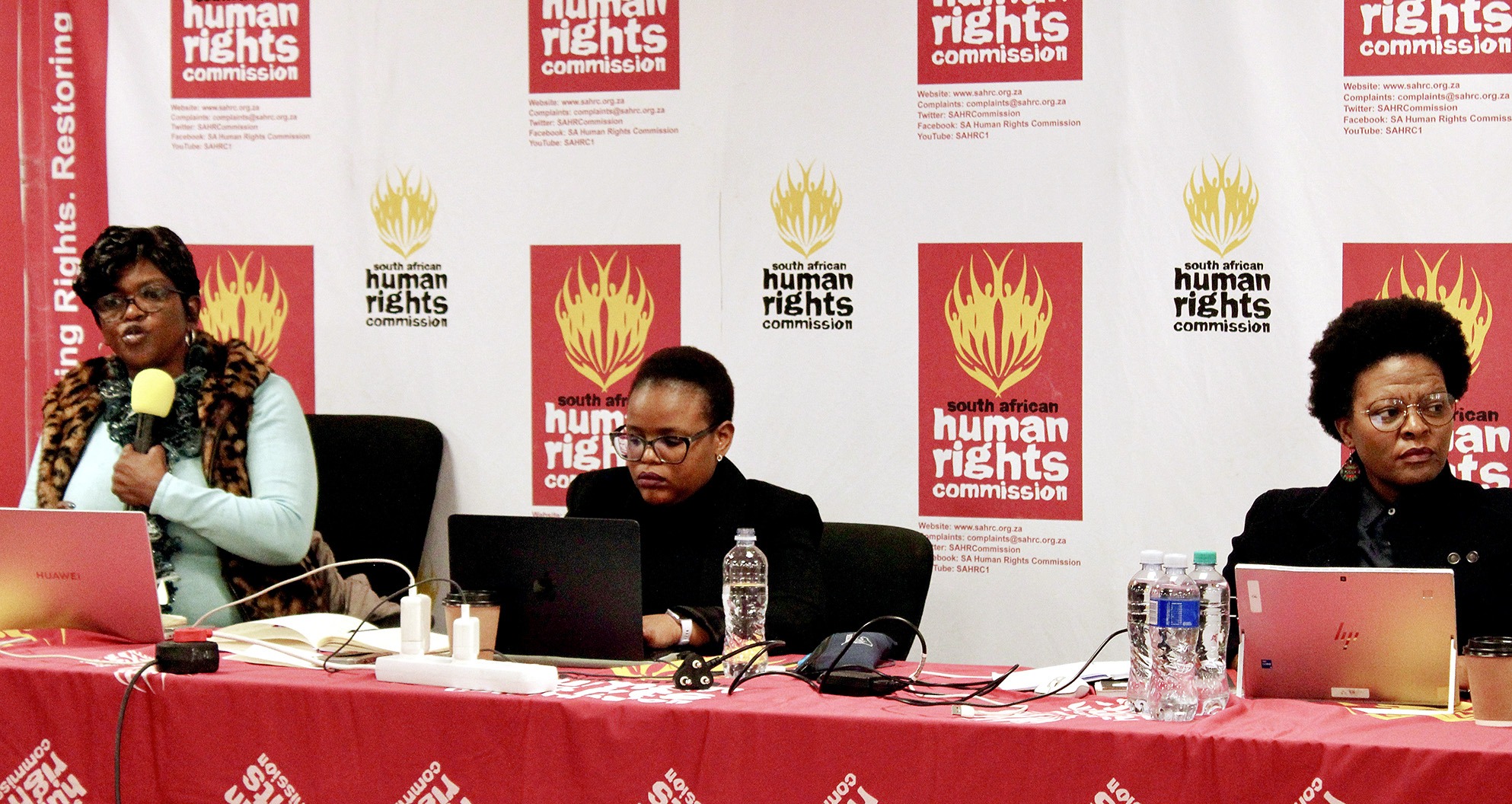
 From left: Commissioners at the South African Human Rights Commission hearings into hunger: Nomahlubi Khwinana, chairperson Sandra Makoasha and Philele Ntuli. (Photo: Lillian Roberts)
 The second leg of South African Human Rights Commission (SAHRC) hearings on food systems began on Monday, 6 July, with key agrochemical and beef companies noticeably absent.
As in the first leg of the inquiry, SAHRC commissioner Sandra Makoasha, the chairperson of the inquiry, expressed disappointment at those who failed to appear or provide submissions, and said the commission will announce steps and possible investigations by Friday.
Esther Padi, national organiser of the Union Against Hunger, said: “We are here ... because 20 million South Africans are not benefiting from this food system.” She said that when the private sector fails to testify, it renders the exercise void.
Meat manufacturing
Acting on behalf of the Sparta Group, a cattle feeding and beef processing facility, advocate Jacques Eastes said the group had applied for a postponement of its submissions. It did intend to comply, he said, but needed more time.
He said the SAHRC’s request was not a subpoena compelling the group to appear, but rather asking it to do so voluntarily.
/file/attachments/orphans/D979F51B-1549-40BB-85C5-5CB8571F3F89_1_201_a_333380.jpeg "Jacques Eastes speaks at the hearing on behalf of the Sparta Group. (Photo: Lillian Roberts)")
Makoasha responded: “As a Chapter 9 institution, there is a mandate that we have to perform, and when we send out invitations, we are asking public entities or corporations to assist us in fulfilling our mandate.”
Also notably absent from the scheduled proceedings were Schoeman Boerdery, the Congress of Traditional Leaders of South Africa, the National Agricultural Marketing Council and the Department of Cooperative Governance and Traditional Affairs.
‘Upstream’ agricultural suppliers
In a written submission to questions from the commission read by evidence leader Shirley Mlambo, the crop protection chemical company Syngenta said that as an “upstream agricultural” supplier, its primary influence on diet is through what is produced by farmers, not what is marketed to consumers.
On the issue of safeguards to prevent exploitative pricing of seeds, fertilisers and chemicals, Syngenta said it operates strictly within the law, and its prices are subject to market competition.
The company stated that it holds a minority market share, and that major players drive competitive pricing and the entry of new industry players.
Five agrochemical companies collectively controlled nearly half of South Africa’s agrochemicals market share in 2025.
Speaking to Daily Maverick on the sidelines, the CEO of GrainSA, Tobias Doyer, said: “Pesticide use is a dangerous technology that we use on farms. To do that effectively, [we must] ensure that the right safeguards are in place. Just as cockroaches, fungi and mould are killed in people’s homes, farmers use agrochemicals to protect crops.
“The key challenge is: how do we find better, safer, and softer solutions? A purely business-minded approach would be, if it’s cheaper and it works better, then the farmers will use it, but we need to maintain and adopt a bigger picture approach for the safety of society.”
/file/attachments/orphans/GrainSATobiasDoyerCEO_671292.jpg "The CEO of GrainSA, Tobias Doyer, testifies at the SAHRC inquiry. (Photo: Lillian Roberts)")
Daily Maverick previously reported that the Global Framework on Chemicals, to which SA is a signatory, has set a 2035 target to phase out highly hazardous pesticides where risks have not been managed, and no safe alternatives exist.
Grain farming
Doyer outlined the organisation’s massive footprint, representing 70% of South Africa’s grain industry and roughly 15,000 emerging farmers. He noted their primary focus spans major staple and oilseed crops, including maize, wheat, sunflowers and soybeans.
Evidence leader Dr Stephen Devereux criticised GrainSA for undermining food security by advocating for higher tariffs on imported grain. Doyer responded that GrainSA supports tariffs to protect local producers from subsidised international competition.
Devereux pointed out that GrainSA represents a mainly large-scale, white, male commercial farming system that perpetuates inequality, and questioned the level of transformation occurring in the system.
“The observation is very true and unfortunately still a reality in terms of the transformation that is required,” Doyer conceded. He added that there is a long way to go to ensure an inclusive rural economy.
Addressing GrainSA’s efforts to combat malnutrition and obesity, Doyer highlighted the delicate balance between food affordability and public health, arguing for market-driven solutions. He added that as corporate citizens, it is vital to engage in these debates to build a better South Africa.
Food manufacturing
Werna Oberholzer, Tiger Brands’ chief corporate affairs and sustainability officer, said the company views its food as fundamental to health, dignity and wellbeing — a principle that directly shapes how it manufactures and markets its products.
“It also reflects our belief that commercial success and positive social impact are not competing objectives but mutually reinforcing outcomes.”
/file/attachments/orphans/Tigerbrands_799772.jpg "Lorraine de Graaff (left) and Werna Oberholzer of Tiger Brands testified on Monday at the SAHRC inquiry. (Photo: Lillian Roberts)")
Tiger Brands highlighted several 2025 milestones, noting a 1.7% price deflation that lowered consumer costs, alongside slashing food waste from 4.88% to 1.47%. Oberholzer added that the company directs 1.5% of net profits toward socioeconomic development — reaching 71,000 beneficiaries last year — while aiming for 65% of its portfolio to meet its “Eat Well, Live Well” nutritional labelling standards by 2030.
However, Devereux challenged these figures, pointing out that nearly half of Tiger Brands’ current portfolio fails its own nutritional standards. Because these low-nutrition products are heavily promoted and consumed at scale in low-income communities, Devereux questioned how the company justifies continuing to profit from them.
/file/attachments/orphans/MobilizeandUAHactivists-Tigerbrand_634280.jpg "Activists wear shirts highlighting the listeriosis outbreak of 2017 and 2018, in which 218 people died. A class action about the outbreak continues to drag on (Photo: Lillian Roberts)")
Tiger Brands’ nutritionist, Arthur Ramoroka, defended the gap by explaining that snacks and treats are entirely excluded from the 65% health target, characterising them as “indulgences” meant to be eaten in moderation. Meanwhile, Oberholzer noted that the company plans to adjust its labelling system once the government’s draft front-of-package regulations come into effect.
Rural development and land reform
Appearing for the second time on Tuesday, 7 July, Rural Development and Land Reform Minister Mzwanele Nyhontso and acting Director-General Clinton Heimann conceded that while the department doesn’t control the entire food system, it still bears responsibility.
Their presentation drew sharp criticism from Commissioner Nomahlubi Khwinana, who accused the political leadership of passing the buck. “I have heard you keep on saying ... this sits with the Department of Health, [or] sits with that department, but I’m not hearing you taking accountability,” said Khwinana.
Nyhontso defended the sluggish pace, blaming budget constraints, litigation and endless negotiations, prompting Commissioner Philile Ntuli to press for concrete solutions.
“It must be fast-tracked ... we must change the pace,” Nyhontso shot back, rejecting harsher assessments of his tenure. “I don’t agree with those who say it is a complete failure.”
/file/attachments/orphans/6A95E5FF-98EF-4C69-8E6D-92E8F65FFABE_1_201_a_266694.jpeg "Acting Director-General Clinton Heimann and Rural Development and Land Reform Minister Mzwanele Nyhontso originally appeared at the commission on 19 March (Photo: Lillian Roberts)")
Heimann told the commission that “with leased agricultural state land, out of 314 compliant applications, 292 are in transfer, 82 farms transferred and 58 title deeds handed over in this financial year. In total, 5.3 million hectares have been redistributed since 1994, with 73,000 female beneficiaries recorded, 368,000 hectares of agricultural land allocated, 155,000 hectares allocated to women and 132,000 hectares allocated to youth.”
To secure tenure rights, the department highlighted legislative tools like the Extension of Security of Tenure Act. Under its broader tenure programmes, more than 37,000 hectares have been distributed to 2,270 beneficiaries across 515 households. While 1,110 labour claims have been settled, a massive backlog remains, with roughly 9,000 of the 20,000 lodged claims still outstanding.
The department relies on two key instruments to expand formal ownership: the post-apartheid Transformation of Certain Rural Areas Act — which has transferred 651,000 hectares to more than 1,100 households — and the Upgrading of Land Tenure Rights Act (Ultra). Of the 1,158 Ultra applications received to rectify historical land dispossession, 494 have been gazetted and 119 approved.
However, infrastructure support remains a critical bottleneck. Though land allocation is meant to be packaged with water, funding, and market access, only 257 farmers have received this assistance since 2019.
Nyhontso conceded the limitation of their current metrics. “A hectare doesn’t translate into food on the plate,” the minister admitted, “but access to land is not peripheral.”
The hearings are set to continue until 10 July. DM