



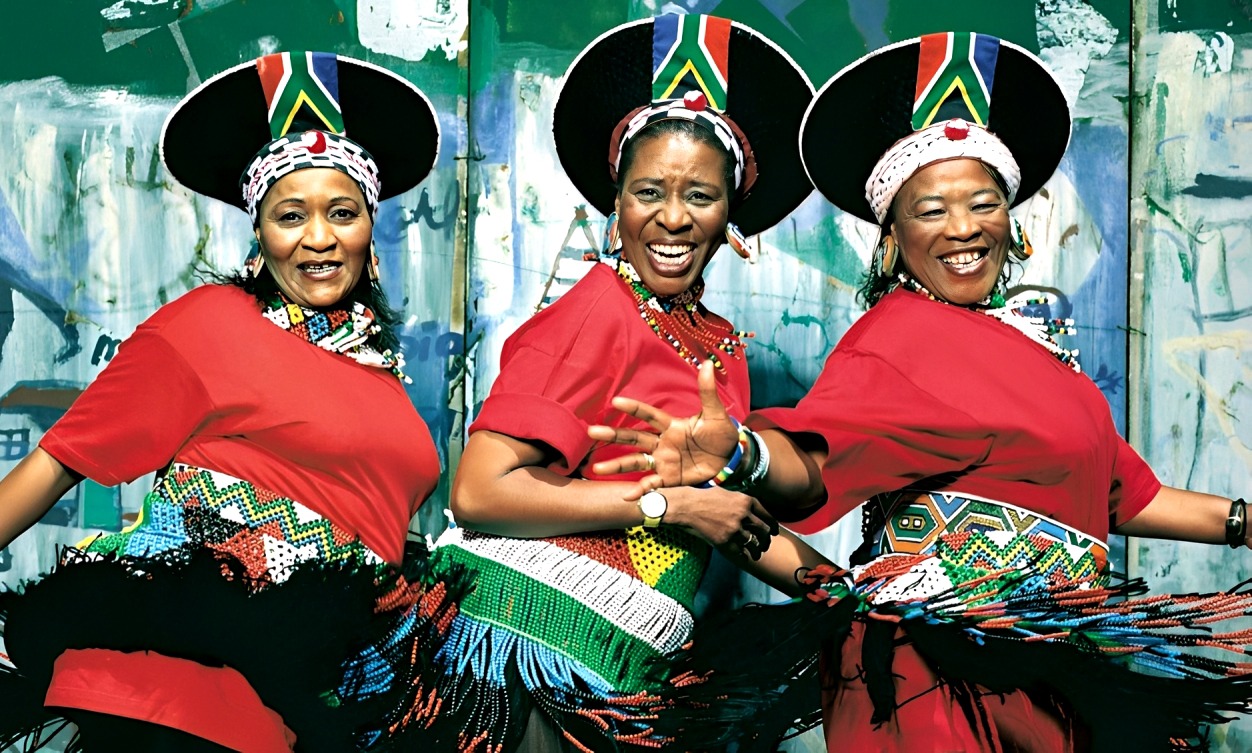
 Mahotella Queens.
(Photo: Pan African Music / Wikpedia)
Mahotella Queens.
(Photo: Pan African Music / Wikpedia) Abdullah Ibrahim’s life and music, so beautifully remembered by J Brooks Spector, got me thinking about another, slightly earlier world of South African sound: the Soweto and Johannesburg music scene of the 1960s. It was a time of marabi jazz, mbaqanga, mqashiyo, kwela, male groaners, close-harmony women’s groups and the beginnings of what would later be called Afro-jazz.
In the late 1960s, I was working as a sub-editor at The World newspaper, the Argus Company’s “black press”, at its offices on the edge of Soweto. For me and two white colleagues, it seemed ridiculous to trek back and forth from white Johannesburg every day, so we found a place in Dobsonville nearby, probably the only whites in the whole of Soweto.
Our neighbours were welcoming, shebeen life was rocking and the music scene was everywhere. Kaizer Motaung was busy stitching together the most amazing football team South Africa had known.
White Johannesburg was just catching on to Bob Dylan, the Beatles, Cliff Richard, Donovan and Joan Baez. Across the divide, Soweto was moving to a different pulse.
Here, the soundtrack was marabi and mbaqanga, kwela pennywhistles, saxophones, electric guitars, thudding basslines, awesome women singers and the deep-voiced groaners who could set a hall on fire before the first chorus was over.
It was Saturday-night music, shebeen music, commuter music, soccer-stadium music, wedding music, music for people who had been pushed to the edge of the city, but refused to live quietly.
After a week of subbing crime, sex and sport under the tutelage of MT Moerane and Percy Qoboza, plus editing journos like Selope Thema, Aggrey Klaaste and Joe Latakgomo, captioning pics by Sam Nzima and dealing with Damon Runyonesque columns by the legendary Aggrey Klaaste – who wrote best when pissed – weekends for us often meant a trip to the local shebeen.
/file/attachments/orphans/default_278552.jpg "Percy Qoboza. (Photo: Tufts University / X)")
There, we met willing guides to soccer stadiums, boxing bouts and music venues. It was a delicious culture shock.
The city we had been raised to fear turned out to be generous, funny, sharp, argumentative and profoundly musical.
At the heart of much of that music was the enigmatic Rupert Bopape of Gallo Africa. He was one of the great behind-the-scenes figures of black popular music, first as a talent scout and producer and then as the force behind Mavuthela, Gallo’s black music division.
/file/attachments/orphans/FF3EWscWYAcfhLV_827068.jpg "Rupert Bopape. (Photo: ThobelaFMYaka / X)")
Bopape understood the township ear. He knew what would move a dance hall, what would work on Radio Bantu, what could be made quickly in the studio and pressed into a hit. The word “mbaqanga” itself was often explained as a kind of musical meal, something put together quickly from whatever was at hand.
In Gallo’s Johannesburg studios, that meant marabi, migrant songs, Zulu guitar, Sotho harmonies, kwela, American jazz traces and the hard urgency of city life.
Bopape’s genius was also his ruthlessness. The industry was not sentimental. Songs were made fast, musicians were often poorly credited, groups were renamed, recombined, sent back into the studio and put on the road. But out of that hard machinery came a sound of astonishing vitality.
The most famous product of that world was the combination of Mahlathini, the Mahotella Queens and the Makgona Tsohle Band. Mahlathini, born Simon Nkabinde, had the gravel-throated bass voice that became known as the “groaner” style. Alongside him were the Mahotella Queens, with their tight, bright, dancing harmonies: Hilda Tloubatla, Nobesuthu Mbadu, Mildred Mangxola and others, though the line-ups shifted and the singers often recorded under different names.
/file/attachments/orphans/Mahotella-Queens_547944.jpg "Mahotella Queens’ last original member Hilda Tloubatla (middle) with new members Amanda Nkosi (L) and Nonku Maseko (R). (Photo: Supplied)")
/file/attachments/orphans/Mahlathini_1986_709447.jpg "Simon \"Mahlathini\" Nkabinde. (Photo: Wikipedia)")
Behind them was Makgona Tsohle, “the band that could do everything”: Marks Mankwane on guitar, Joseph Makwela on bass, West Nkosi on sax and pennywhistle, Lucky Monama on drums and Vivian Ngubane on rhythm guitar.
Together they created a music that was polished and raw at the same time. Around them, Soweto was becoming not just a dormitory for black labour, but a vast cultural city. The music carried joy under pressure, elegance under insult, swing under surveillance.
Philip Tabane was part of this same wider world, though he travelled a different road. From Mamelodi rather than Soweto, he and the Malombo Jazz Men drew on traditional rhythms, guitar, flute, voice and drums to make something more open, spiritual and searching.
If Bopape’s Mavuthela sound was the great township hit machine, Tabane’s malombo music was more like constructing ritual space. Both belonged to the same decade of experimentation, when black musicians were reshaping the sounds available to them despite every restriction placed in their way.
What I remember most is not only the brilliance of individual musicians, but the atmosphere around them. Soweto in those years was loud with life. The music was not background. It was how people named themselves, courted each other, mocked authority, mourned, boasted, danced and survived.
To stand in a shebeen or hall with that music rising around you was to understand that apartheid had failed in one decisive respect. It could control where people lived, where they worked, what pass they carried, what train they took. But it could not dictate the rhythm of their inner lives.
That rhythm was mbaqanga, mqashiyo, kwela, marabi and malombo. It was Soweto speaking in bass, brass, guitar and harmony. And for a few years in Dobsonville, we were lucky enough to hear it from inside. By comparison, the Beatles and Cliff Richard were English vanilla. DM