



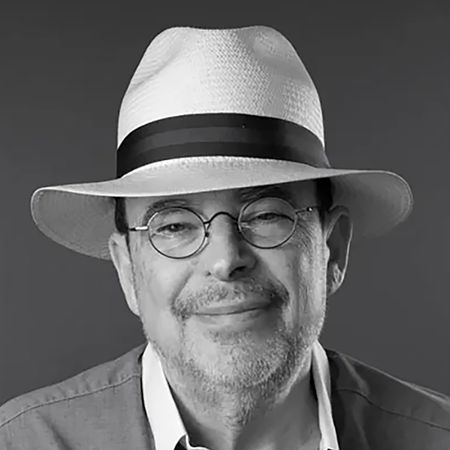
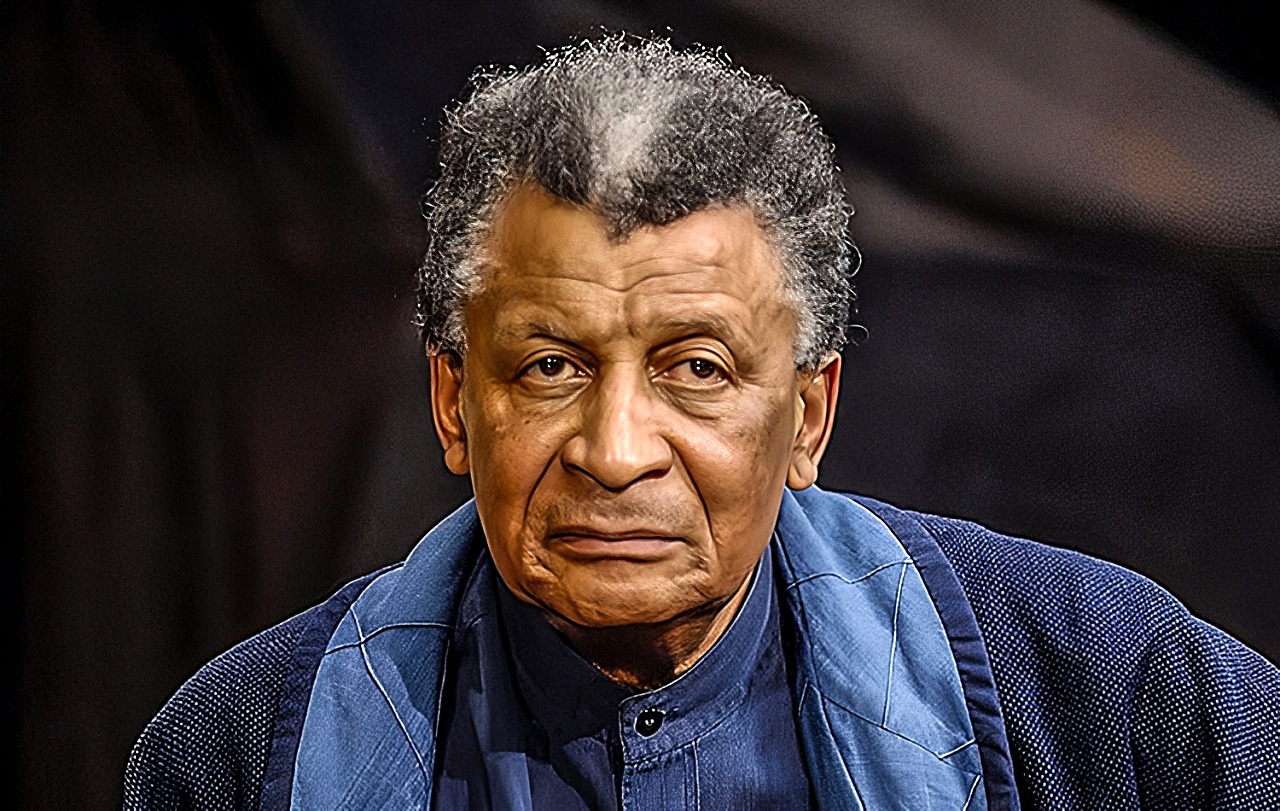
 Legendary South African jazz musician Abdullah Ebrahim. (Photo: South African Government / Facebook)
Between my wife, Ruth, and I, our history with the late Abdullah Ibrahim reaches back more than half a century. My wife actually knew of him first when she was a young music student at the University of Cape Town and he was still Adolph “Dollar” Brand. This happened before I had even heard of him or listened to his music – let alone met my wife.
Back then, Ruth had joined a neighbourhood shotokan-style karate dojo. I wonder, were she and her friends somehow preparing for their defence in revolutionary street fighting that might occur? Or perhaps to be able to protect herself as a young woman when she travelled to and from late university classes or music practice at night? Or maybe it was just an urge to gain the discipline that participation in martial arts training imposes on its students.
As it happened, Dollar Brand was also a dedicated student of karate. His dojo, or karate studio, also instructed in the shotokan style, but we believe his dojo had been led by Cape Town’s master karate teacher, Stan Schmidt.
It turned out those two clubs scheduled challenge matches, and as a result, Ruth first saw Dollar Brand in a karate dojo. In my mind’s eye, when I heard about it, I visualised those matches taking place something like the cinematic “Karate Kid” – challenges between South African karate devotees in different clubs as they competed in one of Japan’s great athletic and spiritual activities.
Back then, my wife also occasionally heard Brand’s music performances in Cape Town. This was as he was still emulating – or re-envisioning and reinterpreting – the styles of his favourite contemporary American jazz greats such as Thelonious Monk and Duke Ellington. But just around that time, Brand undertook the consequential step to embrace Islam, and changed his name to Abdullah Ibrahim.
New influences
At that point, too, Abdullah Ibrahim began reimagining his music, subtly incorporating the influences of the church music from his early childhood, echoes of the muezzins’ daily calls to prayer in Cape Town, those nearly hypnotic repetitions in Asian music, and other influences and melodies from Southeast Asian musical traditions. He also began incorporating references to the ancient musical influences of the indigenous Khoi and San peoples.
As a result, he forged a musical vocabulary and style that became a special South African genre of jazz, copied, emulated and performed by others, and increasingly appreciated by audiences as one of South Africa’s very own musical languages and voices.
Then, in 1974, his album “Mannenberg” was issued by the Al-Shams (the Sun) arm of Kohinoor Records, led by music entrepreneur Rashid Vally. That record store in downtown Johannesburg had been a sanctuary for the country’s jazz world since the early 1950s, and Abdullah Ibrahim had become a true star.
/file/attachments/orphans/724242961_28203517065902906_1023353458789379398_n_648194.jpg "Abdullah Ebrahim. (Photo: Charles Chillo Slinger / Facebook)")
Meanwhile, in January 1975, I had just arrived in Johannesburg for my time with the American Consulate General there. I knew very little about South African music and, quite frankly, I had never heard of Abdullah Ibrahim. But early in my first year, one of my South African colleagues invited me to his home for a typical South African institution, the Sunday lunch. (He lived in a neighbourhood zoned for coloured South Africans, close to mining dumps – the toxic waste rock and soil deposited there after any gold ore had been extracted, and so I would also see beyond that diplomatic bubble.)
Mannenberg
As a special gift for coming, my colleague presented me with a copy of Abdullah Ibrahim’s newly released recording, entitled “Mannenberg”. (Mannenberg is the name of one of Cape Town’s working-class coloured neighbourhoods.) The gift came with a stern admonition that I must listen to it to understand the country I was now living in.
I fell under the spell of the complex rhythms and interwoven aural textures of that music in which Abdullah Ibrahim was playing an ever so slightly out of tune, almost honky-tonk piano, together with his musical colleagues, Basil “Mannenberg” Coetzee and Robbie Jansen, who had created a defining moment in South Africa’s musical vocabulary.
A half century later, I still have that vinyl, even though we have subsequently added CD versions of the same album, plus many others of Ibrahim’s oeuvre, to our collection.
Thereafter, for years, I served in assignments in East Asia and in Washington. When we returned to SA in 1989, soon enough, the frozen-in-amber quality of South African politics had begun to break up and it seemed increasingly clear that new things might be possible in our cultural activities.
Early on, we worked overtime to assist the musician, Sipho “Hotstix” Mabuse and his band, who were stuck in Britain before trying to go onwards to the US. We arranged to sort out emergency visas for Mabuse and his group to be issued in London (we could still do such things, pre-9/11 or Covid) and then we scrambled to find some funding to cover some of their US expenses.
Inspiration
The office backstopping us in Washington had the inspiration to arrange for Mabuse and his group to stay in New York City’s famous Chelsea Hotel – the place so many artists, musicians and other creatives had used in New York City. And it just happened that Abdullah Ibrahim was living in that hotel then, and when Mabuse returned to SA he could tell us he had had a chance to meet with Ibrahim there.
Soon, Ibrahim was relocating back to SA from his semi-exiled status. As the American cultural attaché, it seemed logical to host a party welcoming him back to SA from America. We invited a guest list of famous musicians like jazz guitarist Philip Tabane, but, this being SA, others also decided they wanted to attend, and so our guest list expanded dramatically.
I rushed to the nearest Woolworths to buy a full crate of halaal/kosher chickens so we could make a huge pot of authentic Cape-style curry. The guest of honour arrived with his then-manager, photographer Rashid Lombard, and a retinue of others, and we all had a great time, even if we could not prevail upon Abdullah Ibrahim to sit down at our piano for a few minutes.
But that triggered another idea.
Cultural presentations
Through our office, we had begun setting up cultural presentations in the ambassador’s residence such as an excerpt from the show, “Ain’t Misbehaving” from an ongoing local production. As the political circumstances in SA continued to evolve, we could increasingly easily invite a much wider cross-section of South Africans to mix and mingle in our spaces.
/file/attachments/orphans/GettyImages-961462964_761976.jpg "Darius Brubeck Quartet, Scarborough Jazz Festival, 2012. (Photo: Alan John Ainsworth / Heritage Images / Getty Images)")
/file/attachments/orphans/0000138102_819443.jpg "South African jazz musician Zim Ngqawana at the Jazz on the River on 21 September 2004. (Photo: Gallo Images / City Press / Sipho Maluka)<br>")
/file/attachments/orphans/AV_00030044_976336.jpg "Victor Ntoni plays at Barringtons restaurant in Killarney on 17 August 2008, in Johannesburg. (Photo: Gallo Images / Sowetan / Vathiswa Ruselo)")
Then, when we learned Darius Brubeck and his trio – Victor Ntoni, Lulu Gontsana and Zim Ngqawana – would be in Johannesburg en route to an overseas gig, and so we asked them to perform for us. Brubeck is the son of Dave Brubeck, and our Brubeck had spent decades teaching in Durban at the University of KwaZulu-Natal where he had founded that university’s jazz centre.
But the second set would be Abdullah Ibrahim’s, now that he was living and working in SA and who was also in Johannesburg. Then we asked Don Mattera, the activist poet and memoirist, to read while Ibrahim’s improvisations would play off of Mattera’s words.
Of course there is always Murphy’s Law.
In the intermission between the Brubeck quartet and Ibrahim’s set, somebody had moved the Baby Grand piano in the ambassador’s residence. Just a few inches, but it was just enough to weaken the link between the pedestal connecting the pedal action and the main body of the piano. When he did a quick intermission warm-up, Ibrahim signalled there was a problem with the instrument. One thing we hadn’t planned on was having a piano tuner/repairman on standby for the evening.
Disaster in the making
To address this disaster in the making, I appropriated a large wooden spoon from the residence kitchen and began to break it up and then feed the pieces to one of our other guests, musician Rashid Lanie, who kept inserting the resulting wood slivers into the linkage to temporarily stabilise the connection between the pedestal and piano – at least for our evening.
Given the vibe of that evening and the talent on show, Darius Brubeck and his colleagues were wonderful and Abdullah Ibrahim was brilliant – both as a soloist and partnered with the poet.
/file/dailymaverick/wp-content/uploads/2024/01/Mick-KZN-Jazz-pioneers.jpg "‘The Jazzanians’ cover, 1987. From left, Zim Ngqawana, Melvyn Peters, Johnny Mekoa, Nic Paton, Victor Masondo, Andrew Eagle and Lulu Gontsana. (Photo: Supplied)")
Inevitably, my family and I eventually moved countries again, only returning to SA in 2001, and I retired two years later, stayed on in Johannesburg, and started doing a weekly culture and the arts programme for a local community radio station. When I learned Abdullah Ibrahim would be performing in Johannesburg I tracked him down again and asked him to be a guest on the show, publicising his upcoming concerts.
As we walked to the station from the parking lot, he told me he had recently been in Japan, studying karate and Japanese language and culture. And so, as we went on air, live, I decided to introduce my next guest by saying: “Abdullah Ibrahim-sensei, yoko irashaimase, taihen koei de-gozaimasu.” (Master Ibrahim, you are very welcome here. We are deeply honoured.) And to my delight, he responded, “Ie, ie, tondemo gozaimasen.” (No, no, it is nothing!)
A few days later, we attended his performance at the University of the Witwatersrand. Naturally we heard some of his most famous music, but there was also material that was new to us, music that was deeply meditative in nature. It was wonderful.
And now we join with all those around the world who love his music and who now mourn his passing. DM
Comments
Scroll down to load comments...