



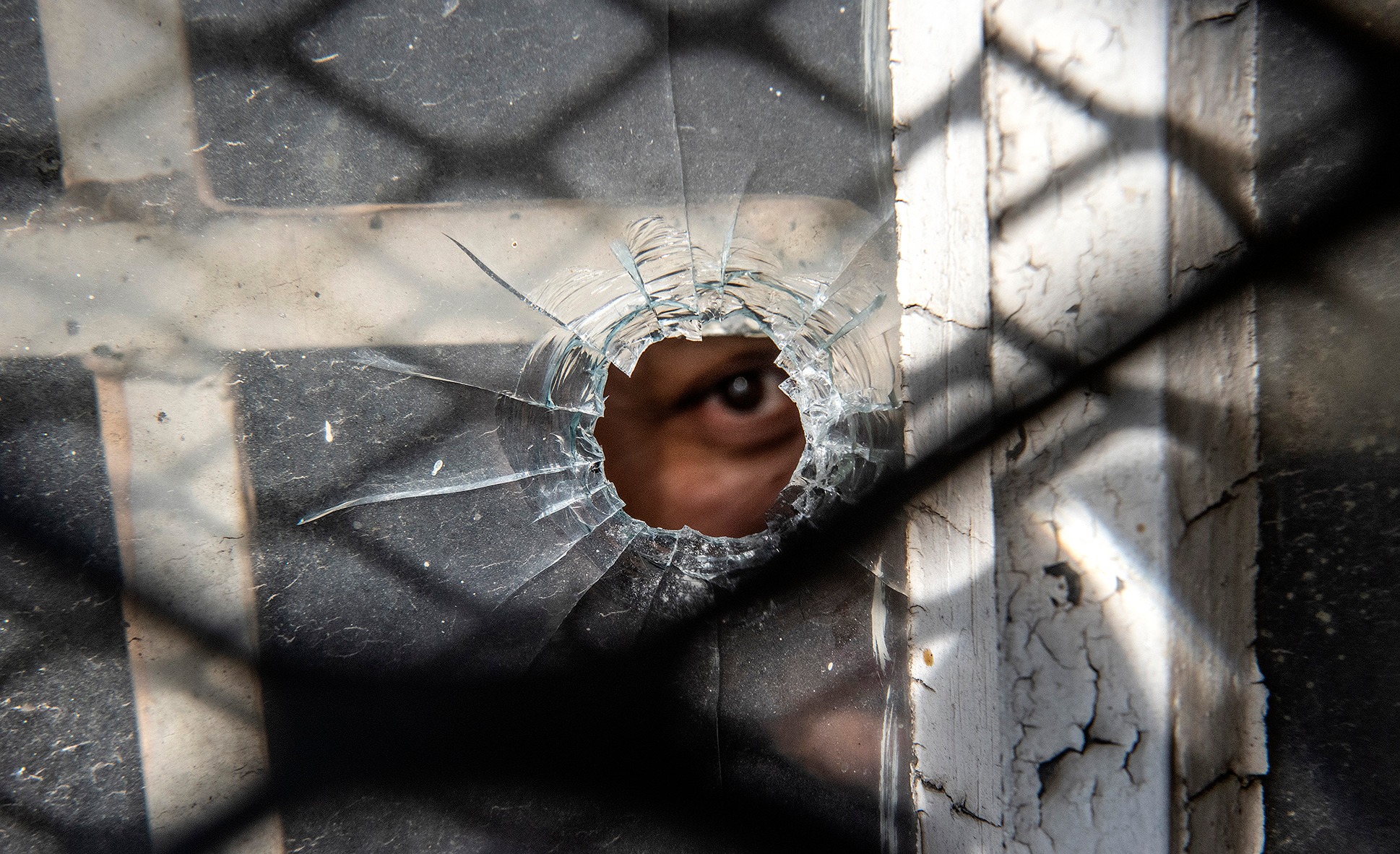
 Deputy principal Sidney Williams of Manenberg High School in Cape Town peers through a bullet hole after a round went through the teachers’ staff room in May, 2022. (Photo: Gallo Images / Brenton Geach)
Roegchanda Pascoe, an activist and former resident of Manenberg in Cape Town’s Cape Flats area, has seen the lives of multiple generations of her family disrupted by violence.
Her efforts to advocate against violent crime in her community, and her role as a State witness in a gang-related murder case, forced her to flee overseas for her own safety, but she lives with the knowledge that her children and grandchildren remained behind.
Her situation highlights the high price paid by residents in gang hotspots who speak out about what is happening around them.
“Before I left, I was in Manenberg with [my children], but the fear – not only of my children, but even of my neighbours – [meant] nobody wanted me out there. They didn’t even want me to go to the shop,” recalled Pascoe.
“My children themselves, I feel very sorry. They are paying a big price. My daughter said yesterday over the phone… ‘Mommy, I feel sad because our children cannot play outside. We are too afraid to allow them to play outside.’”
Manenberg has a high rate of violent contact crimes, with the local police station recording 81 cases of murder, 155 cases of attempted murder and 232 cases of assault with intent to inflict grievous bodily harm in 2024/25.
/file/attachments/orphans/1000031455_592681.jpg "Roegchanda Pascoe, an activist from Manenberg in Cape Town’s Cape Flats area, has paid a high price for her anti-gang activism, relocating overseas for her safety. (Photo: Supplied / Roegchanda Pascoe)")
Targeted by criminals
In 2016, Pascoe and her grandson, then aged three, were among several residents who witnessed the brutal assault of a man by members of a gang, resulting in his death. The incident weighed heavily on Pascoe, affecting her sleep and mental health. She decided that she could not remain silent.
However, becoming a State witness in the case led to a violent backlash that forever changed the lives of those in her family.
In 2019, the night before the case against the accused was set to begin, a gunman shot through Pascoe’s home. Nine members of her family were staying there, including her grandson, who was in pre-school, and her four-month-old granddaughter.
Pascoe, who was working with the Global Initiative against Transnational Organized Crime at the time, had been relocated to one of the organisation’s safe houses due to threats against her life, but her family had chosen to remain at home as they were not involved in the criminal case.
While they all survived, the incident left an indelible and traumatic mark on everyone involved.
“My daughter-in-law phoned me [during the attack], and I heard the gunshots. I heard the screams over the phone, and she told me, ‘Ma, they’re going to kill us tonight.’ I heard my grandkids scream,” remembered Pascoe.
Read more: Why is SAPS withholding vital crime statistics on women and children?
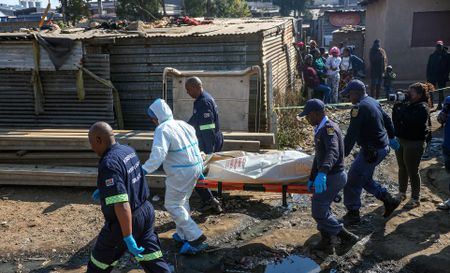
/file/attachments/orphans/ED_370188_259978.jpg "Minister of Police Bheki Cele was talking to residents in Heideveld on 17 March 2022 as a man was shot a few hundred metres away in a drive-by shooting during a street izimbizo after a spate of deadly shootings in Manenberg and Khayelitsha. The community engagements aimed to strengthen the working relations between the police and residents. (Photo: Gallo Images / Brenton Geach)")
Growing up in fear
It was not the first time Pascoe and her family had been targeted. In 2013, her oldest daughter – then 16 years old – was shot in the leg while buying vegetables at a local store with a friend. Pascoe believes that the gunman mistook her daughter for her, after a hit was taken out on her life due to her activism in the community.
/file/dailymaverick/wp-content/uploads/MC-GangsLindyJacobs-Anso.jpg "“I held his hands, started talking to him and praying for him and I felt how his hands got colder. I started calling him – ‘Zinny, Zinny!’ He opened his eyes and I could see my child is busy dying, his eyes blinking and closing.” - Sally Ann Jacobs from Westbank lost her child in the gang violence.(Photo: Thom Pierce)")
“I remember the morning she was shot… Everybody was screaming, but she couldn’t speak. I was looking for where she was shot… and then she lifted her tracksuit pants, and the blood was spurting out,” said Pascoe.
“It’s just something that you’d never forget. Sometimes, her leg hurts, and it swells. That comes from before they shoot, when they spray Doom on the bullets to poison [people]. That is what stays behind.”
After the shooting, Pascoe’s daughter went from a sporty and active teenager to being unable to participate in the activities she enjoyed.
Pascoe’s son endured pressure from gang members to sell drugs at the school he attended in Hanover Park. When he refused to cooperate, he was targeted and threatened outside the educational facility to the point that he stopped attending school. Due to challenges in finding a placement for him at another school, he was ultimately unable to complete his matric.
/file/dailymaverick/wp-content/uploads/MC-GangsFoundation-Anso.jpg "Shattered lives: Avril Andrews lost her son to the gang violence and started Moms Move for Justice to support other Moms who had the same experience. (Photo: Thom Pierce)")
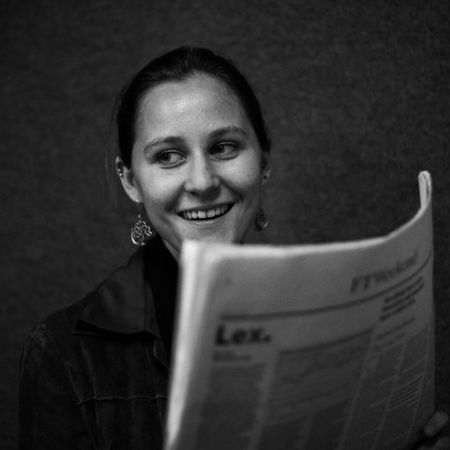
“With each of my three children, raising them in Manenberg… I have my own story… Raising them there has shown me the influence of the whole community on your children… It has shaped me as a mother in showing how far a mother would go to fight for children, because I became a person that I did not recognise, looking in the mirror. I literally had to fight to keep my children intact,” said Pascoe.
A local gangster once tried to force a friend of Pascoe’s son to confess to a muder he had not committed, to ensure the gangster did not face charges.
“He wanted to send this innocent young man that had never been in prison to say he had [committed murder]. It’s these types of impacts and realities young people in areas like Manenberg have to live with, and people outside don’t necessarily know that young boys are being threatened,” said Pascoe.
/file/dailymaverick/wp-content/uploads/MC-GangsLesleyWyngaard-Anso.jpg "“The police tried to tell me not to look at my son’s body, but I broke loose and went to go and see his face. The bullet was stuck in his skull.” – Lesley Wyngaard from Southfields, a mother who lost her son in the gang violence. (Photo: Thom Pierce)")
Changing the social fabric
Pascoe is worried that current systems and communities do not hold space for children affected by these types of crime and violence. She noted that she grew up in Manenberg herself, fostered by her grandparents, and while it was not an easy experience, she found outlets in activities such as drama and modern dancing.
“I had friends, and we connected, and I think today we’re drawn to each other because of what we’re facing in the home, but we could shoulder each other. Today, our youth are living in a competitive society, and so it’s not easy for them to keep their sanity like we used to keep our sanity. The competition is great – if I don’t have the clothes to fit in, I’m an outsider; if I don’t speak the lingo, I’m an outsider – and the pressure is on,” she said.
At one time, Pascoe was on the school governing body for a primary school in Manenberg, and she saw cases of children acting violently against other children. She described visiting the homes of those who were acting out and realising the challenges they were facing.
However, because there was a shortage of mental health and medical professionals working in Cape Flats schools, those cases would seldom be managed effectively, which she feared led to children “falling by the wayside”.
“That’s why we sit with alcohol [and] drug syndrome [affecting] children in schools, and they are the next gangsters to be recruited,” said Pascoe.
She said she was passionate about saving the family unit, as she believed that was key to improving outcomes for children.
“If you look at the children that make it out there, some of them come through harsh realities, but there is a support system. There’s a support system by the extended family or friends in the community, but once that is not even there, my heart bleeds for that child in the society we have to raise them in today,” Pascoe said. DM
/file/attachments/orphans/ChildrensReporterV2_187851.jpg)
Comments
Scroll down to load comments...