



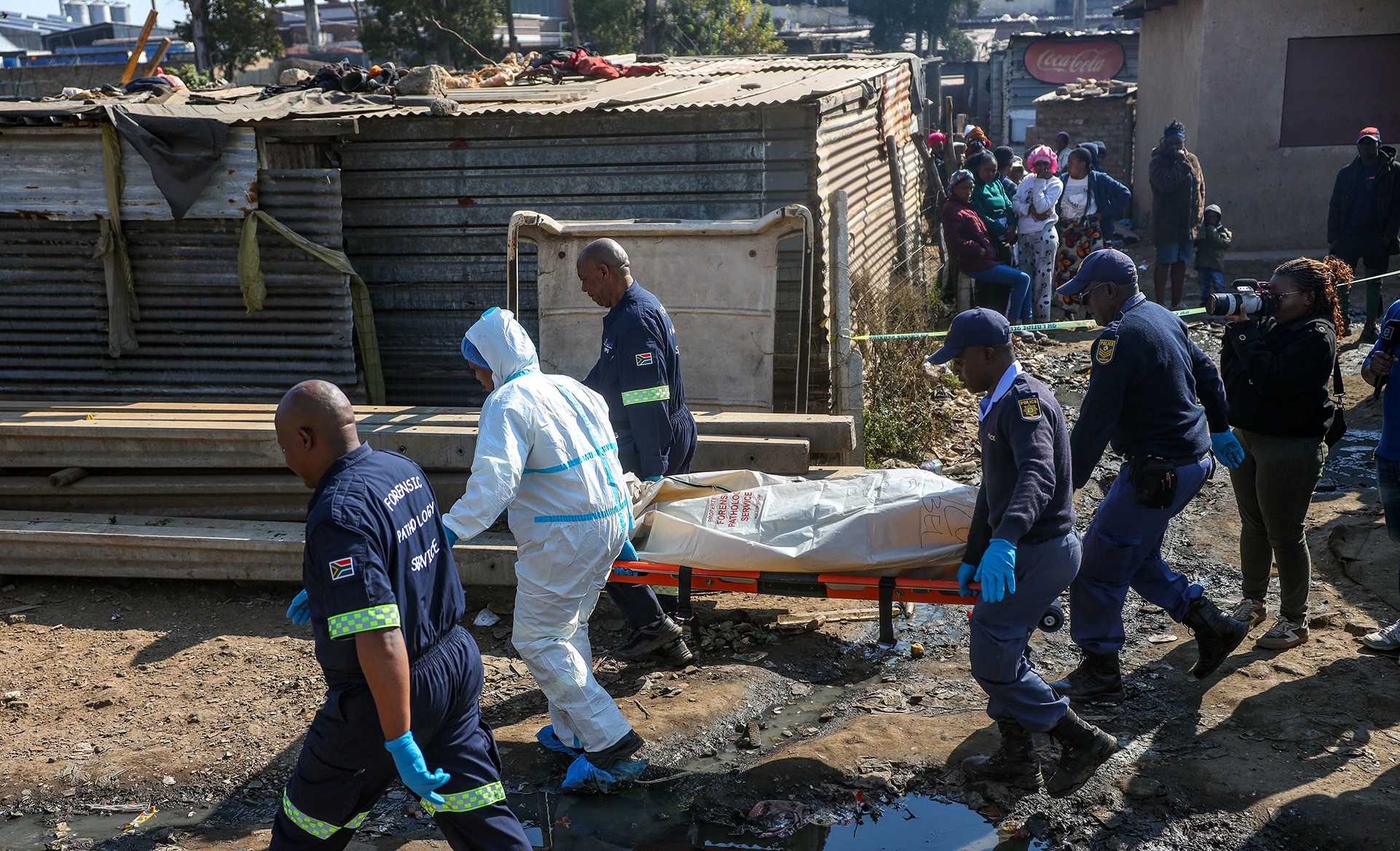
 Members of the Forensic Pathology Services and SAPS remove the bodies of people killed in a mass shooting at the Jumpers informal settlement in Cleveland, Johannesburg, on 10 June 2026. (Photo: Gallo Images / Sharon Seretlo)
In Cape Town, Mitchells Plain in the Cape Flats area sees some of the highest rates of recorded contact crimes, with its police station ranked seventh nationally in 2024/25, with 3,441 cases. In the past few months, the SAPS has investigated several fatal shootings in the area, including one in which a 15-year-old girl was injured.
/file/attachments/orphans/ED_170200_835391.jpg "A South African National Defence Force soldier monitors the streets of Manenberg, Cape Town. (Photo: Gallo Images / Brenton Geach)")
The Mitchells Plain Safety and Development Forum, established in 2026 in partnership with the Western Cape Government and Department of Police Oversight and Community, is working to implement community-driven safety and development projects in the area.
According to the forum, “Mitchells Plain is often spoken about through the lens of crime statistics, but statistics alone do not fully explain what life feels like for children growing up here. For many children, violence is not experienced as a single event — it becomes part of the environment they move through every day. That reality shapes how they play, learn, trust, imagine their future and understand what safety means.”
Children are not only exposed through direct victimisation, but also through hearing gunshots, witnessing violent incidents, losing relatives or peers, moving through unsafe public spaces, living with domestic conflict and adapting daily routines around territorial disputes and fear.
“The normalisation of violence becomes one of the most damaging outcomes,” noted the forum. It said crime in Mitchells Plain was rooted in intersecting social pressures such as family instability, trauma, substance abuse, gender-based violence and youth disengagement that increased vulnerability to gang recruitment and criminal behaviour.
“Importantly, children are not passive observers of these conditions. They adapt to them — often at significant cost to their development,” said the forum.
“The long-term risk is that unresolved trauma becomes intergenerational, reproducing cycles of violence rather than interrupting them.”
The Mitchells Plain Safety and Development Forum emphasised that “violence shrinks a child’s world”. When children are unsafe moving through the community, parents become reluctant to allow their participation in sport, recreation, cultural programmes or informal play.
“Schools often carry the burden of becoming both education sites and emotional refuge spaces. Community parks, open spaces and public infrastructure can become underused or surrendered to fear,” said the forum.
High crime rate
The high rate of violent crime in South Africa has long been a reported scourge affecting not only the safety of residents, but also their sense of security within communities. This is especially true for the country’s most vulnerable population, its children, who are dependent on adults when it comes to well-being, and shaped by the environments in which they grow up.
Every year, thousands of children are victims of violent crimes such as murder, assault and sexual offences, though the rate of these offences against minors has been more challenging to track in the 2025/26 financial year due to the absence of disaggregated data on crimes against children in the South African Police Service (SAPS) quarterly crime statistics reports over the past 12 months.
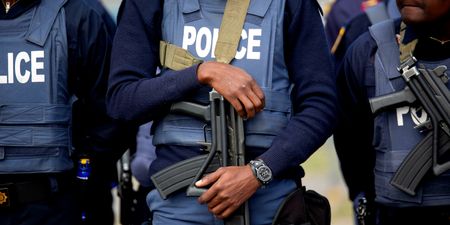
Even more difficult to track is the large number of young people who are traumatised through witnessing or being exposed to violence in communities with high rates of gangsterism and violent crimes.
Growing up amid violence
Growing up surrounded by constant violence fundamentally changes a child’s mind long before they ever reach adulthood, according to Lethokuhle Nkambule, an office coordinator for Childline Soweto in Gauteng. His office falls under Childline South Africa, a national non-profit organisation which works to protect children from violence, running a 24-hour, toll-free telephone counselling service for children and adults
Soweto is plagued by high rates of gang violence and organised crime. Its Eldorado Park Police Station fell in the top 30 stations for recorded contact crime incidents in 2024/25, coming in at number 29 with 2,495 cases.
Nkambule noted that for children, exposure to both abuse and a broader violent environment could trigger “toxic stress”, reducing their capacity to think properly or problem solve.
“That poses a long-term risk of dysregulation or behavioural problems,” he said.
/file/attachments/orphans/ED_583297_455568.jpg "Exterior view of a house in Westbury, Johannesburg, on 22 October 2025, after two teenagers were shot dead and five others injured in a suspected outbreak of gang violence. (Photo: Gallo Images / Sharon Seretlo)")
Nkambule explained that children typically processed chronic unsafety through two distinct psychological adaptations. On one end, the mental toll is turned inward, causing children to internalise the chaos through anxiety, depression, social withdrawal and a profound loss of trust in the world around them. On the other end, they externalise their trauma by actively modelling the criminality and aggression they witness daily.
He noted a correlation between highly volatile zones such as informal settlements, hostels and gang-afflicted neighbourhoods such as Eldorado Park and Kliptown, and the intensity of this outward aggression.
These patterns of trauma for children hold across other areas in South Africa experiencing high rates of violent crime.
In Childline South Africa’s January to March 2026 Quarterly Report, the helpline recorded 119 instances of children being used for criminal activity, remaining distressingly consistent with the 120 cases reported in the previous quarter. There were 21 reports related to drug dealing, a concerning increase from 14 in the prior quarter.
/file/attachments/orphans/ED_612051_862376.jpg "A resident moves through the area where 13 people were killed in a shooting at the Jumpers Informal Settlement in Cleveland, Johannesburg, on 10 June 2026. (Photo: Gallo Images / Sharon Seretlo)")
Strained support services
Access to specialist support services for children remains uneven. Edith Kriel, executive director of the nonprofit Jelly Beanz in Cape Town, pointed out that social workers were often inundated with statutory work, involving investigations and the removal and placement of children. They had little time left over for therapeutic work.
“To imagine that you can have individual therapy is also quite ludicrous, given the amount of children and the amount of professionals, so we have to start thinking about community members and how we support the work that they can do, because there’s amazing people in communities, but how do we ensure that they are properly selected, trained, supervised going forward,” she said.
Jelly Beanz works with children under the age of 18 who have been exposed to a range of challenges, from bullying in schools to loss of a loved one, as well as exposure to abuse and neglect. The organisation does therapeutic work, provides training for professionals and community members, and offers resources for working with young people.
/file/attachments/orphans/edith21june_147285.jpg "Edith Kriel, executive director of Jelly Beanz.
<br>(Photo: Afternoon Express / Wikipedia)")
(Photo: Afternoon Express / Wikipedia)
“The majority of children that we see in terms of trauma would definitely be [related to] some form of violence – either children being exposed to it or children experiencing it themselves,” said Kriel.
Another nonprofit in Cape Town, the Trauma Centre for Survivors of Violence and Torture, works with children and adults who have been exposed to trauma, supported by funding from the Western Cape Department of Social Development.
Marguerite Holtzhausen, executive director of the nonprofit, echoed Kriel’s concerns about the capacity constraints of specialist support services.
“Your Model C [schools], they have ... school board posts, funded posts, which are paid with the very high school fees, but in our schools that are government funded, there’s one social worker for every 20 schools,” she said.
“The Western Cape Education Department started something they call Wellness Hubs in some schools... They use us as NGOs to do the work there... It’s a partnership [and] there’s intention from there to bring more support into certain schools, and we are also involved in Manenberg and Delft... That for me is wonderful that there is some initiative, but it’s also still in pilot [phase]... I believe there’s a lot more that can be done.”
The Trauma Centre has a wide range of programmes aimed at supporting children, providing psycho-education programmes in schools, and counselling through social auxilliary workers. It works in hotspot areas for crime and gender-based violence.
“We do work with parents as well... We do trauma support work training for lay counsellors and communities, mostly for the victim-friendly room volunteers at police stations,” said Holtzhausen.
Both Kriel and Holtzhausen noted the importance of community consultation and involvement in the creation of support systems for children.
The Mitchells Plain Safety and Development Forum argued that support for children should not be dependent on whether they could access a specialist service.
“Instead, community systems themselves must become trauma-informed — schools, neighbourhood structures, holiday programmes, recreation spaces and frontline community organisations,” said the forum.
Helping traumatised children
The Trauma Centre’s social auxilliary workers interact with children who have been exposed to violence, helping them to process their emotions and find ways to move forward.
“One thing is when we work with a child in therapy... we always also work with a parent, because sometimes... parents also don’t know how they can support the child, and sometimes your child being harmed is also traumatic for you as a parent. So, in order to find that healing, to create that supportive healing space in the family, the parent must also find some kind of acceptance of what happened,” said Holtzhausen.
The organisation’s trauma support programme aims to educate people about the effects of trauma. Holtzhausen noted that sometimes children were labelled as lazy when they were actually depressed, or naughty when their behaviour could be traced to triggers.
Kriel spoke about the “power of one”, the idea that just one person who cared deeply and consistently about a child could turn their lives around.
“If you have one person that you can run towards that can then help you process all the things that have happened to you and give you a sense of safety, you’re not going to be as traumatised as a child who has to learn to navigate that on their own,” she said.
Building safe spaces
The Mitchells Plain Safety and Development Forum has been piloting “safe zones” in the community that serve as multipurpose activity spaces aimed at “reclaiming public environments and providing structured developmental opportunities for children and families”. The programme has been rolled out at spots in Beacon Valley, Montrose Park and Strandfontein, with additional zones planned for Rocklands and Tafelsig.
Safe Hubs within these zones are designed to provide:
- supervised spaces during high-risk periods;
- psychosocial referral pathways;
- aftercare and homework support;
- skills development and youth pathways; and
- safe and welcoming infrastructure with community ownership.
“This approach reframes safety as both a physical and psychological condition,” said the forum.
Kriel identified sport as an activity with the potential to create safe spaces for children, while also incorporating exercise, a valuable intervention for processing trauma, and team effort.
Holtzhausen noted that the “crime machine” thrived on children having nothing to do, making spaces for sport, art and culture in hotspot communities highly important.
“Just consult with community. Start with where they are at, and to be willing to do those small things that are really important to people. They might not cost a lot of money, but it will need a bit of flexibility in budgets. It will need a bit of caring and [willingness to] make it work, and that’s possible,” she said. DM
/file/attachments/orphans/ChildrensReporterV2_187851.jpg)
Comments
Scroll down to load comments...