




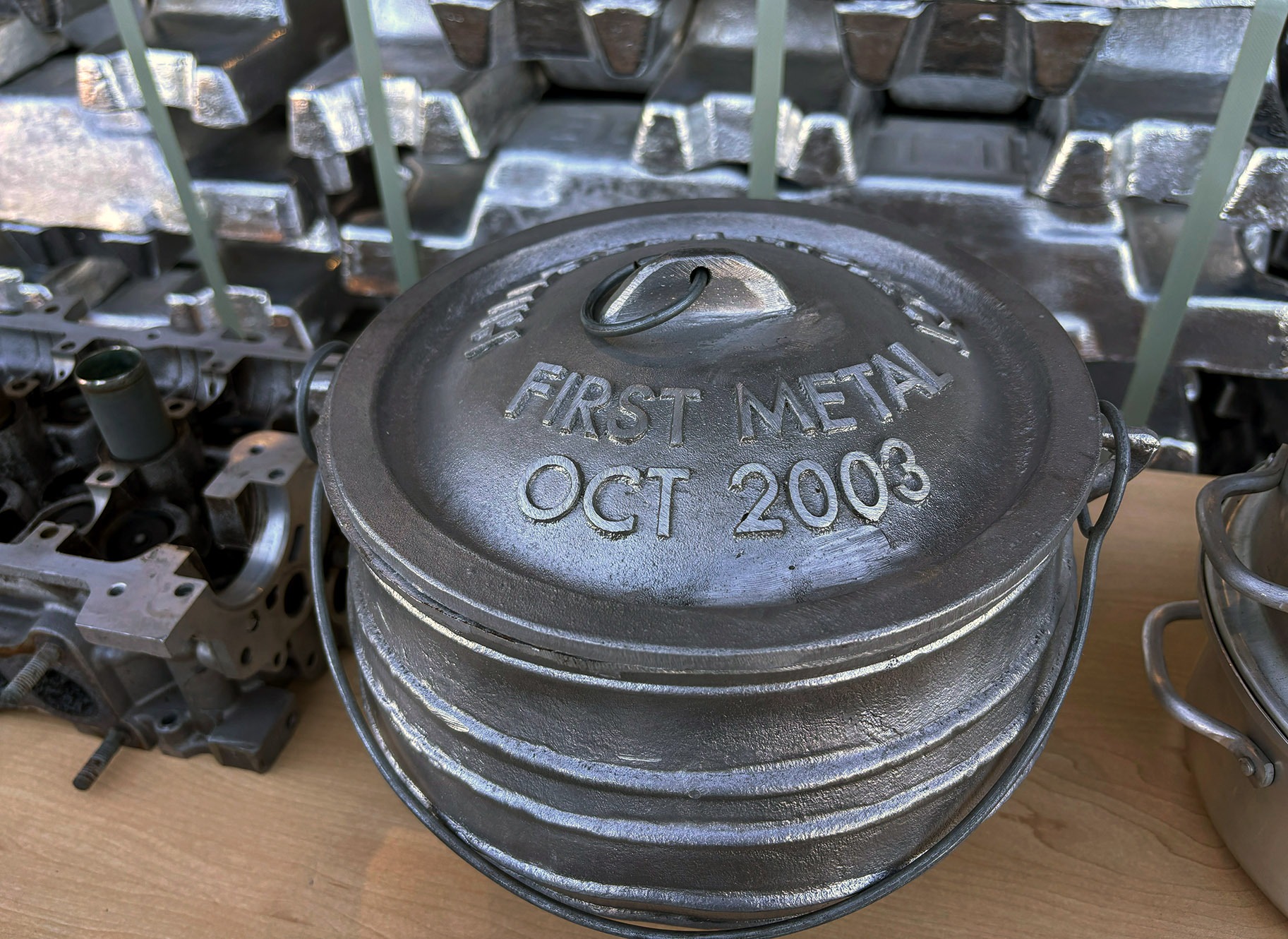
 An aluminium pot at South32's Hillside Aluminium smelter in Richards Bay with aluminium ingots in the background. (Photo: Ed Stoddard)
When the Hillside Aluminium smelter in Richards Bay was launched in 1996, it was the largest private investment in South Africa at the time, signalling confidence in the economic trajectory of the Rainbow Nation under Nelson Mandela, who presided over the opening ceremony.
The asset, owned by BHP spin-off South32, will now be sold to US aluminium giant Alcoa as part of a wider cash-and-shares deal valued at up to $5.6-billion — a timely and much-needed signal of investor confidence against a very different economic and political backdrop.
The deal, announced on Wednesday, pointedly does not publicly provide a breakdown of the valuation of each of the assets, which includes aluminium operations in Brazil and Australia.
But Hillside is clearly a key piece of the transaction, and it employs technology similar to that of two of the other 11 smelters in Alcoa’s worldwide operations, making it a relatively easy fit into the company’s portfolio.
“The acquisition will add a high-quality, low-cost and globally diversified set of mining, refining and smelting assets, further strengthening Alcoa’s mine-to-metal platform, expanding its global footprint and increasing the company’s ability to generate sustainable long-term value for shareholders,” said Alcoa.
Neither company said much about Hillside in their respective statements, but notably, the sale excludes South32’s Mozal aluminium smelter in Mozambique. Hillside, unlike Mozal, was clearly regarded as a “high-quality, low-cost” asset.
Mozal — in which South Africa’s Industrial Development Corporation (IDC) has a 32.4% stake — was shut in March after South32 failed to reach a power supply agreement for the operation.
The transaction that will see Hillside change ownership takes place amid ongoing talks with Eskom for a new power pricing arrangement to replace the current one, which expires in 2031 — a controversial deal.
Hillside receives a discount of about 50% from the power utility — at a time when households and many other businesses, including mining companies, have endured surging energy costs — according to a report by Open Secrets, which estimated it could add up to R92-billion in savings for the operation over the life of the deal.
The smelter is Eskom’s biggest private customer and accounts for about 5% of its demand, consuming more power than Malawi. Criticism of the deal has focused on fairness and the risks to Eskom’s precarious finances.
The flip side of that is the urgent need to arrest South Africa’s descent into de-industrialisation, and soaring power costs have been in the spotlight on this stage. And unlike many of South Africa’s failing municipalities, Hillside has presumably been paying its bills — the kind of customer that Eskom needs.
The initial investment decision to build Hillside was made in a bygone era when Eskom had surplus power and its rates were dirt cheap. There is no way that any investor would build such a smelter today without a steep discount and supply guarantees.
Ultimately, the only way to currently attract foreign investors to power-intensive operations in South Africa is to lower the costs and boost reliability.
Eskom has made big strides on the second front — though local outages (shambolic City Power in Joburg springs to mind) remain frequent — but it has made little headway on the first.
Daily Maverick understands that Alcoa is confident that it can secure a deal with Eskom beyond 2031. It seems unlikely that it would have been tempted by the asset if that was not the case.
Subject to scrutiny
This can be seen as a sign of confidence in Eskom and in South Africa’s economy and labour force more broadly, though any extension of the deal will be the subject of scrutiny, debate and criticism.
It must also be said that for South32, the transaction does not reflect a scramble out of South Africa — it is a global disposal of aluminium assets as the company focuses on a simpler portfolio of higher-margin upstream operations.
Aluminium is a key industrial product with a wide range of uses, from plane fuselages to laptops to bike frames and cans.
Hillside’s role in this global production chain remains a centrepiece of South Africa’s standing as an industrial giant on the continent — for better or worse, depending on your view of power-intensive operations in an economy that remains heavily reliant on coal.
The transaction is subject to shareholder and regulatory approval and is expected to close in the first half of 2027.
It was clearly cooking when South32 marked the smelter’s 30th birthday on 7 May this year with a media and VIP tour of the imposing site and a gala dinner featuring President Cyril Ramaphosa.
“It has been a difficult operating environment for smelters in recent years, with many having been forced to close due to rising costs and adverse market conditions,” Ramaphosa said in his remarks at the gathering.
“We welcome the discussions between Eskom and South32 about a long-term electricity solution for Hillside Aluminium when the current contract ends in 2031.”
Those discussions will now be with Alcoa, and at least for now, there seems to be political backing from the top for a similar deal to be reached. DM
Comments
Scroll down to load comments...