




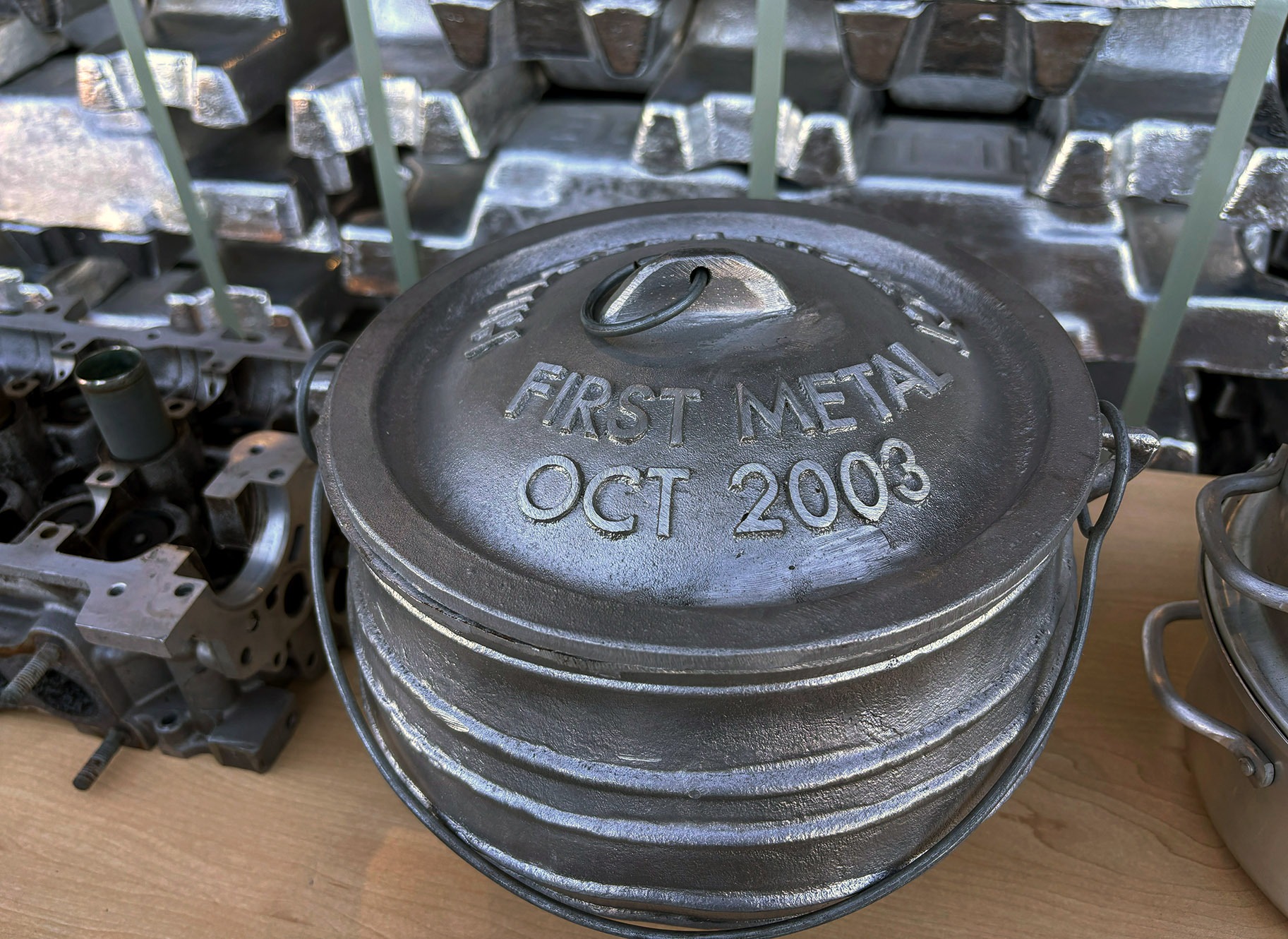
 An aluminium potjie pot at South32’s Hillside smelter in Richards Bay, with aluminium ingots in the background, on 7 May 2026. (Photo: Ed Stoddard)
South32’s Hillside Aluminium smelter in Richards Bay marked 30 years on 7 May with a bang including a media and VIP tour of the site and a gala dinner featuring President Cyril Ramaphosa.
It was all a poignant reminder of a bygone industrial era when an infant democracy freed from the shackles of apartheid had abundant and cheap power, laying the economic foundation for feats such as the construction of the largest aluminium smelter in the southern hemisphere.
“It’s about power... This was built at a time when we had a surplus of power,” Noel Pillay, South32’s southern Africa chief operating officer, told visitors to the smelter during a presentation.
Those heady days when then President Nelson Mandela opened the smelter are a dim and fading memory.
Asked at a media briefing about the prospects of a similar smelter being built in South Africa today, South32 CEO Graham Kerr responded: “If you had the competitive economics and power costs, you could build another one.”
That’s a big IF.
As the wrangles over power costs involving the struggling ferrochrome sector underscore, Eskom’s surging electricity tariffs – which have outpaced inflation by six-fold over the past three decades – have blazed the trail of South African deindustrialisation.
South32 is in talks with Eskom for a new power deal to replace the current one when it expires in 2031. Hillside receives a discount of about 50% from the power utility, which Open Secrets has estimated could add up to R92-billion over the life of the deal.
The deal has been slammed for its secrecy and potential consequences for Eskom’s fiscal stability as Hillside is Eskom’s biggest private customer, accounting for close to 5% of its electricity demand.
Such criticism is not groundless. As a state-owned enterprise, Eskom needs to be accountable, and as a publicly listed company, South32 should also be transparent on this front.
But there are other prisms through which to view the issue, starting from the vantage point of three decades ago.
The original investment decision – South Africa’s largest private investment at the time – was predicated on cheap and reliable power, and those posts have since significantly shifted. Such investments are taken with a very long-term view.
Much of South Africa’s industrial base has subsequently been rendered unviable because of escalating power costs and the long years of rolling power cuts which were the consequence of misgovernance and the Zuma era of State Capture.
But Hillside, which consumes more than 1,100MW – more than Malawi – is still rumbling along, and the sheer scale of the operation when seen up close is simply staggering.
/file/attachments/orphans/IMG_3642_146958.jpeg "Aluminium cooking.
<br>(Photo: Ed Stoddard)")
(Photo: Ed Stoddard)
Another point is that when you buy in bulk, you typically get a discount. And at least Hillside pays its Eskom bills, unlike many of South Africa’s crumbling municipalities, which have a swelling debt to the utility which now amounts to more than R111-billion. That’s the biggest threat to Eskom’s finances.
Eskom now has surplus power again, though it hardly has massive amounts to spare. And while its turnaround under Electricity Minister Kgosientsho Ramokgopa has been impressive on many fronts, it is also testimony to South Africa’s slow rates of economic growth and unfolding deindustrialisation.
Surplus power reflects depressed demand.
“It has been a difficult operating environment for smelters in recent years, with many having been forced to close due to rising costs and adverse market conditions,” Ramaphosa said in his remarks at the gathering.
That sums up the current woeful state of affairs. Hillside is rooted in a starkly different era.
There is legitimate debate about discounts and state support for power-intensive industries against the backdrop of issues such as the climate crisis.
But the fact of the matter is that if South Africa wants to arrest its industrial decline such measures are among the few options on the table.
Are the touted benefits worth it?
Hillside says it supports 3,650 direct and indirect jobs and claims to contribute to 29,000 jobs across the economy since 30% of its products are sold in the domestic market and flow to downstream industries. It produces about 720,000 kilotonnes per year.
Aluminium is a key industrial product with a wide range of uses, from plane fuselages to laptops to bike frames and cans. And South African policymakers are always banging on about “beneficiation”.
As South32 and Eskom negotiate the next power agreement beyond 2031, there will be much for Nersa to consider.
There certainly seems to be high-level political support for a deal.
“We welcome the discussions between Eskom and South32 about a long-term electricity solution for Hillside Aluminium when the current contract ends in 2031," Ramaphosa pointedly said in his remarks.
Will that be in South Africa’s best interests? That is a topic that needs to be scrutinised and subjected to robust public debate. DM
Comments
Scroll down to load comments...