



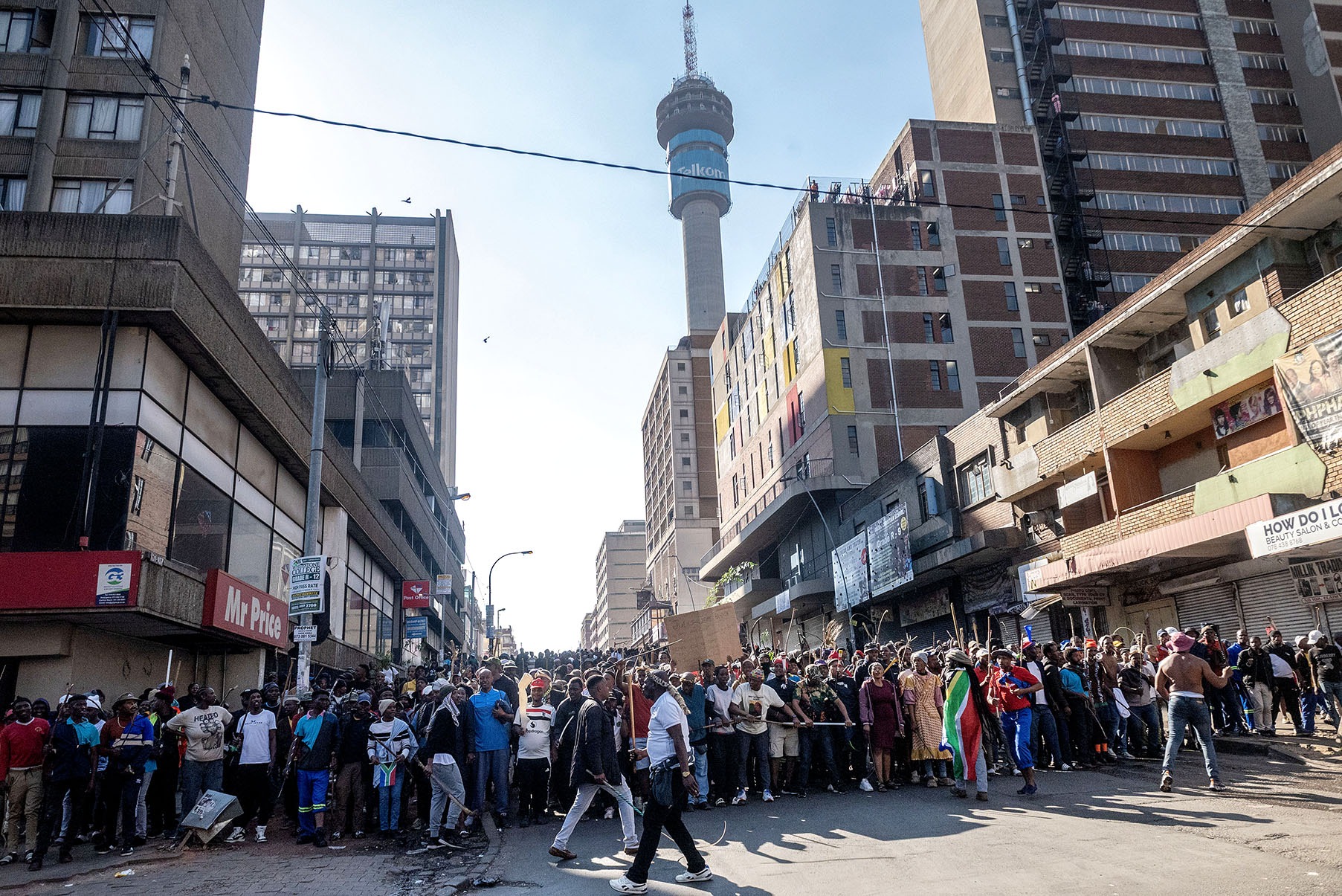
 Protesters march through the Johannesburg CBD on Tuesday, 30 June 30. (Photo: Leon Sadiki)
After months of concerns that the countrywide protests against undocumented migrants on 30 June could be a repeat of the July 2021 riots, the worst-case scenario was avoided. At the time of writing on Tuesday, there had been no reported fatalities, no mass looting and no targeted attacks on infrastructure.
In some areas, however, protesters intimidated and assaulted those they perceived to be foreign. They unlawfully carried traditional weapons, damaged property and went house-to-house targeting suspected undocumented migrants. However, widespread fears of a repeat of the riots of 2021, which left more than 350 people dead and cost the economy R50-billion, were not realised.
On Tuesday, crime expert Willem Els, from the Institute for Security Studies (ISS), said the apparent success of the policing operation needed to be understood against the backdrop of two defining moments in South Africa’s recent history: the Marikana massacre on 16 August 2012, when 34 people were killed by the police, and the widespread unrest that paralysed parts of KwaZulu-Natal and Gauteng in July 2021.
“Let’s start with two things,” said Els. “Firstly, people looked at Marikana and said, ‘This is how the police acted.’ There was a real fear that something similar could happen again,” he added.
Against that backdrop, Els emphasised that security planning, visible policing and swift enforcement played a pivotal role in preventing violence, looting and destruction that many had feared would accompany Tuesday’s protests.
Els’s assessment was echoed by acting Police Minister Firoz Cachalia, who, around midday on Tuesday, said that policing operations had been effective thus far, with demonstrations largely peaceful across the country.
The Ministry of Police said the SAPS had arrested several people in connection with incidents of looting and attempted looting since the early hours of Tuesday.
/file/attachments/orphans/ED_614303_552846.jpg "A protest against illegal immigrants outside St George's Cathedral in Cape Town on 30 June. (Photo: Brenton Geach / Gallo Images)")
Cachalia urged South Africans to exercise their constitutional right to protest responsibly, warning that criminality would not be tolerated.
“We urge citizens to exercise their constitutional rights responsibly and to ensure that demonstrations remain peaceful and lawful. Those who choose to exploit the marches to commit criminal acts will face the full might of the law. Police will continue to identify, arrest and prosecute all those responsible for criminal conduct,” he said.
Drawing on the lessons of the 2008 xenophobic attacks, the July 2021 unrest and the current anti-immigrant mobilisation, Professor Loren Landau and Dr Jean Pierre Misago wrote in an op-ed for the African Centre for Migration and Society that South Africa is confronting not only a migration challenge but also a deeper crisis of governance.
Restoring constitutional order, they wrote, requires more than stronger border controls; it demands a capable state that enforces immigration laws while applying the rule of law equally against those who resort to intimidation, violence and vigilantism to advance political or economic interests.
Visible leadership, clear messaging
The ISS’s Els argued that the visible leadership of Cachalia, coupled with the SAPS’ operational management, marked a significant departure from the state’s handling of previous public-order crises.
“The leadership has made a very big difference. There has been consistent communication, a clear strategy and the mobilisation of police resources. There has also been collaboration with the private security sector.”
Ahead of the protests, Cachalia said he had engaged with the private security sector to discuss its role as a potential force multiplier in support of the police, and emphasised information sharing, planning and pooling resources.
/file/attachments/orphans/Police-chasing-away-demonstrators-in-Delville-Germiston-telling-them-they-are-not-authorised-to-be-questioning-and-intimidating-people-around-their-nationality-Photo_-Danielle-Schaafsm_211820.jpg "Police chase away protesters in Delville, Germiston, telling them they are not authorised to question and intimidate people based on their nationality. (Photo: Daniélle Schaafsma)")
According to Els, the authorities’ messaging was equally important. While reaffirming citizens’ constitutional right to protest, the SAPS made it clear from the outset that violence, looting and other criminal acts would not be tolerated.
While fears of a repeat of the Marikana massacre loomed over the protests, Els said comparisons with the July 2021 unrest were equally unavoidable. He noted that the 2021 violence exposed serious intelligence failures and operational shortcomings, leaving police ill-prepared to contain widespread looting and destruction.
The July 2021 unrest was one of the most traumatic episodes in post-apartheid South Africa. This time, however, Els said there was evidence that SAPS had learned important lessons.
As an example, Els pointed to an attempted looting incident at a shopping mall in Worcester, where police moved swiftly to restore order.
“There was an incident in Worcester where people allegedly tried to loot a shopping mall early in the morning, and the police acted decisively. We understand there were arrests. There was immediate action within the limits of the law, and there were consequences for lawlessness,” he said.
/file/attachments/orphans/P11_854292.jpg "Protesters marched through the Johannesburg CBD on Tuesday, 30 June. (Photo: Leon Sadiki)")
Els said the combination of decisive policing and consistent public messaging appeared to have influenced protesters’ behaviour.
“The leadership has made a very big difference. There has been consistent communication, a clear strategy and the mobilisation of police resources. There has also been collaboration with the private security sector.”
He said the messaging from authorities had been equally important: peaceful protest would be protected, but criminality would not be tolerated.
“They told protesters that if they protest peacefully, that’s fine. But if they break the law, they will be arrested. SAPS kept its word. When people saw decisive action early in the day, it appeared to encourage others to remain calm and act within the law.”
‘Powder keg’
Els cautioned, however, that the operation could not yet be declared over, with some protest action expected to continue into Wednesday.
“The slightest incident can become a powder keg and escalate very quickly,” he warned.
“But so far, the planning appears to have been sound. The actions of SAPS, the broader security cluster and private security companies have all been stabilising factors in keeping the situation under control.”
Els believes the operation offers a blueprint for future policing of major public protests.
“If you look at successful operations involving major arrests, police often describe them as intelligence-driven operations undertaken in partnership with security companies. I think this more holistic approach, together with public buy-in, is the way forward,” he said.
While acknowledging that rebuilding the SAPS will take time, Els argued that intelligence-led policing, consistent leadership and cooperation across the security sector were essential to restoring public confidence.
“Ultimately, policing must be judged by the outcomes. People are talking about the R600-million spent on this operation. The question is: Were buildings burned? Were lives lost? So far, it appears the investment has achieved its objective.”
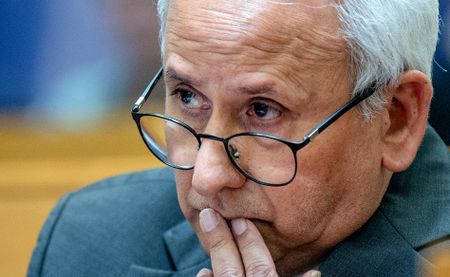
He stressed that accountability must remain central to policing.
“If police act unlawfully, as happened at Marikana, there must be consequences. Police cannot be above the law. Equally, protesters and organisers must also be held accountable when they break the law. The rule of law must apply at all times,” he said.
He underlined that the message, consistently articulated by the police leadership, appears to have resonated.
“So far, it seems that message has found a home,” he said.
Five arrested in KZN
KwaZulu-Natal police confirmed that a 14-year-old was among five suspects, aged 14 to 27, arrested for allegedly looting a tuckshop on Tuesday.
Police spokesperson Colonel Robert Netshiunda said the suspects allegedly broke into a tuckshop in the Woody Glen area of Mpumalanga township, Hammarsdale.
A total of 195 people were arrested and 103 cases were opened since 1 March in connection with nationwide demonstrations and the 30 June deadline for undocumented migrants to leave SA that was imposed by the March on March campaign.
The National Joint Operational and Intelligence Structure (NatJoints), the country’s highest security structure, is due to brief the media on Tuesday’s protests on Wednesday. DM
Comments
Scroll down to load comments...