




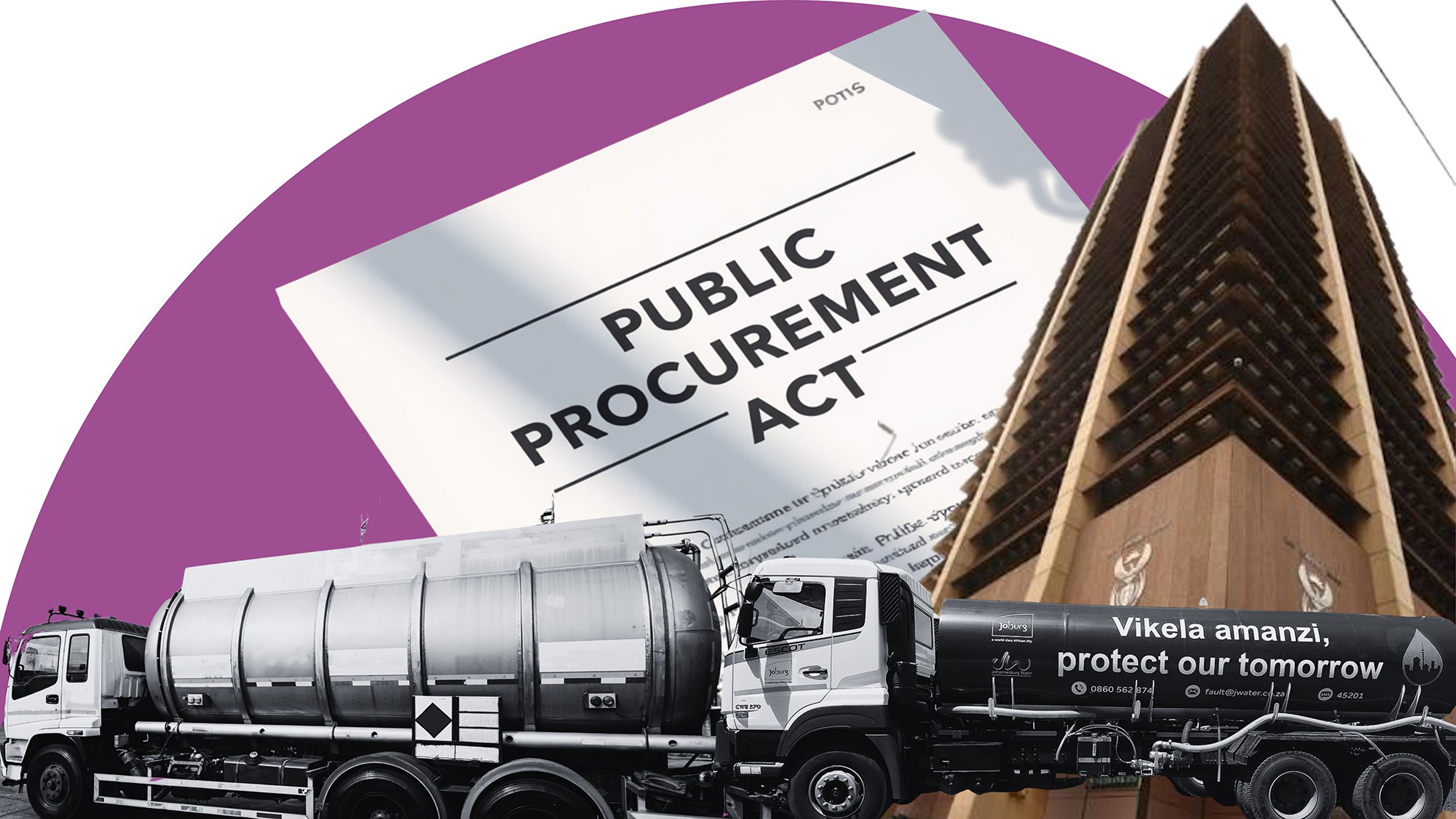
 From Eskom diesel contracts to Johannesburg Water tenders, procurement failures keep exposing the cracks in South Africa’s tender system. The question now is whether reform will fix them – or add more red tape. (Canva / National Treasury / Eskom / JHB Water)
AmaBhungane recently reported that Eskom awarded three diesel-supply contracts, each worth roughly R4-billion, to:
- A group that is under investigation for allegedly bribing Transnet officials.
- An obscure company that also received a large water tanker contract from Johannesburg Water.
- A company led by a 24-year-old psychology graduate and online wig seller.
Eskom is investigating the “possible irregularities” in that and other diesel fuel and storage contracts. But, as with many of the irregular tenders we investigate, this may be too little too late.
Another of our recent investigations detailed how, despite the high court declaring a Johannesburg Water tender process irregular, the contract remains in place during the appeal process and the contractors are likely to receive full fees under the contract.
As our investigations so often demonstrate, corruption and mismanagement crop up at all stages of the tender process – when the tender is conceived and the specifications are designed; when the bids are evaluated and adjudicated and a winning bidder chosen; when successful bidders are allowed to deviate from the terms of their contract; and when managers and external authorities fail to hold those responsible for irregular awards accountable.
It is clear to us that SA’s public procurement system is failing.
But as investigative journalists we find ourselves on the outside of the system – not least because of its extreme opacity and state entities’ allergy to disclosure of tender documents.
And so, what we see – and what we focus on most – is the corruption that appears to be a feature, and not a bug, in the system.
The view from the inside
But earlier this month, an event opened the window a little to how the system works and feels from the inside.
And it showed how, for those on the inside, the failings of the system look different but are no less fatal.
Stellenbosch University’s African Procurement Law Unit held a workshop in Johannesburg to discuss the draft regulations published by the National Treasury for public comment.
The regulations implement the new Public Procurement Act, signed by the president in July 2023. It is this act that we challenged in our recent Constitutional Court case where we argued that the manner in which Parliament passed the act was unconstitutional. The act has not come into force and cannot do so until the regulations are finalised.
The workshop brought together procurement officials from national, provincial and local government departments and state-owned entities, alongside a smattering of representatives of civil society, academia and the private sector.
There were supply chain managers, members of internal legal departments, representatives from the national and provincial treasuries, SARS officials and innovation managers, all sharing their experience with the existing procurement system and their suggestions on how the new system could be strengthened.
It was a unique event where officials were able to speak openly about how they are hamstrung by a clunky system and the red tape and inflexibility that prevents them from responding agilely to the reality of service delivery in the country.
These genuine civil servants aim to use the procurement system to facilitate poverty reduction and economic growth – to achieve the objectives of a developmental state that the more idealistic political actors at the workshop constantly referred to.
One participant spoke about how a tender for jackal-proof fencing had been invalidated because, instead of following the formal national Construction Industry Development Board requirements they had awarded the contract to a local company with direct knowledge of the area and employing local workmen.
Another spoke of their difficulties in managing relationships with suppliers struggling with the fuel increases because they could not adapt the contract price in light of the Iran war because it would trigger red flags and audit irregularities.
The workshop laid bare that the procurement system is failing on two fronts: it is too bureaucratic to allow real work to get done, but also so bureaucratic that it facilitates the type of corruption we investigate constantly.
For the civil servants present at the workshop, they want a system that creates the architecture for them to procure goods and services fairly and cost-effectively, but with enough flexibility that they can adapt when the circumstances require.
For us, as civil society and ordinary citizens, we need one that is robust enough to identify possible fraud and corruption, act on it swiftly and ensure that no officials or suppliers benefit unduly.
The Zondo Commission highlighted the risk that an overly complex and fragmented procurement system contributes to corruption as it inhibits oversight and opens loopholes for abuse.
This is obviously because the more complex a system is the easier it is to hide irregularities.
But the other danger of a formalistic compliance regime is the possibility of weaponising anti-corruption.
We all know that honest civil servants are a threat to those who seek to abuse the system for financial gain. An overly bureaucratic procurement system allows for small mistakes by those honest civil servants to be latched onto by those who would prefer them to be removed.
Our experience over the years has also taught us that procurement officials who are worried about following complicated procedures are also resistant to transparency because they fear that any exposure of their honest mistakes would lead to accusations of wrongdoing.
And so a system with less red tape would benefit us all, provided it is accompanied by high levels of public transparency.
The new act
The Public Procurement Act and its regulations are supposed to streamline the legislative framework governing procurement in SA.
What was an unwieldy web of pieces of legislation, regulations and Treasury Instructions was supposed to be pared down into one overarching law with coherent and concise regulations giving practical detail to the practice of procurement.
But the new regulations add layers of bureaucracy to an already overburdened process.
In an earlier webinar, a participant described the new system as needing a PhD to understand it. In response, even those with PhDs said they struggled to fully comprehend all its nuances!
Time and again at the workshop, procurement practitioners highlighted their concerns that the increased compliance responsibilities required by the new regulations would increase the risk of audit failures, create unnecessary delays in the awarding of contracts and hamper other important goals such as promoting local businesses.
We know, from our investigations, that these compliance requirements will also not inoculate the system against corruption.
In addition, the levels of bureaucracy would require an immensely capacitated and large workforce. In fact, one sarcastic comment was that the government was addressing the rising unemployment rate by creating (on paper only) many, many supply chain management jobs.
Public Procurement Office
And this is another problem with the idealised system created by the act and regulations – so much of its implementation depends on the newly created Public Procurement Office.
The office is a formalised version of the existing Office of the Chief Procurement Officer.
Nowhere in any of the documents published for public comment on either the act or regulations is there a costing of the implementation of the new system.
If the act’s provisions cannot be properly implemented because of a lack of capacity, then the risk of abuse rises.
At the workshop, the codification of the Public Procurement Office was described as a “double-edged sword”; the implementation of it as designed would strengthen procurement in the country but, as it’s unlikely that the ideal system is practically possible, the legislature’s introduction of the Public Procurement Office may cause more harm than good.
It is clear that the proposed system, expressed through the act and its regulations, is not a finished product and needs much amendment to be able to be effective and capable of resisting corruption.
Solutions
Luckily there are two possible solutions – the timeline for public submissions on the regulations has been extended to 15 July and it is likely that the Constitutional Court will declare the process of the act’s adoption unconstitutional, meaning Parliament would have to conduct a fresh public participation process.
We have the opportunity to push for real improvements. We should take it.
The recent workshop showed that there is a strong community of procurement practitioners desperate to put their expertise to use and strengthen the procurement system for all of us.
This is an opportunity for the National Treasury and Parliament to enact real change. They should also take it. DM
This story was produced by the amaBhungane Centre for Investigative Journalism. Sign up for their newsletter.
Comments
Scroll down to load comments...