




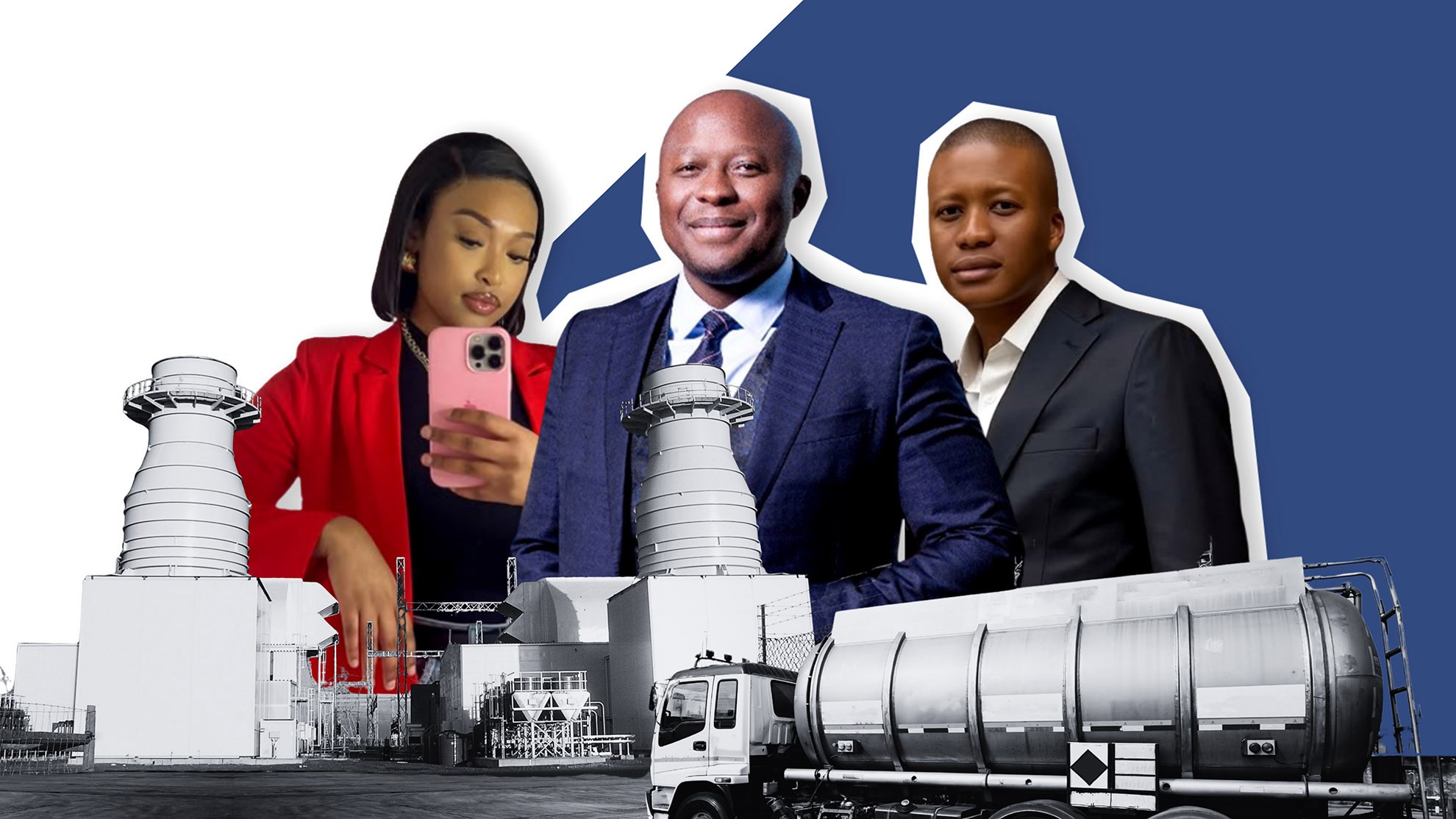
 From left: Minenhle Mavuso, Lwazi Mtshali and Sibuyile Magingxa – three of the beneficiaries of Eskom's R21-billion diesel tender plagued by irregularities and under investigation for almost a year. (Image: Lanele / Eskom / Instagram / Canva)
In 2024, Minenhle Mavuso (24) was living two separate lives.
In one, the BA psychology graduate ran an online wig store – “Milo Hair Beauté” – where a super double drawn bob would set you back R1,180. In the other, she ran Severino Industries, a company that was bidding for a R21-billion contract to supply diesel to Eskom’s Ankerlig power station.
Ankerlig is one of Eskom’s Open Cycle Gas Turbines, located on the outskirts of Cape Town. As a peaking power station, it runs massive diesel generators to keep the lights on for the entire country when Eskom’s fleet can’t meet demand.
Mavuso had been appointed as a director in December 2023, a week before the tender closed, and soon after that the company’s Zimbabwean-born founder, Nigel Nenji, resigned, leaving Mavuso as the sole director.
Ten months later, Severino signed a contract to provide Eskom with roughly R4-billion worth of diesel over the next five years.
Mavuso, now 26, initially agreed to an interview then ghosted us. In a follow-up email she said: “In accordance with company policies and procedures… the company’s official response will suffice, rather than providing a separate response in my personal capacity.”
Yet Eskom’s decision to entrust one of its most critical and lucrative contracts to Mavuso’s company, is only one of the many irregularities we have unearthed while investigating tender MWP2197GX.
From R3-billion in extraordinary prepayments, to a contract awarded to a group under investigation for bribing Transnet officials, this deal is arguably shaping up as one of Eskom’s most problematic.
Two weeks ago, Eskom released a curt statement confirming that its newly established Group Investigations and Security Department was investigating “possible irregularities relating to the procurement of diesel fuel and storage contracts”.
“Eskom can confirm the investigation is now in its final stages of completion… Given that the matter is still pending, Eskom is not in a position to engage on the details or comment further at this stage,” it said.
What Eskom did not say was that amaBhungane had raised questions about the contract in June last year, which Eskom refused to answer.
Nor did Eskom say that it had ignored two PAIA requests asking it to release the documents that would explain how the winning bidders were awarded the contract.
But since then, sources have reached out with detailed forensic evidence showing purchase orders, dates, volumes and payments.
A month ago, we put 47 detailed questions to Eskom. After multiple requests for extensions, a spokesperson told us: “Eskom has issued a statement confirming that the investigation is in its final stages and remains subject to internal governance, legal and assurance processes … Accordingly, we are unable to discuss this matter any further.”
Refiners, importers and middlemen
When Eskom advertised the five-year contract in October 2023, it was clear about who it expected to qualify.
“This contract is currently with PetroSA” – the state-owned petroleum company – “due to capacity and the value of this contract Eskom is willing to test the market on an open tender and is likely to get major importers of the product and local manufacturers in the petroleum and liquid industry.”
It wasn’t just the size of the contract – one billion litres of diesel over five years – that would likely take smaller players out of the running. It was also the rules: bidders were required to keep at least five million litres of diesel (worth around R100-million) in storage and would have to wait for 60 days to be paid.
Unless the rules were bent to suit certain suppliers.
AmaBhungane’s own investigation suggests that Eskom overlooked a series of red flags about the suppliers it picked, leaving it exposed when the tide went out and the country was threatened with load shedding.
On 30 December 2024, Eskom sent a letter – “To All Tenderers” – breaking the news that the tender had been awarded: “The successful suppliers are: African Forwarding and Shipping, Astron Energy, Lanele Resources, Nutinox, Severino Industries,” Eskom’s senior manager for procurement, Antonie Mammes, wrote.
The first, African Forwarding and Shipping (AFS), is a fuel importer and member of the Fuels Industry Association of South Africa, while the second, Astron Energy, is a local refiner.
But the other names left some in the fuel industry scratching their heads.
Nutinox was an obscure company, run and owned by a 30-year-old entrepreneur from the Eastern Cape, Sibuyile Magingxa. Its major claim to fame, revealed by amaBhungane in December 2024, is that it won a questionable R263-million contract to supply water tankers to Johannesburg Water.
Nutinox had a fuel wholesale licence and a turnover of R24-million in 2023. But an extract from what appears to be a memo to Eskom’s board suggests that Nutinox would now be in line for orders potentially worth R4.376-billion over the next five years.
Severino Industries was equally obscure. It had been in business since 2016 and secured a fuel wholesale licence a year later, but it had a rotating carousel of directors: aside from Nenji and the 24-year-old Mavuso, former Reserve Bank governor Tito Mboweni’s brother, Alto Mboweni, had briefly been appointed as a director, then resigned and his resignation was backdated to erase his tenure at the company. (“I’m not going to discuss personal work matters with you,” he told us.)
Severino’s managing director, Mzee Peter, who was appointed to head up the company shortly before the contract was awarded told us: “Severino Industries met all tender and contractual requirements. Eskom conducted its own due diligence and awarded the contract accordingly.”
Severino’s slice of the pie would be R4.366-billion, according to the purported board memo.
Lanele Resources was less obscure, but had a public profile for many of the wrong reasons.
In 2017 its sole director, Lwazi Mtshali, signed a contract on behalf of Lanele Resources’s holding company, Lanele Group, to develop a parcel of land, owned by Transnet’s property division, alongside Durban’s port.
As part of the deal, Lanele Group (where Mtshali was also sole director) received R85-million from Transnet to pay for site infrastructure for a proposed R2-billion fuel storage depot.
But the deal soured and, by 2024 when Eskom was conducting due diligence, Transnet and the Special Investigating Unit (SIU) were accusing Lanele and Mtshali of being involved in a scheme to bribe Transnet officials with three apartments in Johannesburg and a farm in Diepsloot.
Transnet had launched an action to get back its R85-million, while Lanele countered with a damages claim of R1.75-billion for the cancelled depot project.
Lanele denies involvement in the alleged corrupt payments, calling the SIU’s allegations “unproven, false and contradicted by evidence elsewhere on oath”. It confirms paying millions to a business partner who then paid the purchase price for three apartments and a farm that were gifted to Transnet officials. But it points out that the SIU has also claimed that a different Transnet supplier funded those alleged kickbacks, and agreed to pay back the money.
In spite of the allegations hanging over it, Eskom accepted Lanele’s bid and awarded it a potentially R4.359-billion portion of the contract.
In a follow-up interview with amaBhungane, Mtshali, Lanele’s CEO, said: “It’s in the public domain … we believe that we’ve defended it adequately.”
Khumbu Luthuli, Lanele’s chair, then asked us: “Are you suggesting that if there is any entity that is going through court processes and SIU is involved then the likes of Eskom should not deal with those potential suppliers?”
However, they conceded that the company Eskom appointed to carry out a due diligence did not raise the Transnet allegations, meaning that Eskom likely never assessed the potential risk.
A question of price
AmaBhungane understands that Shell, Engen and the state-owned petroleum company PetroSA were amongst the 24 bidders that lost out on the contract.
PetroSA, who had been the main supplier for years, confirmed that it had bid for the contract but wouldn’t disclose what price it had offered, only saying: “PetroSA confirms that our pricing aligned with prevailing market conditions at the time of submission.”
Although government sets the wholesale price of diesel, there is around R1.50/litre in discretionary margins that wholesalers can cut to improve the price of their product, while importers, who negotiate a better price on the international market, can cut their price further.
/file/attachments/orphans/1Wholesalemargins_339982.jpg "Wholesale margins. (Image: Canva)")
Eskom has tried to get a wholesale licence, that would allow it buy diesel from importers at a bigger discount, but the Department of Mineral and Petroleum Resources has refused, forcing Eskom to instead buy from wholesalers.
In May 2024, for instance, PetroSA had agreed to sell an oil tanker of diesel (50 million litres) to an obscure wholesaler at a R1.90/litre discount. At the time, one of the country’s other large importers was offering discounts of R1.80/litre, the supplier told us.
Yet, because Eskom’s tender was more onerous and the volumes smaller, the discounts it could secure would be smaller as well.
Between the five winning bidders, Astron had offered the smallest discount at 50c/litre off the wholesale price while AFS had offered the best discount at R1.60/litre. Nutinox (70c/litre), Severino (72c/litre) and Lanele (55c/litre) had all offered discounts in between.
But with contracts of this size, every cent matters: at potentially one billion litres over five years, every 10c/litre would cost Eskom another R100-million.
From the ‘board memo’, we know that at least one unnamed bidder had “offered competitive prices but because they scored zero on B-BBEE points, they fell behind in the ranking”. This is likely a reference to PetroSA: the tender required bidders to have a minimum level 3 B-BBEE grading and despite being a state-owned entity, PetroSA was only level 9 at the time.
At between 50c and R1.60/litre discount offered by the winning bidders, Eskom wasn’t always getting the best price and, as we’ll see, the power utility had also taken a risk by choosing a number of small players.
An entirely predictable emergency
When the new contracts started in January 2025, it was chaos: “On 1 January 2025 an urgent situation arose for Ankerlig Power Station,” Eskom told National Treasury’s chief procurement officer in a 20 January 2025 memo.
The old contracts had expired on 31 December 2024, the new ones were still being signed, and in the meantime, multiple power stations had suffered load losses, meaning that the Open Cycle Gas Turbines, like Ankerlig, were running overtime. To avoid loadshedding, Eskom needed to buy 10 million litres of diesel from Astron Energy, the local refinery owned by Glencore.
Emergencies are always suspicious in procurement terms. Eskom knew its contracts were expiring; it also knew that the Open Cycle Gas Turbines were working overtime: air emissions reports show that Ankerlig was burning through on average 50 million litres of diesel a month (roughly R1-billion) from December 2024 to April 2025.
/file/attachments/orphans/2Ankerligsdieselburn1_369583.jpg "Ankerlig’s diesel burn. (Image: Canva / Eskom)")
Yet, inexplicably, Eskom had allowed the existing diesel contracts to lapse. In September, Eskom had extended PetroSA’s contract by just three months, but the additional 20 million litres that secured had already been used up. With no plan B in place, Eskom bent the tender rules to keep the lights on.
“The contracts are being finalised with three contracts already having been signed but the new suppliers are still getting ready to deliver,” Eskom told Treasury. “Astron is the only contractor in a position to deliver the diesel required in the shortest time period required.”
The 10 million litres from Astron would cost R181-million. But leaked internal records show that Treasury wasn’t being told the full story.
Bending the rules
When Eskom picked Nutinox, Severino and Lanele as winning bidders, there were people within Eskom who raised concerns. We don’t have permission to quote exactly what was said, as it may identify the source of our information, but it was along the lines of “are we sure that these guys can actually deliver?”. The answer they apparently got was: “We’ve checked, it won’t be a problem.”
The winning bidders would need to have at least five million litres of diesel in tank and be available to deliver at short notice. This was a big ask: five million litres at the going rate of R18.64/litre would cost R93-million.
The tender documents had also been explicit that suppliers would only be paid after 60 days, in line with Eskom’s long-standing payment policy. These rules had already been bent during the tender, when some of the shortlisted bidders were offered the chance to reprice their bids on 15-day payment terms.
The extract from the board memo suggests that Astron had offered a 5c/litre discount off the wholesale price on 60-day payment terms, but had offered a discount of 50c/litre if Eskom agreed to pay its invoices after 15 days.
“Lanele’s bid pricing included a range of values,” CEO Lwazi Mtshali told us. “[I]t was Eskom who initiated price negotiations… Eskom sought greater discount but eventually the contracted pricing fell in the range as those that were submitted in the bid.”
/file/attachments/orphans/3Betterpricesforfasterpayment_677900.jpg "Better prices for faster payment. (Image: Canva / Eskom)")
Yet soon, there were issues with Eskom’s already generous payment terms.
According to the source inside Eskom, the winning bidders couldn’t get product from their own suppliers who, understandably, wanted to be paid before they released the diesel. This was why the tender had anticipated refiners and major importers, who could carry the costs for 60 days.
Now, faced with suppliers who seemingly had neither the cash nor the creditworthiness to pay for the diesel that Eskom desperately needed, the insider says Eskom agreed to give the suppliers a leg-up in the form of prepayments.
Documents show, for example, that on 27 February, Nutinox presented Eskom with an invoice for R18.5-million for one million litres of diesel. The following day, Eskom paid up, labelling the transfer a “100% downpayment” to Nutinox. Eskom would only take ownership of the fuel “in tank” on 11 March, and it would take weeks for the fuel to be delivered by truck to Ankerlig power station.
By contrast, records show that when a normal payment was processed, Eskom received the fuel, then an invoice, which was paid up to 14 days later.
/file/attachments/orphans/4Howprepaymentchangestheprocess1_922313.jpg "How prepayment changes the process. (Image: Canva)")
Yet the R18.5-million prepayment to Nutinox wasn’t a once-off: on 25 February, Eskom made a “downpayment” to Severino for R378.6-million. As soon as Eskom received the 20 million litres of fuel on 27 February, it made another “downpayment” of R473.3-million to Severino. This second order of 25 million litres of diesel would only materialise a week later.
Extracts from Eskom’s SAP system, suggest that between February and July 2025, Eskom made at least 18 payments labelled “downpayments” to:
- Nutinox, worth R295-million,
- Lanele, worth R1.297-billion,
- And Severino, worth R1.374-billion.
In total, it’s alleged that Eskom released almost R3-billion in just five months to help prop up its new suppliers.
Nutinox declined to comment, saying: “we have taken the decision to await the finalisation of the forensic investigation, with which we have fully cooperated … We respect Eskom’s internal processes and will not pre-empt or comment on any alleged irregularities.”
But Severino’s managing director, Mzee Peter, elected to play open cards: “While it is correct that prepayment (PN00) terms were applied in certain instances, this was not done simply because the successful bidders were unable to secure finance for product independently,” he told us in a written response.
“Rather, the decision must be understood in the context of an urgent and constrained operating environment, where the primary objective was to ensure continuity of diesel supply to OCGTs … It would therefore be an oversimplification to suggest that the terms were introduced solely to support the financial position of the winning bidders.”
He added that Severino had credit facilities but that “conventional procurement and payment cycles” could not always meet Eskom’s demand for diesel. “That said, it has become our understanding that such arrangements are not standard practice and carry inherent risks, which is why they could be typically applied under exceptional circumstances…”
In an earlier written response, he told us: “These arrangements were not unique to Severino and formed part of the executed contract … Eskom, as the procuring entity, is responsible for compliance with National Treasury regulations and any deviations. Severino executed its obligations in full and in good faith.”
Fooling the system
Prepayments aren’t illegal, but they’re strongly curtailed by the Public Finance Management Act and have to be written into the original contract.
Eskom has a notorious history with prepayments: in 2016, it agreed to give R659-million to Gupta-controlled Tegeta Exploration and Resources to prepay for coal that would later be delivered to Arnot power station. The prepayment was rushed through on the day it was approved, and helped the Guptas to pay the purchase price for Optimum Coal Mine.
When Eskom accountant Snehal Nagar testified at the State Capture Commission, he said: “[T]he system is set-up where you order goods, when you receive the goods, you pay for it. In this case you almost – I want to call it fooling the system if that’s the right word to use – … what you’re doing is you’re creating an order and you’re settling that order as if you’ve received the goods immediately to affect the prepayment.”
In the Tegeta case, it took months for the coal to be delivered, but it highlighted the risks of enabling a system where prepayments can be made.
One of the questions we put to Eskom a month ago was: “What collateral, if any, did Eskom hold to ensure it would receive the product it had already paid for?” Eskom chose not to answer.
The records we have are incomplete so it’s unclear how long Eskom was dangling in the wind.
Of the 18 transfers labelled “downpayment”, seven were paid several days before Eskom took ownership of the product, suggesting that the bidders could have used Eskom’s money to go out and buy product.
With other “downpayments”, records show that Eskom paid for the diesel and received it on the same day. The Eskom insider argues that many of these were back-to-back transactions, so the risk was lower.
When we initially asked Lanele Resources about the prepayments, CEO Lwazi Mtshali was adamant: “Lanele had to first secure fuel for Eskom in tank prior to Eskom payment. We did not receive ‘prepayments’ or ‘advantage’.”
In a follow-up interview, Khumbu Luthuli, Lanele’s chair, reiterated this: “We are not aware of any time during the tenure of this contract where we were paid any amount of money by Eskom before the ownership of the product had transferred to Eskom.”
Lanele told us that, on average, Eskom paid 45 days after receiving its invoice.
Yet records show that at least seven payments to Lanele – labelled as “downpayments” – came with “PN00” payment terms, meaning that Eskom was required to pay Lanele’s invoice immediately.
This was a long way from Eskom’s standard PN60 payment terms, meaning payment after 60 days, and was a further concession on top of the PN15 payment terms (payment after 15 days) that had been negotiated during the tender.
Luthuli conceded that there may have been instances where Eskom paid Lanele immediately, but that this would have come with further discounts: “Let’s say we agree that the discount is 45c for 30 days from date of statement … however if you pay us within 15 days then the discount will increase to 55c, as an example. If you pay us within five days, then it increases to 65 cents.”
Later, he added: “We’ve got an agreement with Eskom where if there’s an improvement in their payment terms that is followed by an improvement in the discount… I can confirm that the agreement we have with Eskom starts from zero [days] all the way to 60 days from date of statement.”
The records we’ve seen don’t support this claim: instead, they show that Lanele consistently provided the same 55c/litre discount off the wholesale price, regardless of whether Eskom paid after 15 days, or immediately (in breach of the tender rules and its own payment policy).
Records suggest that Astron received similar treatment: 108 smaller payments, labelled as “downpayments”, came with PN00 payment terms. We don’t have records for these payments, which total R169-million, so it’s unclear what kind of advantage Astron received.
Astron denies that it benefited from an irregular arrangement. In a two-line response, it said: “Astron Energy categorically rejects the notion that it benefited from any irregular actions allegedly taken by Eskom. Astron Energy conducts its business in accordance with applicable law and the contractual terms to which it is a party and rejects any implication of improper conduct.”
African Forwarding and Shipping (AFS), the final winning bidder, which had offered Eskom a R1.60/litre discount off the wholesale price, told us that it had not received any prepayments: “AFS did not request, and was not offered, any advance payment in respect of any purchase order issued,” CEO Lorraine Pillay told us. “We have not received any order with PN00 [payment terms].”
In fact, Pillay told us, AFS barely received any orders since the contract started: “AFS had bid for diesel supply on the basis of being an importer and had priced its product accordingly. Eskom unfortunately has refused to issue a [purchase order] that enable full vessel import.”
For price and logistical reasons, fuel importers typically want to order a full tanker cargo, meaning about 50 million litres.
There is nothing in the draft contract we have seen that suggests Eskom was required to order an entire 50-million-litre cargo at one go to suit AFS. Yet AFS had only been able to offer a more generous R1.60/litre discount because it is an importer, and Eskom had placed orders with other suppliers and made generous downpayments for 154 million litres of diesel, that all came at higher prices than AFS had offered.
“[T]here have been numerous letters to Eskom on this matter. Unfortunately, AFS’s pleas fell on deaf ears,” Pillay said. “AFS despite the challenges above has delivered negligible volumes, by truck, to Port Rex and to Ankerlig.”
A non-negotiable gets negotiated
The reason we started asking questions a year ago, was that it seemed improbable that Nutinox – a little-known company that supplied water tankers to Johannesburg – had been able to meet the tender’s strict requirements.
One of the non-negotiables in the tender was that bidders had to own or lease five million litres of storage, which would be kept full of diesel, ready to dispatch as soon as Eskom placed an order.
This was an expensive undertaking: the closest storage facility to Ankerlig is the Montague Gardens tank farm, jointly owned by BP and PetroSA. Here, five million litres of storage at 17.2c/litre will set you back R860,000/month.
It was almost impossible to win the tender without secured storage as it counted for 25% of the technical score, and bidders had to score 70% to move to the next round.
Bidders who planned to lease storage would have just seven days to present Eskom with a signed agreement for the full five-year contract. Eskom would eventually reimburse them for rent, but bidders had to be serious enough players to secure a commitment of five years of storage up front.
Sources alleged that both Nutinox and Lanele had failed to secure storage – a breach of the tender rules that, if true, should have seen both companies eliminated.
Nutinox had signed a contract with Eskom and started receiving orders in January 2025. Yet, records show that Eskom didn’t start reimbursing Nutinox for storage at Montague Gardens until April.
“PetroSA entered into storage arrangements with Nutinox in March 2025,” PetroSA spokesperson Nonny Mashika-Dennison told us.
Nutinox had added a mark-up on PetroSA’s storage fees which are set at 17.2c/litre by the National Energy Regulator (Nersa). Nutinox’s mark-up to 24c/litre seems insignificant, but at five million litres it generated an extra R340,000 a month in profit.
PetroSA told us that it had also supplied Nutinox with diesel: “PetroSA confirms that it has supplied fuel to Nutinox to support its contractual obligations with Eskom … Nutinox operates as a cash customer with PetroSA, and payments are made upfront.”
Records suggest that since Eskom stopped issuing prepayments, the orders to Nutinox have dried up. Despite this, Eskom is obliged to keep paying Nutinox R1.2-million (R1.38-million incl VAT) a month to rent the storage for the next three and a half years.
/file/attachments/orphans/5Nutinoxsstoragewindfall_978417.jpg "Nutinox’s storage windfall. (Image: Canva / Instagram / Eskom)")
We put it to Nutinox’s Sibuyile Magingxa that he seemed to be acting as little more than a middleman, collecting fees while Eskom still, in effect, bought its diesel from PetroSA. Aside from a level 1 B-BBEE grade, what other value was Nutinox adding? Magingxa declined to comment.
As for Lanele? CEO Lwazi Mtshali openly admits that – despite receiving billions of rands in orders – it did not have a signed contract for storage.
“[W]hen we submitted the bid, we showed the evidence that we have an arrangement [at Montague Gardens] for 5,000 cubes … It was an undertaking that we’ll conclude the lease upon us getting the contract,” he explained.
However, this was never signed. Instead, Lanele relied on free storage facilities it had at Astron: “We also had an enterprise development partnership with Astron, which also gave us access to Astron storage … which was submitted as part of the tender to indicate that we have access to molecules plus storage … It was [an] undertaking … it wasn’t a contract.”
We put it to Mtshali that this was clear breach of the tender rules that had seen other bidders with more competitive prices eliminated.
In a written response, he denied that there had been any breach or that Lanele had been given a free pass: “Eskom obtained an additional benefit for not paying for storage costs in 2025 which we (and we assume all other suppliers) were entitled to charge as per the tender and our contract.”
Someone did a due diligence, right?
When the tender was first awarded, the deal seemed low risk: Eskom would only pay for diesel once it was in its tanks.
It was still high risk in the sense that Ankerlig needed a consistent supply of fuel to prevent load shedding, and that the tender included supplying kerosene to Acacia, a much smaller station that is nonetheless responsible for providing back-up power to Koeberg’s nuclear power plant. In that sense, it was pretty important that Eskom knew who it was dealing with.
In October 2024, Eskom had hired professional service firm Rakoma & Associates to conduct due diligence checks on the five shortlisted bidders.
This was late in the day: when Eskom advertised the tender in October 2023, it gave itself a year finalise the contract. Emails with various bidders show that by March 2024, Eskom was chasing up outstanding documents and that by April, it was scheduling site visits. Then, things had gone quiet for six months.
We haven’t seen a copy of Rakoma’s mandate, and the company did not respond to calls and emails. But there were some obvious questions that anyone conducting a due diligence should have asked.
In Nutinox’s case, why was the company registered to a bogus address in Johannesburg’s Waterfall Estate? AmaBhungane had asked this same question a few months earlier when Nutinox had been awarded half of a R263-million contract to supply water tankers to Johannesburg Water.
The address helped Nutinox to score extra points in that tender, even though all indications were that company’s sole director and shareholder, then-29-year-old Sibuyile Magingxa, appeared to live in the Eastern Cape.
When the bids had been submitted for the Eskom tender, the company was run by Sibuyile’s father, Thembile Magingxa, a former president of the Umkhonto we Sizwe Military Veterans Association. But records show that he resigned two weeks later and handed the company over to his son.
In Severino’s case, the musical chairs among the directors should have prompted questions as well. Nenji, the Zimbabwean director, had also resigned shortly after the tender closed, leaving Mavuso – a 24-year-old with two months at the company – as the sole director.
We asked Nenji whether his resignation was an attempt to improve Severino’s B-BBEE score, and if Mavuso was acting as his proxy in the company. In a WhatsApp message he told us: “In the last 4 years I have resigned from 4 companies whom do not have any work or contracts with the government. All which I have had involvement with and reason for this this was purely because of my focus on other things i.e. commodity trading and personal issues. My final resignation from Severino which you are more interested in has always been on the cards and not aligned to the Eskom tender.”
He added: “I am no longer involved in the day to day running of the company and I am not a shareholder. My only involvement is that I had established a supplier relationship and if there is need for product on Severino’s side I can source product for them and the last [time] this happened was March 2025.”
In both cases, Rakoma should have asked whether the companies’ recently appointed directors had the experience to manage contracts that were expected to run to R4.4-billion each.
In Lanele’s case, the red flags were slightly different.
In September 2023, the SIU had disclosed to Parliament it believed Lanele and Mtshali had been involved in a scheme to bribe Transnet officials. Mtshali categorically denies this.
“Rakoma did conduct due diligence,” he told us in a written response. “The Transnet case was not raised with Lanele. We would like to think Eskom and Rakoma or whoever wanted to know about it would have asked us or referred to the papers, where we explain matters in detail and would gladly refer anyone to it… It is regrettable that this matter is now being dragged in, well-opposed and open to the public, to create a negative impression.”
But even if Eskom believed Mtshali’s version, the risk was still there: the SIU was investigating Lanele, and had told Parliament that it was “liaising with the [Specialised Commercial Crimes Unit] to fast track the criminal prosecutions”.
The risk that arrests or a preservation order would follow, attaching Lanele’s bank accounts and assets, was seemingly one that Eskom either overlooked or was willing to take.
The investigation
When we asked questions about the R21-billion diesel contract last year, Eskom offered a vanilla response: “This tender was awarded through Eskom’s current procurement processes and procedures. Each bidder was assessed individually based [on] the requirements set out in the tender documents … any contractual irregularities identified during execution trigger internal processes.”
What Eskom did not disclose was that an investigation was already brewing.
Itsamaya Holdings had been appointed on an emergency contract to conduct forensic investigations for Eskom in March 2025. “There is a threat of major consequential expense to Eskom. There is a threat of serious damage to Eskom’s reputation. Therefore, early delivery is critical,” Eskom had told Treasury in yet another deviation report, justifying Itsamaya’s appointment at a cost of R37.7-million.
The appointment, Itsamaya told us in a written statement, was part of Eskom’s rapid response project, dubbed RAPTOR: “The RAPTOR initiative focuses on urgent, high‐value investigations that may pose a significant risk to Eskom’s operational integrity, financial position, or reputation.”
This wasn’t limited to the R21-billion diesel tender, it added, but covered at least 60 other cases.
Severino, Lanele and AFS confirmed that they had co-operated with Itsamaya’s investigation, but all three were in the dark about its findings.
Two weeks ago, Eskom CEO Dan Marokane told the head of Afriforum’s private prosecutions unit, Advocate Gerrie Nel, that the investigation was almost complete. In a letter, Marokane wrote: “The investigation is currently undergoing internal quality assurance processes… this process is expected to be finalised by no later than 15 May 2026 … Eskom remains fully cognisant of its statutory and governance obligations, including its duty to consider and implement the recommendations arising from forensic investigations where appropriate.”
Last week, the wholesale price of diesel hit R31.54/litre, meaning that Eskom pays between R30 and R31/litre.
For now, Eskom continues to burn diesel in Ankerlig’s Open Cycle Gas Turbines, but at much lower rates. In February and March this year, the station burnt 1.6 million litres of diesel, down from 121 million litres in February and March 2025, when most of the prepayments were made.
“There is absolutely nothing [wrong] with the … prepayment. In fact, it was the only alternative available to Eskom,” a senior Eskom official once said in other circumstances.
That official was Matshela Koko, the former head of generation, justifying the R659-million prepayment made to the Guptas in 2016.
Nine years later, has Eskom changed? DM
This story was produced by the amaBhungane Centre for Investigative Journalism. Sign up for their newsletter.
Comments
Scroll down to load comments...