



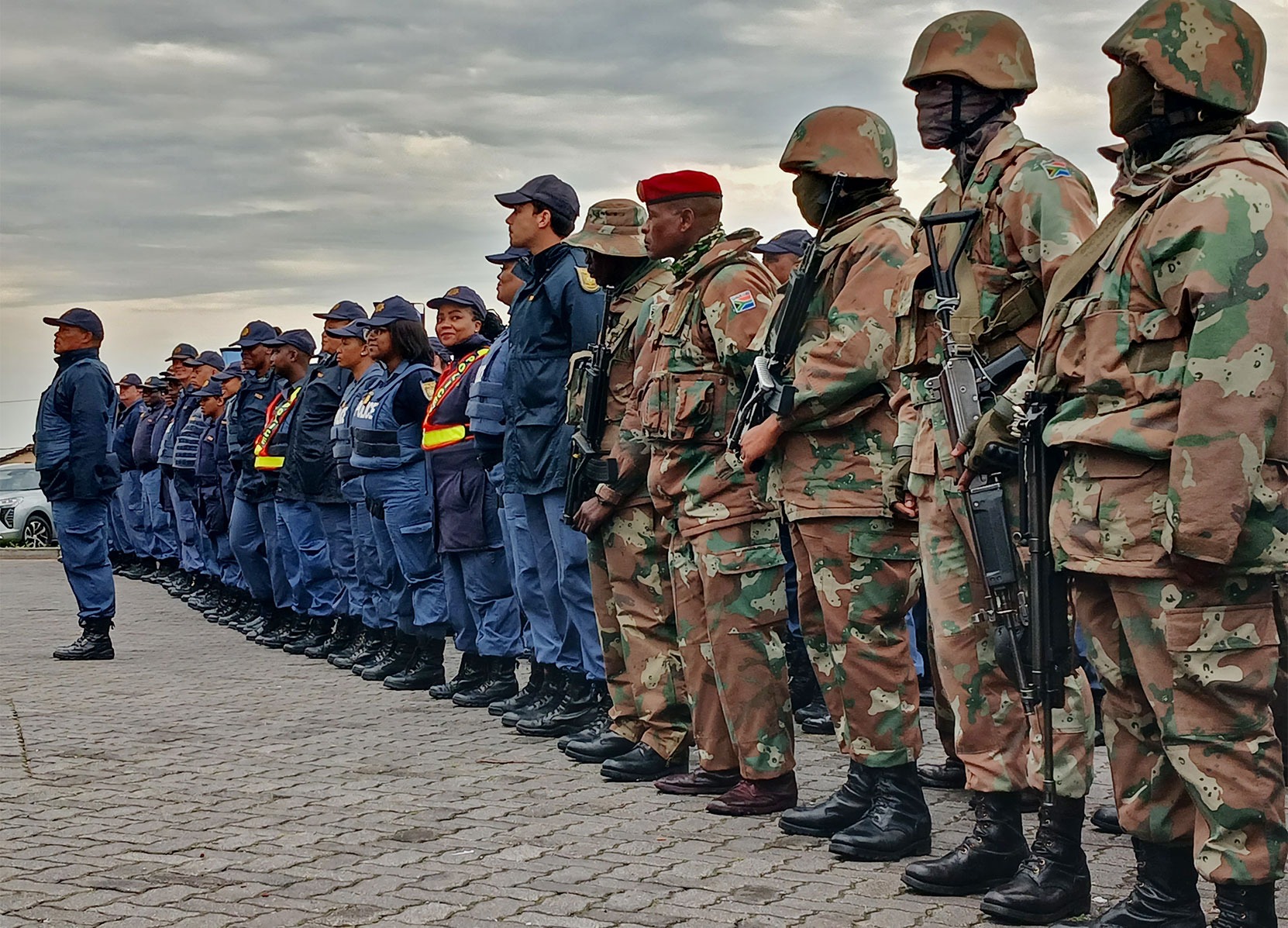
 SAPS and SANDF personnel at the Nelson Mandela Bay SAPS 10111 Centre on Thursday, 25 June, for a briefing in preparation for anticipated countrywide protests against illegal immigrants on 30 June 2026. (Photo: Riaan Marais)
Law enforcement in the Eastern Cape will adopt a zero-tolerance approach to the anticipated anti-immigration protests set to take place across the country on 30 June.
There will be no tolerance for violence, no roads will be closed, and there will be no negotiation with people who escalate peaceful protests into violent riots.
This was the clear and concise message MEC for Community Safety Xolile Nqatha, along with provincial police commissioner Lieutenant General Vuyisile Ncata, shared with members of the police, SANDF and other law enforcement agencies when they gathered at the SAPS 10111 Centre in Gqeberha on Thursday.
While reports indicate that the Eastern Cape has been earmarked as a ‘minimal risk’ zone for violence during the anticipated protests against illegal immigrants across South Africa on Tuesday, the police have identified several locations as potential hotspots where additional resources will be deployed if needed.
“In recent weeks, we have noted the concerns raised by various activist groups across the province and country about illegal immigration and its impact on local businesses and communities. And while we understand these concerns, we must emphasise that no private individuals or groups will be allowed to assume the duties and responsibilities of law enforcement,” the MEC said.
/file/attachments/orphans/SAPS-Ready-4_971125.jpg "Eastern Cape MEC for Community Safety Xolile Nqatha, flanked by provincial police commissioner Lieutenant General Vuyisile Ncata, briefs law enforcement members at the Nelson Mandela Bay SAPS 10111 Centre on Thursday, 25 June 2026, ahead of anticipated countrywide protests against illegal immigrants on 30 June. (Photo: Riaan Marais)<br>")
Everyone’s right to peaceful protests was protected by law, but Nqatha warned that the police across the Eastern Cape had been placed on high alert and were mandated to protect the public should demonstrations turn violent.
“You are not here to negotiate the law. You are here to enforce it,” he told members of the gathered law enforcement agencies on Thursday.
Nqatha said each of the province’s eight districts would establish a joint operations centre (JOC) where roleplayers from various law enforcement agencies and government departments would gather to monitor activity in their regions.
Potential hotspots identified
He said forces on the ground would have the support of the Eastern Cape’s political leadership, who he said had an equally important role to play in the unfolding situation.
“Our political leaders will not be spectators on 30 June. The challenges our law enforcement officials will face are due to shortcomings from government departments. We need to address these issues and do our jobs, so that our forces on the ground can do theirs.”
He mentioned Nelson Mandela Bay, KuGompo, Komani, Ngcobo, Butterworth and several smaller, rural communities that had been identified through police intelligence and community reports as possible hotspots for violent protests.
“No violence, from or against protestors, will be tolerated. We cannot have vehicles being torched, shops looted, infrastructure targeted, vigilantism and mob justice,” the MEC said.
In response to questions around hotspots specifically in Nelson Mandela Bay, provincial police commissioner Ncata said areas like Korsten, Veeplaas, Central, Motherwell and New Brighton would be among locations monitored closely.
“We are constantly receiving updates and reports from crime intelligence and sources within the community about where the hotspots could be. This is a moving target, and we need to approach it accordingly,” Ncata said.
He said among the government officials deployed along with law enforcement, Home Affairs and immigration officers would have one of the most crucial roles to play come 30 June.
Sources within the private security community have indicated that they anticipate less violence in the Eastern Cape, and that the major areas of concern will probably be in KwaZulu-Natal and Gauteng.
They largely agree with the police’s assessment of Nelson Mandela Bay, that Korsten and Motherwell could be the most likely to see violence. Korsten, because of the high concentration of foreign-owned shops, and the roads around Motherwell are some of the main routes for vulnerable road freight.
However, several firms specialising in armed escorts for trucks have indicated that their clients will suspend road freight on 30 June to avoid possible damage and losses to goods.
/file/attachments/orphans/SAPS-Ready-3_176713.jpg "Members of the SAPS and SANDF gathered at the Nelson Mandela Bay SAPS 10111 Centre on Thursday morning for a briefing in preparation for protests against illegal immigrants anticipated around the country. (Photo: Riaan Marais)<br>")
Speaking to the ground forces gathered in Gqeberha, Nqatha also urged them to take care of themselves and their colleagues in the performance of their duties.
“March forward when it is safe to do so and do not take uncalculated risks. You also have lives to live and families to go home to.
“Do not try to be movie stars and do not be afraid to fall back and call for backup. Move forward when it is safe to do so and keep watch over each other,” Nqatha said. DM
Comments
Scroll down to load comments...