




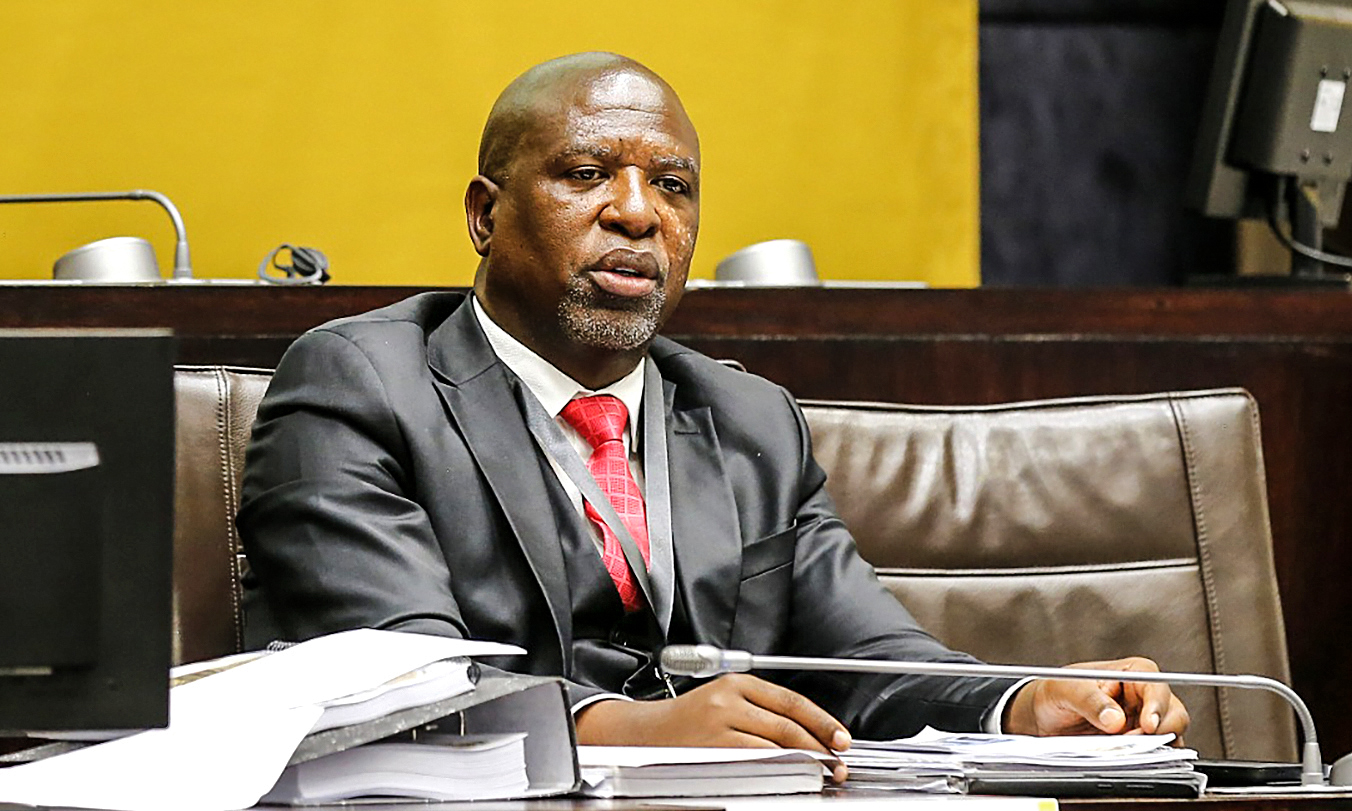
 Soviet Lekganyane, chair of the parliamentary ad hoc committee inquiry into alleged corruption and political interference in the criminal justice system. (Photo: Phando Jikelo / RSA Parliament)
Among the proposals submitted by political parties for inclusion in the preliminary report of Parliament’s ad hoc committee on the policing crisis is a recommendation to strengthen cooperation between the SAPS, its Directorate for Priority Crime Investigation, the Independent Police Investigative Directorate (Ipid), Investigating Directorate Against Corruption (Idac) and the National Prosecuting Authority (NPA).
Political parties have also called for an assessment of disputes between these agencies and their impact on investigations and prosecutions.
The calls, contained in submissions by the ANC, MK party and the EFF on Wednesday, 24 June, come against the backdrop of deteriorating relations between several of the country’s key law enforcement agencies following a dramatic chain of events triggered by the Idac attempted arrest of Crime Intelligence head, Lieutenant-General Dumisani Khumalo, and senior officer, Major-General Nosipho Madondo.
The tensions were further heightened by widespread speculation that KwaZulu-Natal Police Commissioner, Lieutenant-General Nhlanhla Mkhwanazi, could also face arrest.
The developments culminated in Mkhwanazi’s explosive public warning that the SAPS was “facing a war” and that “there are many players in this game”, remarks that ignited a national debate about criminal infiltration, factional battles and the integrity of South Africa’s law enforcement institutions, and Idac head Andrea Johnson’s warning that his comments were a “serious threat”.
When the ad hoc committee met on Wednesday, 24 June, to consider its draft preliminary report into allegations made by Mkhwanazi, MPs did not debate the report itself. Instead, they received a detailed summary of political party submissions that have since been incorporated into the draft.
Nicolette van Zyl-Gous, the committee’s content adviser and parliamentary researcher, outlined the various proposals, concerns and recommendations raised by parties during the consultation process.
Committee members will now study the revised draft before reconvening for two days of deliberations scheduled for Tuesday, 30 June and Wednesday, 1 July, when the report’s findings and recommendations are expected to come under closer scrutiny.
In the committee’s draft report, advocate Norman Arendse SC, the evidence leader in the committee, which is investigating the infiltration of law enforcement agencies, said SAPS was facing a serious and multilayered institutional crisis. He outlined the committee’s preliminary findings when the report was presented late on Thursday, 28 May 2026.
The committee has been investigating accusations first made in July 2025 by Mkhwanazi. He alleged that a drug cartel, known as the Big Five, had infiltrated South Africa’s criminal justice system, politics and private security.
Several police officers and other state figures testified about these and broader allegations before the ad hoc committee.
Key figures mentioned in the first draft report included organised crime suspect Vusimuzi “Cat” Matlala, who faces various charges, and sidelined police minister Senzo Mchunu.
Mkhwanazi previously alleged that Matlala was a Big Five cartel member and had dubious links to Mchunu, which Mchunu denied.

PKTT disbandment
The 31 December 2024 directive by Mchunu to disband the Political Killings Task Team (PKTT) remains a sticky issue.
It was the evidence by controversial ANC-aligned North West businessman Brown Mogotsi before the ad hoc committee and the Madlanga Commission that opened a can of worms and shed light on his alleged relationship with Mchunu. He apparently knew of the disbandment before it was officially communicated.

The ANC has called for a separate assessment of all three components of Mchunu’s 31 December 2024 directive, which include the PKTT disbandment, a moratorium on crime intelligence appointments, and a review of police deployments at ports of entry.
The EFF said there should be a clearer conclusion in the committee’s report that the PKTT was operationally effective and remained authorised.
Parties also questioned the credibility of evidence presented by suspended Lieutenant-General Shadrack Sibiya, the controversial R360-million Medicare24 contract awarded to Matlala and the recurring role of Mogotsi.
The MK party raised concern that the inquiry focused too narrowly on the SAPS and did not sufficiently investigate the NPA, Idac, the judiciary and magistrates.
Public dispute between Idac and SAPS
The growing tensions between the SAPS and Idac also drew criticism from Portfolio Committee on Police chairperson Ian Cameron on Wednesday.
Cameron said he was concerned by the increasingly public nature of the dispute between the two law enforcement agencies. He is of the view that the public exchange between them undermines their credibility and, in turn, weakens their ability to effectively execute their mandates in the fight against crime.
“The media spectacle that has unfolded in recent times does little to enhance the legitimacy of either institution. At face value, it presents a law enforcement apparatus in disarray, preoccupied with internal battles rather than the safety and security of the people of South Africa,” Cameron said.
Cameron said he would engage the Portfolio Committee on Justice and Constitutional Development with a view to both committees jointly seeking answers to the broader concerns raised by the unfolding dispute.
He stressed that the issue was not about choosing between Idac and the SAPS, but rather ensuring that both institutions are able to perform their statutory functions independently and without fear, favour or political interference.
“The real question is whether the rule of law is being protected,” Cameron said, warning that public attacks by senior law enforcement officials on one another risk undermining confidence in the very institutions tasked with upholding it.
While noting Idac’s explanation for suspending the execution of arrest warrants issued for Khumalo and Madondo, Cameron questioned whether the circumstances surrounding the decision could further erode public trust in the criminal justice system.
He said the reasons advanced by Idac appeared, at face value, difficult to reconcile with standard law enforcement practice and had fuelled perceptions of possible interference.
Cameron called on Idac to provide a full account of how the decision to suspend the warrants had been reached, including who was involved and the legal basis for the intervention. DM
Comments
Scroll down to load comments...