



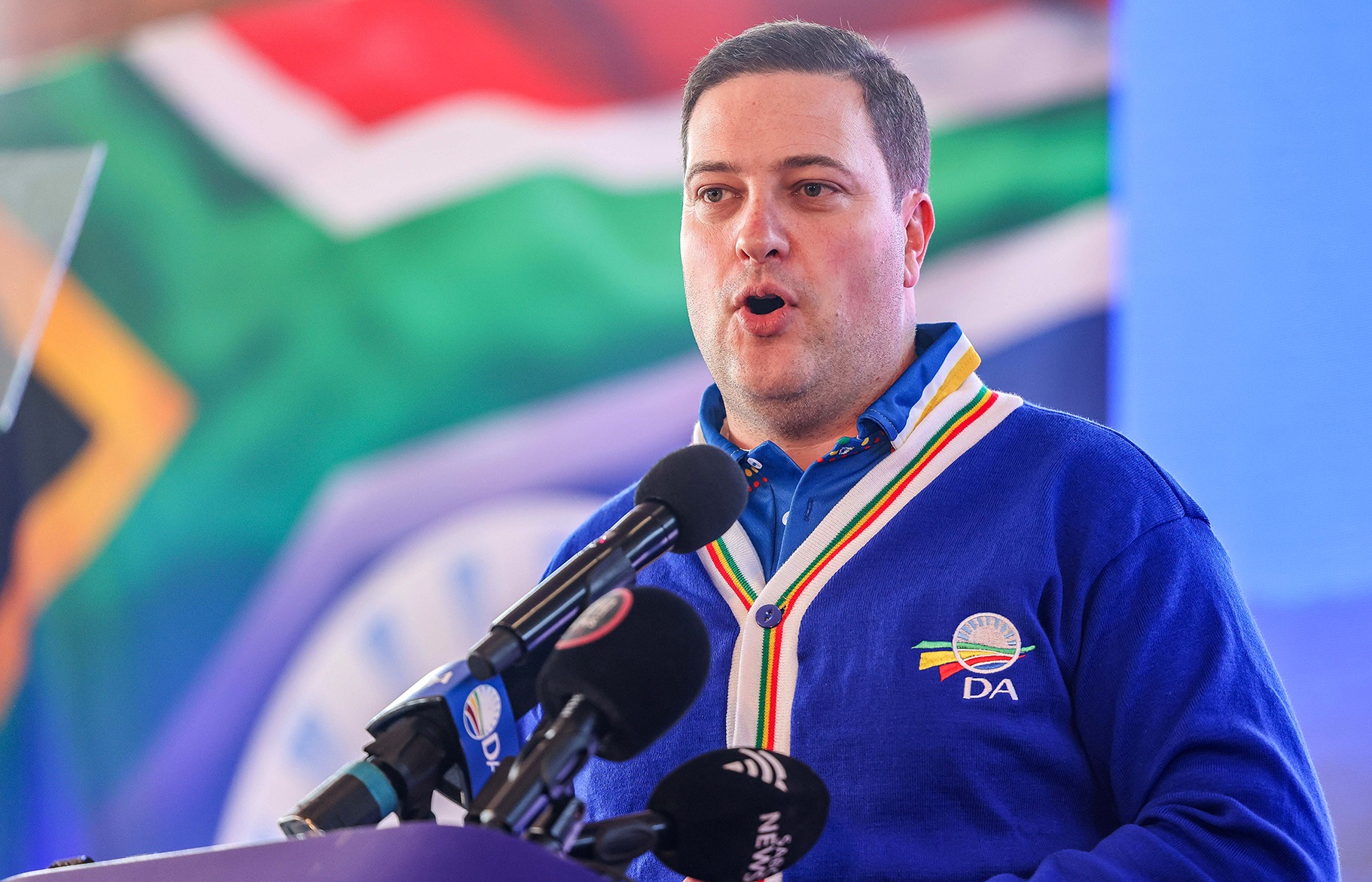
 Geordin Hill-Lewis, DA Federal Leader, speaks at the announcement of the Democratic Alliance (DA) election pledges on 10 June 2026 in Boksburg, South Africa. (Photo: Gallo Images / OJ Koloti)
A dispute over the detainment of a Ukrainian scientist has laid bare one of the sharpest geopolitical schisms yet seen in Antarctic governance – pitting a Global North bloc of Antarctic Treaty consultative states against a Global South bloc of consultative states with the same veto powers.
The split apparently neatly cleaved the treaty’s decision-making ecosystem of 29 consultative states between Global North and Global South. It surfaced during the 48th Antarctic Treaty Consultative Meeting (ATCM) in Hiroshima, Japan.
There is one exception to the Global North bloc. That sole exception is the US, the treaty depositary increasingly seen to align with Russia at other international forums such as the UN.
According to the meeting’s preliminary report, released on 19 June, Ukraine raised the ongoing detention of marine biologist Dr Leonid Pshenichnov, a Ukrainian citizen and adviser to Ukraine’s delegation to the Commission for the Conservation of Antarctic Marine Living Resources (CCAMLR).
Ukraine demanded his immediate release and urged treaty powers to protect scientific freedom.
The report records that “many parties” joined Ukraine’s call.
But behind the heavily redacted diplomatic language lies a potentially more consequential development for the nations that make decisions about the future of the warming Antarctic.
/file/dailymaverick/wp-content/uploads/2023/06/Crew-group-shot.jpg "The crew of Ukraine's national polar research and resupply vessel, Noosfera, display the flags of Ukraine and the state Antarctic programme in Table Bay Harbour, Cape Town, April 2023. (Photo: Nic Bothma)")
Daily Maverick understands that not one among the Global South’s 10 consultative states backed Ukraine. This bloc holds Argentina, Brazil, Chile, China, Ecuador, India, Peru, South Africa, Uruguay and, of course, Russia. The US, a Global North state, sits alongside this influential cluster.
Information provided to Daily Maverick by Ukraine indicates the support instead came from European treaty powers and close Western-aligned Asia-Pacific partners.
The Global North bloc included Australia, Belgium, Bulgaria, Czechia, Finland, France, Germany, Italy, Japan, the Netherlands, New Zealand, Norway, Poland, Spain, South Korea, Sweden and the UK.
In its response to our questions, Ukraine cited no non-consultative states, except Canada and Estonia – which joined the Global North.
Moscow, according to the report, used its Hiroshima podium to hit back. The matter had been addressed at CCAMLR’s October fisheries gathering in Tasmania, its delegation said. Saying Pshenichnov also held Russian nationality, they maintained that Russian authorities in occupied Crimea were acting lawfully.
Pshenichnov was detained in Crimea on 11 September and has remained in pretrial detention in Simferopol. At the time of the talks in Japan, he had been held for eight months.
Yet, the conservation of Antarctica, a climate-imperilled region spanning 10% of Earth, lives and dies by consensus – the absence of disagreement.
The treaty marks the 65th anniversary of its signing this week. How the Pshenichnov affair played out in Hiroshima suggests the emergence of a fault line striking at the core of Antarctica’s diplomacy.
/file/attachments/orphans/RussianATCMdelegation2026copy_158833.jpg "The Russian delegation at the Antarctic Treaty Consultative Meeting in Hiroshima, Japan, in May 2026. (Photo: AARI statement)")
‘Shameful moral disgrace’: SA’s position attracts attention
Hiroshima’s tectonic split reaches all the way to Cape Town, one of the world’s most important Antarctic gateways. Ukraine’s polar vessel, Noosfera, has berthed here since February 2022 while Russia’s entire Antarctic fleet has used the same port.
This is the popular tourist city run by Mayor Geordin Hill-Lewis – elected in April to lead the party that inherited South Africa’s Antarctic programme from the ANC when it entered the national coalition government in June 2024.
Yet, in April 2023, while in East Antarctica to relaunch Cape Town as a gateway, Hill-Lewis told Daily Maverick that “Russian state vessels should not be here”, but pointed out that ports were handled by the ANC-run transport department. “All of these Russian war exercises, and the meetings with Russian government ministers, are a shameful moral disgrace.”
The Western-aligned DA has, in fact, repeatedly defined itself in opposition to the Kremlin. And on 4 June, the DA issued a statement on alleged Russian electoral interference.
“The free people of the Republic of South Africa have nothing in common with a Russian dictatorship,” it said.
/file/dailymaverick/wp-content/uploads/2025/10/Not-welcome-Karpinsky.jpg "Protesters marked the April 2023 return of the Russian survey ship, the Akademik Alexander Karpinsky, from the Southern Ocean with flags at Cape Town harbour. (Photo: Nic Bothma)")
But the DA’s management of the Antarctic portfolio under the Department of Forestry, Fisheries and the Environment (DFFE), which it now also runs, contains an awkward paper trail from its ANC days. In 2021, the department signed a diplomatic eyebrow-raiser: an Antarctic memorandum of understanding with Russia under which the two countries agreed – “where possible” – to “coordinate their positions” on issues of “common interest”.
Responding to questions last year on Moscow’s international roadshow to attract “friendly country” support, the department denied that the “non-binding” MOU equalled “alignment with Russia’s stance on conservation matters”. It “reflects South Africa’s broader approach to diplomatic engagement, where dialogue and cooperation with all Antarctic Treaty parties – including Russia – are essential to advancing conservation-based measures”.
DA to ‘seek clarity through Parliament’
Are the DA’s positions consistent with South Africa’s decision not to join the Global North bloc backing Ukraine?
The DA’s DFFE spokesperson, Andrew de Blocq, said the party believed South Africa should have backed calls for Pshenichnov’s release, because “any action that appears to criminalise normal scientific cooperation risks undermining principles that have underpinned Antarctic governance for more than six decades”.
He said the DA would “seek clarity on this matter through parliamentary processes, including the submission of a parliamentary question to the DFFE, in order to establish what mandate, if any, was provided to the South African delegation and on what basis the decision not to support the call was taken”, said De Blocq.
In a phone call to Daily Maverick on Wednesday, DFFE Minister Willie Aucamp said the department’s scientific personnel had no mandate to speak on political issues but had dispatched an ATCM report to the Department on International Relations and Cooperation (Dirco).
/file/attachments/orphans/tori-aucamp-complain_843154.jpg "South Africa's two most recent DFFE ministers under the DA, Willie Aucamp (left) and predecessor Dion George. (Photo: Gallo Images / OJ Koloti) | (Illustration: Daniella Lee Ming Yesca)")
We also got a response from DFFE spokesperson Zolile Nqayi. Nqayi stressed South Africa’s commitment to the treaty’s foundational principles, including peaceful use and scientific freedom.
“South Africa cannot support any position that contravenes these fundamental principles,” Nqayi noted, but said the ATCM was not the appropriate forum to address the issue. “Even though the ATCM is not immune from geopolitical division, South Africa seeks to ensure that the treaty’s principles are advanced.”
ANC-run Dirco also sent a legal delegate to Hiroshima, so we sought comment from spokesperson Chrispin Phiri. Phiri acknowledged our query and promised to “revert”. No response was received within a 24-hour comment period.
Daily Maverick also contacted US and Russian Antarctic authorities, as well as Ukraine’s Ministry of Foreign Affairs.
The arrest and Antarctica’s hydrocarbon shadow
The Pshenichnov affair has become one of the most unusual legal and diplomatic disputes to emerge from the Antarctic Treaty System (ATS). He is the first member of an ATS delegation to be arrested by the authorities of another treaty state for activities connected to work done within Antarctic governance.
Evgen Dykyi, director of Ukraine’s National Antarctic Scientific Centre, told Daily Maverick that Pshenichnov was Antarctica’s “first-ever political prisoner”.
“Dr Pshenichnov, a 70-year-old adviser to Ukraine’s delegation to the CCAMLR, was charged with high treason for his scientific contributions on MPAs in the Southern Ocean.
/file/dailymaverick/wp-content/uploads/2025/10/Marine-biologist-profile-photo-1.jpg "Ukraine CCAMLR delegation member Dr Leonid Pshenichnov. (Photo: Supplied)")
“As the situation has not changed since the last CCAMLR meeting, Ukraine demands that the Russian Federation immediately release Dr Leonid Pshenichnov, and urges all treaty parties to prevent the persecution of a Ukrainian scientist in this manner as the first-ever Antarctic political prisoner.”
Initial allegations, according to Ukraine, linked Pshenichnov to Antarctic Marine Protected Areas (MPAs), and claim that his work had undermined Russia’s future access to Antarctic oil and gas resources.
Ukraine says the current accusation is aimed at Pshenichnov’s involvement in an attempt to limit Russia’s krill catch.
The hydrocarbon claims may have fallen away. But according to Ukraine, they formed part of a case that initially accused an Antarctic scientist of undermining Russia’s hydrocarbon interests in a region where mineral resource activities are banned.
The allegation intersects with a broader Antarctic controversy.
Russia’s Southern Ocean survey vessel, the Akademik Alexander Karpinsky, has led seismic expeditions that experts and local environmental groups argue resemble prohibited hydrocarbon prospecting.
Cape Town is its preferred Antarctic gateway.
Scientific cooperation continues despite political tension
Hiroshima’s tension, however, contrasts rather sharply with Antarctic scientific cooperation now underway in the heart of South Africa’s Big Five bushveld region outside Kruger National Park.
Until 26 June, it is none other than the sleepy safari town of Hazyview that is hosting an international workshop on the controversial Southern Ocean zone dryly known as “Area 48”, which supports major Antarctic krill fisheries.
The meeting has brought together scientists and fisheries experts from multiple countries to assess ecosystem management and krill conservation.
The workshop’s focus is technical rather than political, but Area 48 is the zone where Ukraine’s August 2023 proposal aimed to impose a 70% krill cap.
And it is this proposal Pshenichnov is now allegedly accused of being involved in.
Ukraine’s CCAMLR delegation head, Kostiantyn Demianenko, told Daily Maverick that the proposal was not Pshenichnov’s “personal initiative”, but that he has been a Ukraine delegation member for 30 years. The proposal was rejected by the 2023 CCAMLR meeting in Tasmania.
/file/dailymaverick/wp-content/uploads/2022/10/Antarctic_krill_Euphausia_superba.jpg "Antarctic krill. (Photo: Wikipedia)")
‘This is not an isolated dispute’
Professor Peter Convey, chief editor of Cambridge University Press’ Antarctic Science, said “the implicit formation of geopolitical groupings within the ATCM and its instruments is a clear threat to the very international cooperation and collaboration meant to be foundational to the Antarctic Treaty itself”.
Convey, among other affiliations, is also a distinguished visiting professor of polar biology at the University of Johannesburg.
“I, therefore, cannot do otherwise than find it extremely concerning that a Ukrainian scientist and CCAMLR delegation member has been arrested in this way, in essence for performing his entirely appropriate and designated scientific advisory role within the CCAMLR MPA process.”
All the parties should “push back hard against this progressive and scientifically counterproductive advance of current geopolitics into the core activities they exist to deliver”.
Klaus Dodds, professor of geopolitics at Middlesex University London, noted that “the Pshenichnov case should not be seen in isolation – it is yet another example of how the reverberations from the full-scale invasion of Ukraine are being felt 15,000km from Kyiv”.
He observed that ATS support for Ukraine was not universal.
“There is no unqualified solidarity for Ukraine. Some Antarctic Treaty consultative parties, ranging from Argentina to South Africa, have revealed a failure to act in a case of a scientist being penalised for both his nationality and scientific contribution.”
If anything, it appears that Russia’s dogged state campaign to forge a diplomatic bloc of “friendly countries” may be coming together. DM


Comments
Scroll down to load comments...