



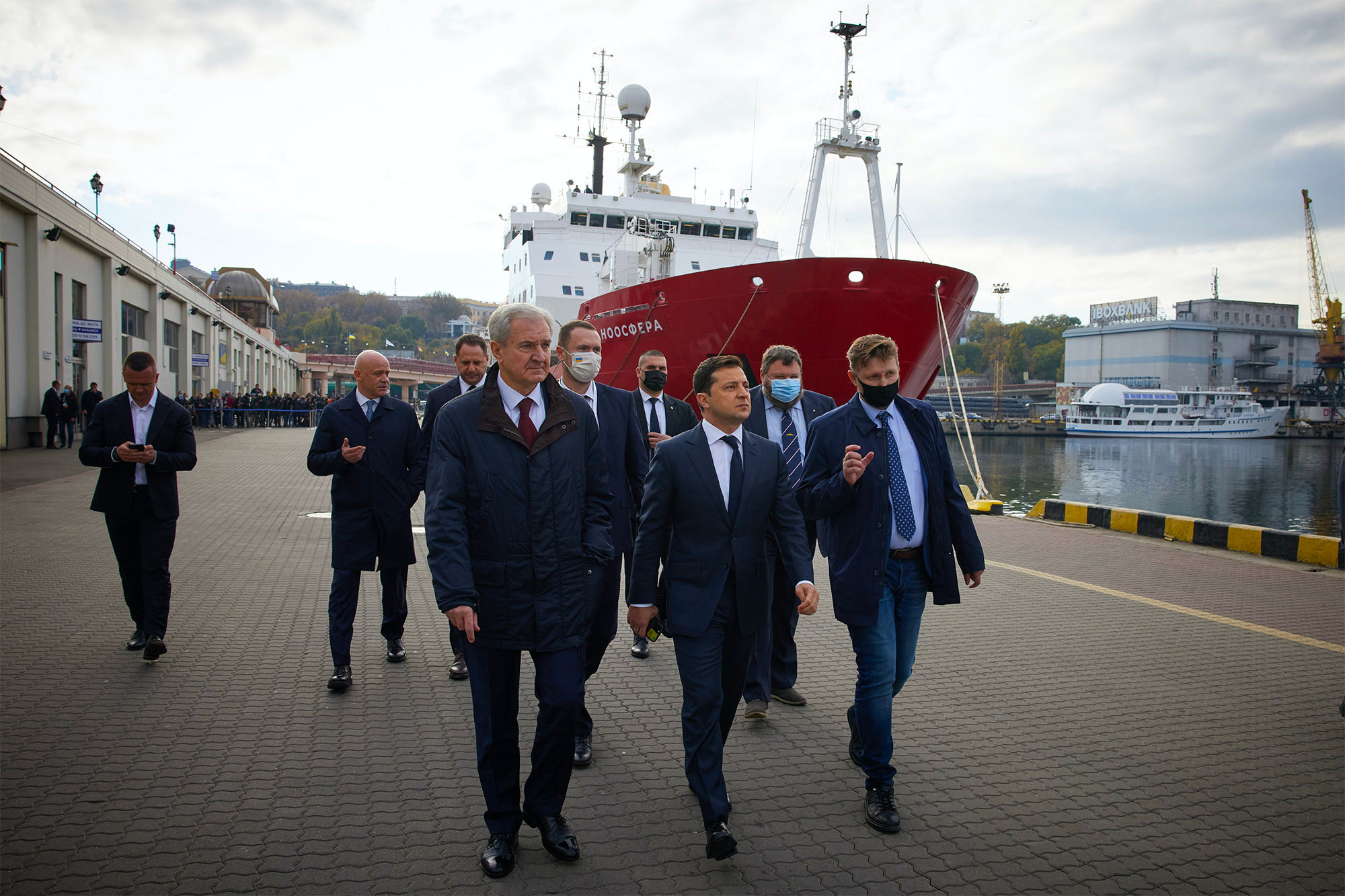
 Ukraine President Volodymyr Zelensky, Antarctic division head Evgen Dykyi and fellow state officials inspect the country’s polar research vessel, the Noosfera, during her arrival in the port of Odesa in October 2021. (Photo: The Ukraine National Antarctic Scientific Centre)
When Antarctic Treaty states convene in the “Peace Memorial City” of Hiroshima, Japan, on 11 May, its public opening session will mark exactly eight months since the scientist was detained by a country that will be in the conference room.
That country is Russia.
Leonid Pshenichnov, a veteran marine biologist working within the Commission for the Conservation of Antarctic Marine Living Resources (CCAMLR), has been held in pre-trial detention in Simferopol, Crimea since his 11 September arrest.
There was no confirmed court date at the time of publication.
Pshenichnov is, by all available accounts, the first member of an Antarctic Treaty System (ATS) delegation to be arrested by the authorities of another participating state for work conducted in that system.
But the allegation that placed his detention inside a growing geopolitical struggle over Antarctic hydrocarbons has now been dropped. A narrower claim tied to a Ukraine krill proposal has become the most prominent charge.
Filed as “CCAMLR-42/17”, the August 2023 proposal sought to impose a 70% cap on the krill catch taken by continuous trawlers in the controversial Southern Ocean zone dryly known as “Statistical Area 48”.
Ukraine’s CCAMLR delegation head, Kostiantyn Demianenko, told Daily Maverick the proposal was not Pshenichnov’s “personal initiative” but that he has been a Ukraine delegation member for 30 years. The proposal was rejected by the 2023 CCAMLR meeting in Hobart, Tasmania, which convenes 26 member states plus the EU.
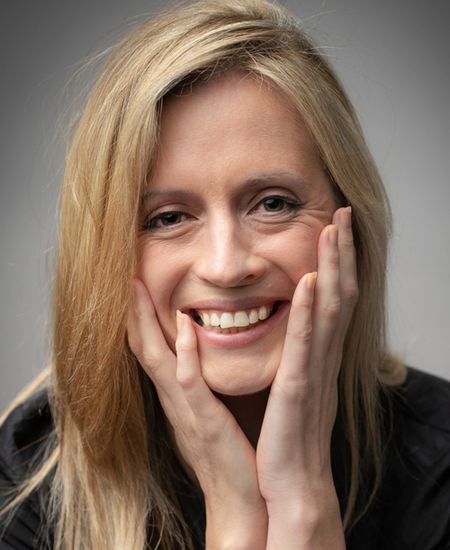
/file/attachments/orphans/Marinebiologistprofilephoto_715877.jpg "Detained Ukrainian CCAMLR scientist Leonid Pshenichnov. (Photo: Supplied)")
The charge that vanished
When Russian authorities moved against Pshenichnov, the accusation – according to information supplied by Ukraine – was explicit.
An alleged copy of a Federal Security Service charge sheet, seen by Daily Maverick and first reported by ABC Australia, stated his actions could lead to “the loss of opportunities for Russia to exploit hydrocarbon resources on the continental shelf of Antarctica”.
That claim linked the case directly to a long-running issue: Russia’s seismic surveys in Antarctic waters – described by experts as prospecting for oil and gas despite a treaty system that prohibits mineral resource activity.
The allegations associated with the arrest now matched a pattern documented and exposed by Daily Maverick over five years – a sustained Russian effort, launched repeatedly from Cape Town, to map the Southern Ocean’s hydrocarbon potential.
But those hydrocarbon-related accusations may have vanished. The security service has now accused Pshenichnov of being a Ukraine delegation member who “prepared” the 70% krill cap proposal.
/file/dailymaverick/wp-content/uploads/2022/10/Antarctic_krill_Euphausia_superba.jpg "Krill (Euphausia superba) in the Southern Ocean. (Photo: Wikipedia)")
Despite contacting Russian authorities, we have received no explanation on why the original allegation – tied to oil and gas – was abandoned.
The case may be “narrower”, but that may only complicate it because Russia has continued to pursue “high treason” charges linked to legitimate conduct within an open, multilateral scientific forum.
“According to his lawyer, the charges have become substantially narrower in scope,” Demianenko said. “References to marine protected areas (MPAs) and to the Russian Federation’s ‘losses’ due to inability to conduct extraction activities on the Antarctic shelf have been removed.”
A note from his lawyer, supplied by Demianenko, argues “there are no facts confirming that the Ukrainian delegation in any year blocked the fishing or research activities of the Russian Federation”. It continues that the “entire available Antarctic krill resource in Area 48 (620,000 tons) could have been harvested by the Russian Federation together with other countries”.
“For our part, we have provided the defence team – through Leonid’s family – with comprehensive arguments as to why the Russian charges are completely absurd,” Demianenko said.
CCAMLR meeting before the arrest
Pshenichnov’s detention came at a moment of rising friction inside CCAMLR. At the October 2025 meeting, China and Russia again blocked marine-protected areas – some overlapping with regions of known hydrocarbon interest in which Moscow’s Rosgeo-owned survey vessel has repeatedly operated since 2011.
Photographed at that meeting was Pavel Lunev, head of the Russian Antarctic Programme and former head of the state-linked entity behind those surveys. The overlap between MPA proposals and survey zones may be one of the more sensitive, if largely unacknowledged, fault lines in Antarctic governance.
Demianenko said Russian authorities sealed the proceedings since the arrest hit international media. So the removal of the original alleged charge – linking Pshenichnov’s work to hydrocarbon losses – leaves unanswered if that dispute has been stripped from the public record.
“The proceedings were made completely closed – it is now virtually impossible to obtain any investigative documents,” Demianenko said.
Hiroshima: a test for the treaty system
From 11 to 21 May, treaty states will gather in Hiroshima for the 48th Antarctic Treaty consultative meeting (ATCM), hosted by Japan for the first time in 32 years.
As one of 12 founding signatories to the treaty, Tokyo has framed the meeting around “transparency of activities in Antarctica, responses to the recent surge in Antarctic tourism and the impacts of climate change on the Antarctic region”.
And yet, each year CCAMLR’s outcomes feed into the ATCM, where consultative parties must account for their conduct in Antarctica. At ATCM 2025 in Milan, Italy, “several” treaty states noted that a conservation measure blocked by Beijing and Moscow resulted “in the highest krill catch in the region for decades”. Weeks after the June ATCM, Associated Press (AP) reported that a record krill catch triggered a historic early closure of the season. AP revealed that it had surged “in one popular fishing ground, denoted Sub-Area 48.1” – the very area that Ukraine’s proposal had warned about.
Russian Antarctic authorities have not responded to our repeated requests for comment, but Moscow’s CCAMLR diplomats have also refused to supply evidence supporting the arrest.
In the October 2025 CCAMLR meeting minutes, the Moscow delegation “stressed that matters concerning Russian citizens are within the jurisdiction of the Russian Federation in accordance with internation [sic] law and should not be raised in the context of the CCAMLR framework”.
Ukraine, announcing the arrest at the meeting, hit back: “Is it acceptable for the CCAMLR community to stand by while a Ukrainian biologist, who has devoted his life to the study, conservation, and rational use of Antarctic marine living resources, faces persecution and imprisonment by Russia?”
/file/dailymaverick/wp-content/uploads/2022/07/zelenskyvideo.jpg "Ukraine President Volodymyr Zelensky, during an inspection of the Noosfera in October 2021, addresses the country’s polar scientists in Antarctica via video link. (Photo: Administration of the President of Ukraine)")
Ukraine’s Australia ambassador Vasyl Myroshnychenko told Daily Maverick that Russian-born Pshenichnov, 70, has been a citizen of Ukraine since 1991.
“Until 2014, when Russia occupied Crimea, he never held a Russian passport,” said Myroshnychenko. Demianenko said Pshenichnov was forced to obtain a Russian passport after the occupation “while continuing to remain a citizen of Ukraine”.
“Peaceful” scientific cooperation is a cornerstone of the treaty’s legal text. Thus, the Peace Memorial City of Hiroshima offers an opportunity to table the detention of a long-serving ATS member at the upcoming meeting. Treaty members could either reaffirm that there is zero basis for consultative states to arrest the delegation members of fellow consultative states for doing their legal job. By staying silent, they risk setting problematic precedents.
Washington weighs in
The original alleged charges have reportedly tightened. Even so, unsupported hydrocarbon charges may have originally sent an ATS delegation member into indefinite “high treason” detention.
Mining is banned in Antarctica and Russian authorities have equally not responded to requests for evidence that Pshenichnov had ever raised the issue privately or publicly.
Speaking to Daily Maverick in October, former US treaty delegation head William Muntean urged treaty states to assess “whether the document justifying the arrest reflects the Russian government’s Antarctic policy”.
“If so, then it appears – based on the reported information – that its policy is to oppose scientific freedom and international scientific collaboration, support hydrocarbon exploitation and pursue unregulated industrial fishing,” said Muntean, who led the mining ban’s reaffirmation at ATCM 2023 in Helsinki, Finland.
/file/dailymaverick/wp-content/uploads/2023/05/Mufamadi-US-visit-3.jpg "Senator Jim Risch of the US Senate Foreign Relations Committee departs a closed-door intelligence briefing on Capitol Hill in Washington, DC, US, on 9 February 2023. (Photo: Al Drago / Bloomberg via Getty Images)")
As first reported by Daily Maverick, US Senate Foreign Relations Committee chair Jim Risch also challenged Russia’s mineral resource activities at a nomination hearing in February. Risch suggested those activities had to be among Washington’s top “enforcement” priorities in Antarctica.
The US is the depositary of the treaty. Risch’s office has not responded to repeated requests for comment.
The Human Rights Committee of Sweden’s Scientific and Literary Academies also called for Pshenichnov's release in February.
A scientist’s lingering hope: Russia-Ukraine prisoner exchange
Discussions around possible prisoner exchanges between Ukraine and Russia continue, but it seems that Moscow holds the cards.
“The best and undoubtedly the most just outcome would be the termination of criminal prosecution against Leonid and his unconditional release,” Demianenko said.
“We have been trying to assess how realistic the chances are of having Leonid exchanged as part of a prisoner swap between Ukraine and Russia,” he observed. “From various sources, we have concluded that the Russian authorities have very significant influence over the choice of which prisoners will be released in each separate exchange.
“Therefore, efforts directed primarily toward the Russian authorities are extremely important to achieve Leonid’s release.” DM


Comments
Scroll down to load comments...