




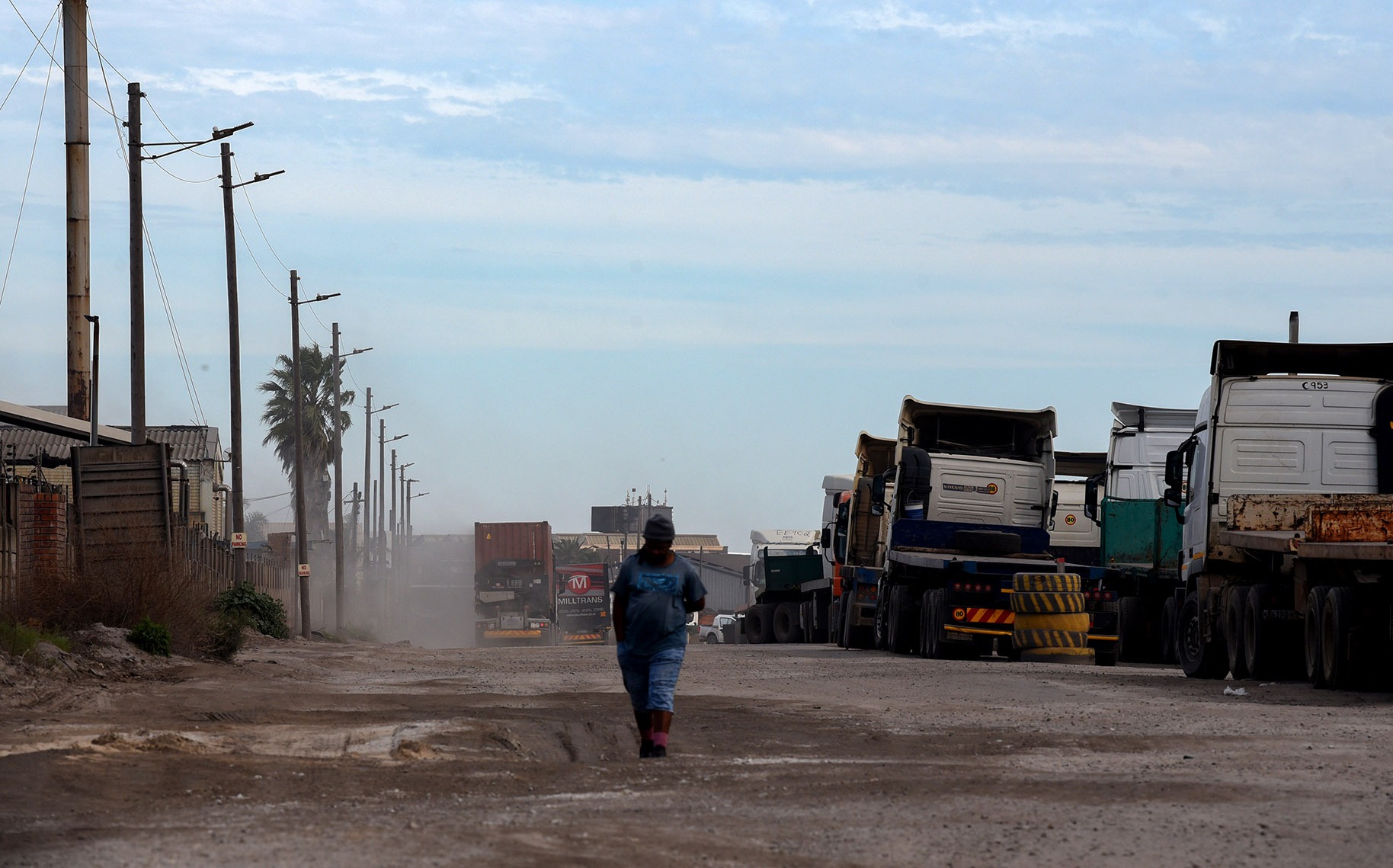
 A walk through the dust plumes as manganese trucks drive by on 11 June 2026. (Photo: Deon Ferreira)
 The Nelson Mandela Bay Business Chamber says the metro is shouldering the environmental, health and infrastructure costs of manganese exports, while seeing little economic benefit in return.
It is calling for the urgent relocation of manganese ore operations to the Port of Ngqura, and greater use of rail to reduce pressure on the city’s roads.
The renewed call follows a report by the Nelson Mandela Bay metro on air quality, which found critical deterioration in ambient air quality in areas where manganese operators are working.
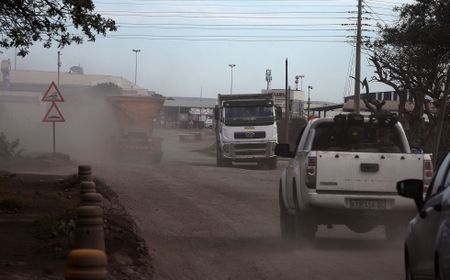
The manganese operations in Markman Industrial area have been widely criticised for the negative and costly impact they have on the city’s roads.
At the same time Transnet has faced backlash from residents and affected groups for stalling the relocation of operations from the Port of Port Elizabeth to the Port of Ngqura – a move that has been delayed since 2016 and which has now been moved up to 2031.
Chamber of Commerce CEO Denise van Huyssteen said: “There is no doubt that the ongoing delays in relocating and setting up the manganese storage facilities at the Ngqura Port, and the inefficiencies of rail transportation, has exacerbated the situation.
“We require urgent prioritisation in getting the North to South rail corridor to become much more efficient, so that cargo can be transported by rail, instead of the current scenario where roads are over-burdened by too many trucks.”
/file/attachments/orphans/Screenshot2025-12-15at145307_748755_485995_651198.png "Nelson Mandela Bay Business Chamber CEO Denise van Huyssteen (Photo: Facebook)")
Van Huyssteen said the reality is that the manganese trade holds very little economic benefit for the country, with the product mostly exported in its raw format, and with virtually no local beneficiation taking place.
“Ideally, manganese should be used to help produce steel and batteries in the country at a more cost effective rate. From a Nelson Mandela Bay economy perspective, the transportation and storage of manganese in the metro is not benefitting, but is costing our local economy.
“This cost comes in the form of severe infrastructure damage, the knock-on negative impacts to other types of businesses operating in the area, reputational damage to the metro as an investment destination, and also compromising the health and safety of people.”
/file/attachments/orphans/Dusty_897536.jpg "Eroded roads and manganese trucks cause health risks according to a Nelson Mandela Bay metro survey that links it to dust fall as a threat to the health of workers and nearby communities. (Photo: Deon Ferreira)")
Van Huyssteen said since 2020 manganese activities have caused severe destruction to the metro’s infrastructure, especially in the Markman area, which now resembles a dustbowl.
“It is vital that the various stakeholders take urgent accountability and action to address the root causes of the issues which have led to this destruction. This ranges from ensuring that the manganese operators strictly adhere to the required municipal by-laws, port health and safety regulations, and the implementation of measures to rehabilitate the infrastructure.”
She added that damage to the roads has made travelling in the affected areas very unsafe, and even more worrying is the harmful pollutant effects on the businesses and surrounding communities.
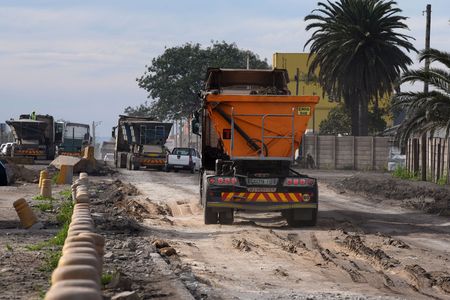
According to the report by the municipality’s acting executive director for public health, Anna-Lisa Dyakala, samples for the air quality study were taken at the Port of Port Elizabeth and in the Markman Industrial area, revealing that the local airshed has reached a state of saturation with dust deposition rates far exceeding the non-residential limit.
“The health sub-directorate has reviewed the comprehensive dust fallout surveys for December 2025 and January 2026, submitted by the authorised operators at all authorised manganese handling sites in Markman and the PE Harbour, as required by their conditions of authorisation.
“The results confirm that the local airshed has reached a state of saturation, with dust deposition rate far exceeding the non-residential limit of 1,200mg/m2/day [miligrams per square metre, per day] at multiple sampling points across different sites,” the report read.
/file/attachments/orphans/Road_248985.jpg "A manganese truck on damaged roads at Markman Industrial Area on 11 June 2026. (Photo: Deon Ferreira)")
There was no official comment to Daily Maverick questions sent to Transnet spokesperson Gqeberha Sakhiwo Tetyana on 16 June.
Tetyana said on Tuesday: “Please accept my apologies for the delays. The matter requires input from multiple stakeholders within Transnet, which has impacted the approval process. I am currently still awaiting final approval.”
Comments will be added when received.
More voices join the fray
DA councillor Annette Lovemore wrote to the South African Human Rights Commission raising concern about the health risks that communities were placed under by those mandated to monitor and regulate the operations to ensure dust levels meet safety standards and municipal by-laws.
The commission’s lawyer Dr Eileen Carter stated she would check their complaints registry and provide feedback as soon as possible.
Municipal spokesperson Sithembiso Soyaya said the environmental regulation within the manganese handling sector involves multiple stakeholders, including operators, Transnet National Ports Authority, national and provincial environmental authorities, and other regulatory bodies.
He said despite these complexities, the municipality continued to exercise its statutory mandate to ensure compliance and environmental accountability.
Asked about how the city enforces accountability on operators transgressing municipal bylaws, Soyaya said the regulatory framework provides several mechanisms to facilitate compliance before more severe enforcement measures are considered.
“These include compliance notices, corrective action plans, operational improvements, enhanced monitoring requirements, environmental management interventions and follow-up inspections.
“Businesses are afforded reasonable opportunities to address identified shortcomings within legally prescribed timeframes. Closure notices are generally considered a measure of last resort and are only implemented where circumstances warrant such action in terms of the applicable legislative framework.
“The municipality remains committed to balancing environmental protection, public health considerations and sustainable economic development.
At a public health committee meeting on 11 June, officials said that of the 20 operators in the city, only four possessed valid operating licences.
However, Soyaya said the city could not confirm how many were operating without licences saying that there were four authorised facilities in the metro.
“The Municipality is aware of one unauthorised facility within the Markman area for which enforcement processes have been initiated and a closure notice has been issued.
“The municipality is unable to verify the figure of approximately 20 operators and can only comment on facilities recorded within its regulatory database and subject to its licensing and compliance monitoring functions.” DM
Comments
Scroll down to load comments...