



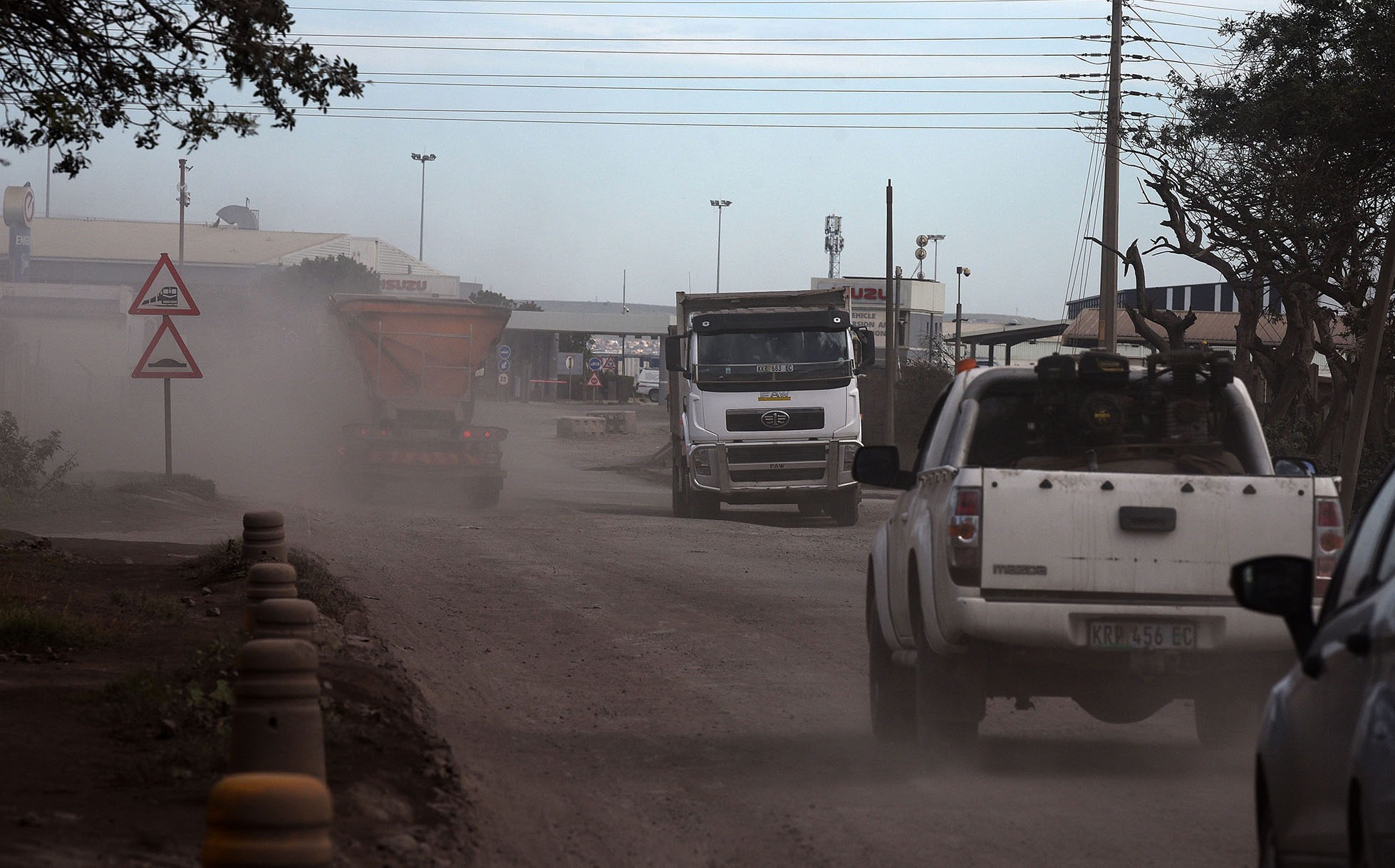
 Badly damaged roads and particulate matter from manganese trucks operating in PE Harbour and the Markman industrial area in Nelson Mandela Bay metro have been linked to air pollution in the area. (Photo: Deon Ferreira)
A study conducted by the Nelson Mandela Bay metro on air quality, with samples taken at the PE Harbour and Markman Industrial area, where manganese ore companies operate, reveals that the local airshed has reached a state of saturation with dust deposition rates far exceeding the non-residential limit.
An airshed is a geographic region where local topography and weather patterns trap or channel the air, causing the entire area to share a common air mass.
The report by the acting executive director of public health, Anna-Lisa Dyakala, tabled at the public health committee meeting on Thursday, 11 June, warns that the dust fall standards carry a litigation risk as it poses a threat to the health of workers and nearby communities.
Manganese operations have been widely criticised in the municipality and by concerned groups and residents, as operators have been caught contravening by-laws, particularly in the Markman area, and damaging road infrastructure.
/file/attachments/orphans/Road_248985.jpg "A manganese truck drives on the damaged roads in the Markman Industrial Area on 11 June 2026. (Photo: Deon Ferreira)")
The manganese ore operators began establishing themselves in the Markman area during the national lockdown of 2020.
The report states that initial complaints regarding air pollution and infrastructure damage were received in June 2020.
However, despite ongoing compliance monitoring and enforcement actions – which include the issuance of compliance notices and the closure of unauthorised operations – fugitive dust emissions from the handling, storage and transport of manganese ore have persisted.
The committee resolved that bulk manganese storage authorisations in the PE Harbour should not be renewed by the municipality beyond 30 June 2027.
/file/attachments/2993/Water_870925.jpg "Air samples taken at the Markman Industrial area and the PE Harbour, where manganese businesses operate, reveal that the local airshed has reached a state of saturation with dust deposition rates exceeding the non-residential limits. (Photo: Deon Ferreira)")
The committee also resolved that every possible measure must be implemented to minimise manganese dust emissions from storage facilities, transport routes and handling operations, in line with international best-practice standards, to ensure the health, safety, and wellbeing of all residents and affected communities.
“The health sub-directorate has reviewed the comprehensive dust fallout surveys for December 2025 and January 2026, submitted by the authorised operators at all authorised manganese handling sites in Markman and the PE Harbour, as required by their conditions of authorisation. The results confirm that the local airshed has reached a state of saturation, with dust deposition rate far exceeding the non-residential limit of 1200mg/m2/day [miligrams per square metre, per day] at multiple sampling points across different sites,” Dyakala writes in her report.
According to the report, the 2025 monitoring period revealed a critical deterioration in ambient air quality, which is the condition of the outdoor air we breathe, encompassing the surrounding atmosphere.
The cumulative effect of multiple authorised and unauthorised operators, combined with heavy truck traffic on dilapidated roads, has led to a state of airshed saturation, states the report.
“This means the atmosphere in and around Markman can no longer incorporate additional dust pollution without causing severe and sustained exceedances of national standards directly endangering public health,” the report reads.
/file/attachments/2993/Tyres_323564.jpg "The dusty streets of Markman Industrial area in Nelson Mandela Bay on 11 June. (Photo: Deon Ferreira)")
In the report, Dyakala states that meteorological reviews of the prevailing wind data for Gqeberha and Coega show significant wind components originating from the southwest and west and, during summer, from the northeast.
This wind pattern directs the dust plumes directly over the residential areas of Wells Estate, Bluewater Bay and parts of Amsterdamhoek.
Illness associated with the manganese dust plumes
Neurological damage (Manganism): Manganese is a neurotoxin. Chronic inhalation of manganese-laden dust is clinically associated with a Parkinson’s-like condition known as Manganism. Symptoms include tremors, gait disturbance, cognitive slowing and psychiatric symptoms such as hallucinations and irritability.
Respiratory disease: The total dust particulate is an irritant. Residents exposed to levels exceeding 1200mg/m2/day are at high risk for developing asthma, chronic bronchitis and silicosis-like conditions. The ultra-fine particles can penetrate deep into the alveolar regions of the lungs.
“The dust fallout data in both Markman and the PE Harbour area provide irrefutable scientific evidence that the airshed over the Markman area and the PE Harbour is saturated,” says the report.
It states that for the Markman Township, the saturation of the airshed means that no new ore-related applications may be processed for the area.
“The status of air quality in the PE Harbour shows chronic non-conformance to the dust fall standards and carries a litigation risk for the municipality as it poses health risks for workers in the harbour area and to the citizens in the nearby communities.
“It must be borne in mind that the manganese ore facilities in the PE Harbour are authorised by the NMBM [Melson Mandela Bay Municipality]. The licences for the bulk storage facilities in the PE Harbour will expire on 30 June 2027. It would be risky for the NMBM to renew the authorisations knowing that they pose health risks to its community,” the report says.
/file/attachments/2993/DSC_0730copy_278272.jpg "Markman business owner Chris Collett walks over a wet patch of the road in the industrial area, where operators are required to operate water sprinklers to prevent excessive dust. (Photo: Deon Ferreira)")
Markman Business Forum spokesperson Graham Taylor said they were committed to being environmentally compliant.
“We have tried to speak to the municipality for the past five years to precisely address these issues to ensure that various industries are compliant. Last year in October we were subjected to a Hollywood-style raids, which produced nothing,” he said.
“We’ve engaged with parliamentary officials and the municipality to forge good working relations. The primary solution is to ensure industrial vehicles are kept on industrial roads. Part of this involves the opening of Neptune Road for direct access to the Port of Ngqura, which would mitigate the situation considerably.”
Taylor said air quality studies were notoriously fickle.
“We would have to have a close look at the report. When air monitoring [is] done correctly, we would know where exactly the monitoring points are and what parameters are being used. What I saw in the pictures you sent, that information is questionable.”
Taylor said one of the requirements for the licences was for operators to maintain roads, but currently maintenance is non-existent in Markman.
“Anyone who has been in Markman will know that there is dust; 90% of the dust comes from the bad roads and not the manganese. If you go there on a windy day, you will see. There are no roads left in that area; the municipal roads [have not been] maintained since 1956.
“If there are illegal trucks we are happy for them to be taken off the road, but most have permits to use public roads, which they pay for,” he said
At Thursday’s committee meeting, Democratic Alliance (DA) councillor Annette Lovemore said it was reported that air monitoring by the City in 2025 had found each month that the dust was polluted and still it did nothing to avert the situation.
/file/dailymaverick/wp-content/uploads/2022/06/Annette-Lovemore.jpg "DA councillor Annette Lovemore (Photo: Deon Ferreira).")
“The municipality has been fully aware of the health risks that are suffered by the people living in the areas near the Harbour and Markman, but what has been done to address it? Every month we’ve known that people in South End are suffering from bronchitis, perhaps it’s indeed because of manganese. Why haven’t we told the affected communities about the health risks, because it is our duty as public health to do so?”
Lovemore said not renewing operator licences did not solve the problem, but instead drove much-needed business away.
“There are no roads left in Markman; they’ve all been damaged and the gravel or soil they drive on will definitely generate dust.
“We now know that only four operators have licences in Markman, and we know for a fact the rest still do operate. The same thing will happen beyond the cut-off date in 2027. The harbour makes massive income from these operations, and do we honestly think they will stop operations due to a non-renewed licence?”
Another DA councillor Vernon Boggenpoel urged that alternative measures be explored to curb the health risks.
“There are simple solutions we have spoken about in this committee that we said must be implemented, but nothing is done. We can come up with bylaws to control it, such as covering the manganese in the trucks when they’re transported and others.”
Lovemore asked why one of the recommendations was for the council to ratify information in the report pertaining to the manganese operations in the city.
Politics head for public health, Thsonono Buyeye, said officials had to do away with the mentality of closing business and instead strengthen measures for them to become compliant.
/file/attachments/2993/Buyeye_213966.jpg "Politics head for public health Thsonono Buyeye. (Photo: Deon Ferreira)")
Buyeye said officials must approach the legal unit for advice on how to deal with operators that contravene bylaws, without preventing them from operating.
“Councillor Lovemore is correct to say we need to strengthen our measures to enforce compliance. She is also correct about informing the residents about the health risk that we’ve placed them under. We also need to answer as to what will we do to enforce compliance to curb the health risk so long we wait for the June 2027 date to stop renewing licences.
“The harbour is allowing illegal operators to get in there and work. We’ve had engagements with the harbour. Indeed, we should rather intensify regulating them instead of closing down businesses;we can’t be chasing businesses away every time there’s a problem. In fact we need more businesses here as we are faced with a high employment rate.”
/file/attachments/2993/N2_855640.jpg "A truck transporting the manganese in the streets of Gqeberha on 11 June. (Photo: Deon Ferreira)")
Deputy director for environmental health services, Patrick Nodwele, said communicating the airshed results to the communities will place the City at risk of litigation.
Nodwele said the issue of manganese operations taking place near communities was exacerbated by poor spatial planning in the City.
“Spatial planning for industries has not been done, so those businesses in Markman just arrived in 2020 without consulting the municipality and occupied the Markman area, and we have been engaging them about compliance, so it’s not correct that we have done nothing,” he said.
Nodwele said a section dealing with manganese ore operations has been added to the municipal bylaws to govern its handling and transportation.
“The issues raised in relation to litigation, we have consulted the National Prosecuting Authority because we wanted to litigate criminally. We have opened three cases at the Swartkops police station, but those cases don’t go beyond the police, and we would later be informed that the cases have been withdrawn.”
Dyakala said authorisation for manganese operations at the PE Harbour was granted because it was initially communicated that they would move to the Coega industrial development zone, but the date keeps being postponed.
“So ratification will help in that it will no longer be a council resolution for the operations to continue, and this will eliminate the litigation risk on the side of the municipality. Currently, if anything happens, we will be liable for any health risks because we are the ones who provide the licences.”
Also responding to councillors, Dyakala said delays in enforcing compliance was also affected by the regular changing of City managers.
“On receipt of the report, we also conducted an inspection and a memorandum was drafted and sent to the acting City manager at the time. Mr Lonwabo Ngoqo, who was acting at the time, was to coordinate other affected directorates to address the matter. We received an invite for a meeting but it did not convene. A second meeting was scheduled, but again it did not convene.” DM
Comments
Scroll down to load comments...