




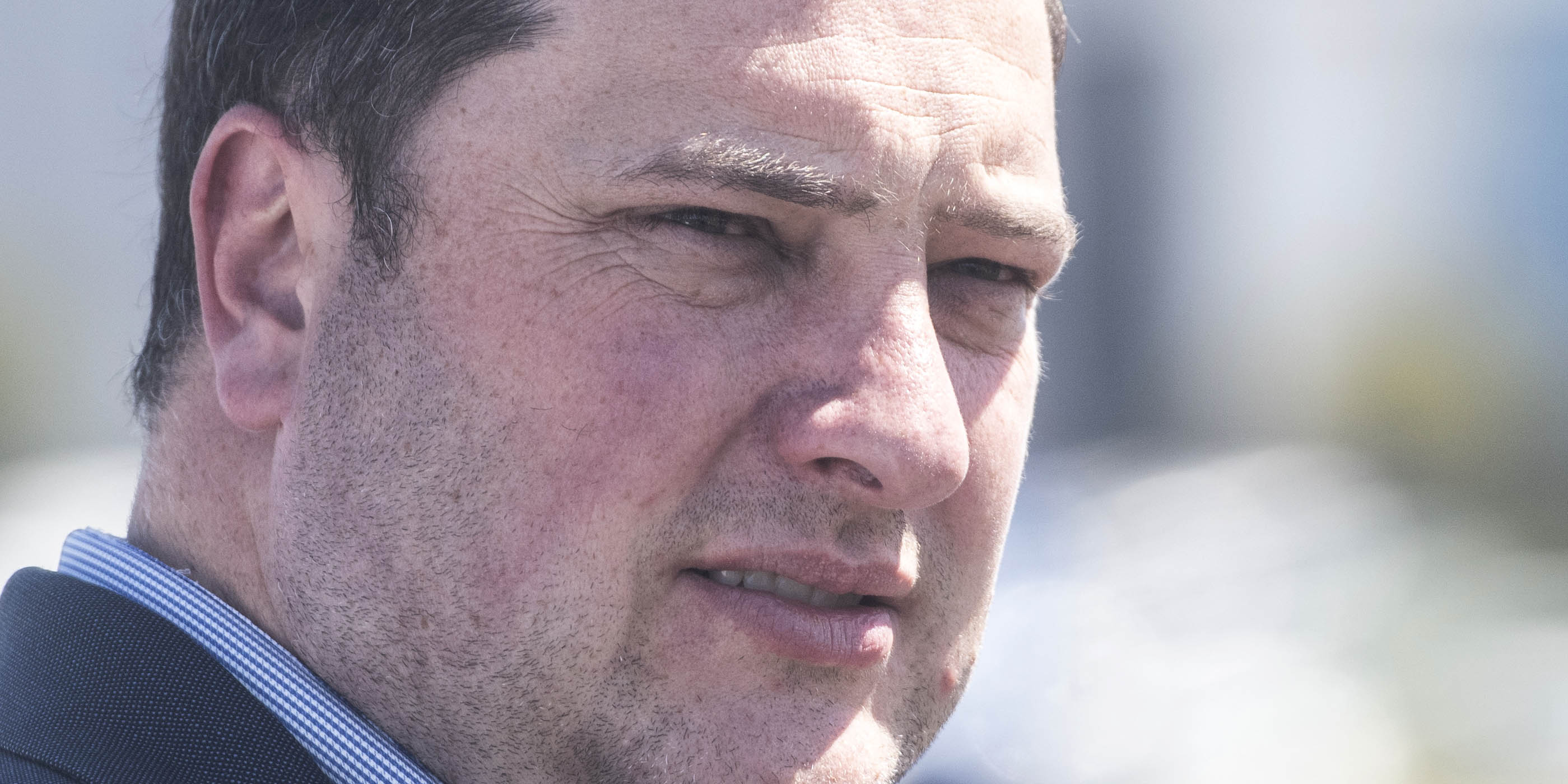
 DA leader Geordin Hill-Lewis is solidifying his influence on the party ahead of local elections. (Photo: Brenton Geach / Gallo Images)
 New party leaders frequently alter inherited Cabinet lineups, but immediately demoting a predecessor is an unusual step.
In the months before Daily Maverick’s Rebecca Davis revealed that the DA’s Federal Council finance head, Dion George, had flagged the party’s then leader, John Steenhuisen, for using a DA credit card for personal expenses, Geordin Hill-Lewis made it clear he would not contest for the position of DA leader against Steenhuisen.
The public perception was that they were friends, which sharpens the new DA leader’s decision to move Steenhuisen from agriculture minister to deputy minister of trade, industry and competition.

Hill-Lewis might have felt he had no choice.
The agricultural community is an important constituency for the DA, which faces fierce competition from the Freedom Front Plus for the rural farming vote. President Cyril Ramaphosa knew this when he offered Steenhuisen the post; it was a gift to the DA against its major political threat.
Also, the DA’s main selling point to voters is good governance and administration, and the stream of complaints from farmers about Steenhuisen’s management of the foot-and-mouth disease (FMD) outbreak might well have been too much for Hill-Lewis to accept.
But the real last straw was probably the behaviour of Steenhuisen’s chief of staff, Jana le Roux.
According to Rapport, Le Roux swore at Free State Agriculture CEO Gernie Botha during a social event. To make matters worse, the event was hosted by a journalist (the legendary Farmers Weekly editor Chris Burgess), making it unlikely this would be kept quiet.
This was after she had forwarded an email from another important actor in the FMD outbreak to staff in the department for “your general amusement”.
/file/attachments/orphans/ED_599277_437704.jpg "Agriculture Minister John Steenhuisen is due to move to the position of deputy minister of trade, industry and competition. Industry groups have criticised his handling of the foot-and-mouth disease outbreak. (Photo: OJ Koloti / Gallo Images)")
Given Steenhuisen’s publicly embarrassing and protracted appointment of the right-wing figure Roman Cabanac, Hill-Lewis’s move suggests a lack of confidence in his predecessor’s judgement.
If administrative appointments are indeed the fault line, it highlights a striking parallel with the ANC, where chief-of-staff selections have triggered ministerial downfalls. Most recently, former social development minister Sisisi Tolashe’s appointment of an unqualified chief of staff ultimately contributed to her axing.
New opportunity
While being demoted from a full Cabinet post is a public humiliation for Steenhuisen, his new role offers a critical strategic opportunity. As the new deputy minister of trade, industry and competition, he becomes the most prominent DA figure stationed directly on the ideological fault line where the ANC and DA inevitably collide.
Notably, this is the only portfolio where President Cyril Ramaphosa removed a DA incumbent — Andrew Whitfield — under circumstances that remain murky.
Given that Steenhuisen has known no other career than full-time politics since becoming an eThekwini councillor at the age of 22, he probably recognises he has few alternatives but to make the best of the deployment. Consequently, he is unlikely to stage a public rebellion against Hill-Lewis.
Certainly, it would be unwise for any group to campaign against a new leader just ahead of local elections. But, as the recent history of the ANC has shown, sometimes even an upcoming election is not enough to contain internal disputes.
While Hill-Lewis’s move against Steenhuisen will correctly gain the most attention, the other changes are important too.
Environment and agriculture
Moving David Maynier from the Western Cape Education Department to the national Forestry, Fisheries and the Environment portfolio brings a veteran strategist to a crucial frontline. The department operates at the primary intersection of economic growth and climate change — one of the most contested spaces in modern governance.
Maynier is a sharp, dedicated politician, but he will need to tread carefully. Most intriguing will be his inevitable interactions with Mineral and Petroleum Resources Minister Gwede Mantashe.
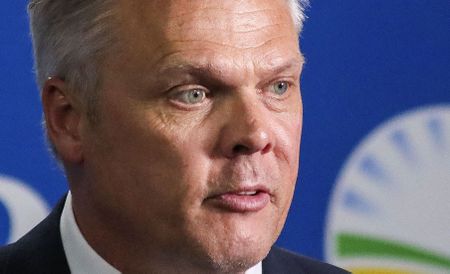
Hill-Lewis’s reshuffle also removes former Environmental Affairs Minister Willie Aucamp from a potential conflict of interest, after it emerged he had not declared his stake in a transport business that worked with a platinum mine.
Aucamp is a farmer, which might give him more legitimacy in the Agriculture portfolio. Also, the fact that his first language is Afrikaans might make it easier for the DA to counter the FF+ in this constituency.
/file/attachments/orphans/DA-minister-changes_189281.jpg "Photos: (From top) John Steenhuisen. (Volksblad / Mlungisi Louw / Gallo Images); Willie Aucamp. (Sharon Seretlo / Gallo Images); David Maynier. (Luba Lesolle / Gallo Images); Alexandra Abrahams. (Parliament of South Africa); Samantha Graham. (GCIS); Mimmy Gondwe. (Darren Stewart / Gallo Images); Yusuf Cassim. (Deaan Vivier / Gallo Images); Isaac Seitlholo. (Julia Evans); Jack Bloom. (Papi Morake / Gallo Images)<br>")
Strategic deputy deployments
The appointment of Yusuf Cassim as deputy minister of higher education and training brings someone with vital experience to that sector. His track record dates back to his student days, when he won the Nelson Mandela University SRC presidency for the DA, and he has remained deeply engaged in higher education policy ever since.
/file/dailymaverick/wp-content/uploads/2024/07/ED_442784.jpg "DA Eastern Cape chairperson Yusuf Cassim is set to become the deputy minister of higher education and training. (Photo: Deaan Vivier / Gallo Images)")
A wry smile might have crossed the face of those who have been watching Gauteng politics for many years with the announcement that Jack Bloom is set to become the new deputy minister of water affairs and sanitation.
As the DA’s long-standing health spokesperson in Gauteng, Bloom developed a deeper understanding of the province’s healthcare crises than most of its MECs, consistently championing the needs of patients, nurses and doctors.
Yet, his transition to deputy minister of water and sanitation promises to be a frustrating adjustment. Bloom is an improbable candidate to join Minister Pemmy Majodina in singing a “water song” at an event, and his view of co-deputy David Mahlobo could be coloured by Mahlobo’s role as state security minister during the State Capture era. Nevertheless, a mutual focus on resolving technical issues could offer Bloom and Mahlobo a pathway to a productive partnership.
/file/dailymaverick/wp-content/uploads/2023/09/MC-Gauteng-jobs-campaign-2.jpg "Longtime DA Gauteng health spokesperson Jack Bloom is set to become the deputy minister of water and sanitation in the national government. (Photo: Gallo Images / Papi Morake)")
Heading into the local elections, water problems are likely to become a major issue, and Bloom might find opportunities to make the DA heard on these issues at an important time.
For Hill-Lewis, reshuffling his representatives in the national government mirrors a problem a reshuffle would pose for Ramaphosa: sidelining colleagues creates political enemies.
While both leaders prefer to avoid internal fallout, the sweeping scope of these adjustments proves that Hill-Lewis views the restructuring as a critical, immediate priority.
And he will hope that his decisions, particularly the demotion of Steenhuisen, do not lay the foundation for sustained opposition to his leadership. DM
Comments
Scroll down to load comments...