




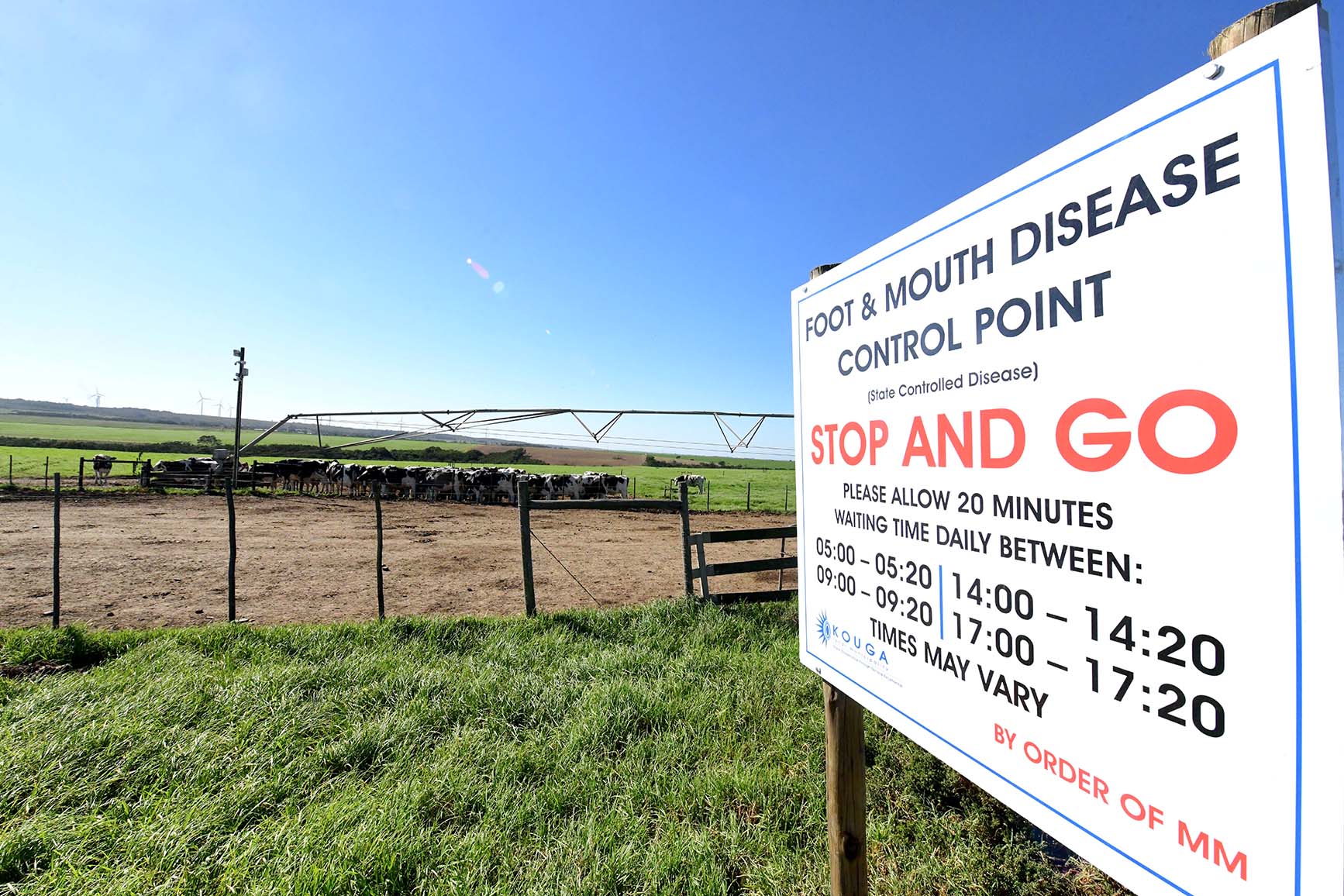
 A stop-and-go notice alerting motorists to the outbreak of foot-and-mouth disease on 6 May 2024 in Humansdorp, South Africa. (Photo: Lulama Zenzile / Die Burger / Gallo Images)
A formal letter from a farmer-led initiative asking for engagement on South Africa’s foot-and-mouth disease (FMD) vaccination strategy was forwarded by Minister of Agriculture John Steenhuisen’s chief of staff to senior departmental officials, referring to it as “for some amusement”.
/file/attachments/2993/721089639_10165301108714935_7263098806027806817_n_747588.jpg)
The email, which began circulating on social media on 8 June, has put Steenhuisen’s office on the back foot over its handling of a formal request from a farmer-led initiative seeking engagement on South Africa’s FMD vaccination strategy.
In the email, Jana le Roux, chief of staff to Minister Steenhuisen, forwards a letter from FMD Response SA, a collective of farmers and industry stakeholders directly affected by what they call “the FMD response gap”, to the Department of Agriculture’s director-general and deputy director-general on 3 June 2026. Her message accompanying the forwarded letter read: “Attached just received for some amusement...”
/file/attachments/orphans/ED_599278_704745.jpg "Gauteng Agriculture MEC Vuyiswa Ramokgopa (left) and Agriculture Minister John Steenhuisen (centre) attend an outreach session regarding the roll-out of the mass vaccination against foot-and-mouth disease at Magagula Heights in Katlehong, Ekurhuleni, in March 2026. The ongoing vaccination roll-out forms part of the government’s response to curb the spread of FMD. (Photo: OJ Koloti / Gallo Images)")
Concerns over FMD vaccination strategy
The letter, signed by Andrew Morphew, spokesperson for FMD Response SA, and addressed directly to Steenhuisen’s office on 3 June, acknowledged the department’s efforts to secure vaccines under difficult circumstances, and stated clearly that the organisation’s goal was to work constructively with authorities, not to pursue preferential treatment for its members, but to ensure the national strategy worked for every farmer in the country.
Its core argument was that vaccination activity alone does not equal population immunity – that vaccinated cattle surrounded by large numbers of unvaccinated animals remain vulnerable, and that the experience of Brazil and Argentina demonstrates vaccination programmes must be implemented within tightly coordinated windows and repeated at six-monthly intervals to achieve simultaneous immunity and to interrupt transmission. The letter asked for a meeting to discuss coordinated vaccination windows, area-based coverage thresholds and appropriately timed booster rounds.
FMD Response SA was formed specifically to address what Morphew describes as a fundamental flaw in the country’s approach. “The country is running its foot-and-mouth response as an administrative roll-out rather than a biological control programme,” he said. “Vaccinating animals over many months is not the same as protecting the national herd at a single point in time, which is what controlling this disease actually requires.”
The World Organisation for Animal Health, he said, requires simultaneous immunity, meaning 80% of cattle need immunity at once, requiring nearly every cow in the country to be vaccinated within a tight timeframe.
The letter was not FMD Response SA’s first attempt to be heard.
“Individually and then collectively, we made repeated attempts to engage the department over a period of months,” Morphew said. The organisation had also submitted comments on the Section 10 Scheme and written formal letters previously.
“We were seeing no change in a failing plan and felt we needed to engage the minister directly.”
/file/attachments/orphans/1736408616350_747552.jpg "Jana le Roux, Agriculture Minister John Steenhuisen’s chief of staff. (Photo: LinkedIn)")
After Le Roux forwarded the letter internally with her “amusement” comment, FMD Response SA became aware of it when the email chain was forwarded back to the organisation as part of a response from one of the recipients. That response included an offer to help FMD Response SA’s members place direct vaccine orders.
Morphew’s reply drew a clear line: “Our aim, as set out in our recent letter to Minister Steenhuisen, is a lasting solution that works for every cattle farmer in the country, commercial and small-scale alike, not an arrangement for our members alone.”
“Farmers have a right to know how seriously their concerns are being treated, in a crisis that is costing them their animals, causing great suffering to animals and decimating their livelihoods.”
No further response was received. “We did not make this public to embarrass anyone,” Morphew said. “Farmers have a right to know how seriously their concerns are being treated, in a crisis that is costing them their animals, causing great suffering to animals and decimating their livelihoods.”
Morphew said the organisation did not have time to be offended by the email, as they have to focus their attention on the disease that they are trying to beat.
“It risks being viewed as a posture where engagement with farmers is treated as amusement rather than as part of the solution, at exactly the moment that partnership is what the crisis demands,” he said. “You cannot bring a disease like this under control if the people leading the response do not take that partnership seriously.”
/file/attachments/orphans/33a6809625ba90c3b55e55310ba24c00f41245aew700_305798.jpg "Andrew Morphew, spokesperson for FMD Response SA. (Photo: Supplied)")
Morphew said FMD Response SA had never seen a plan from the department demonstrating, in biological terms, how the current vaccination roll-out would achieve the simultaneous immunity required to actually stop transmission. Reporting the number of doses received, he argued, was not the same as showing how those doses would add up to beating the disease.
“That’s the question that matters. And it’s still sitting there with no answer.” He added that the concern was not his organisation’s alone; veterinarians, economists and researchers studying FMD had all warned that the current approach could not achieve the immunity threshold required to halt the spread.
Steenhuisen’s problematic chiefs of staff
Steenhuisen posted on X on 9 June, acknowledging that the email had been “in bad taste” and stating he had requested the person concerned to apologise, adding that collaboration was the only way to overcome obstacles in the sector.
I note an email originating from a ministry staff member.
— John Steenhuisen MP (@jsteenhuisen) June 9, 2026
The email was in bad taste and I have requested the person concerned to apologise to the respective parties.
We must continue to show mutual respect and always act in good faith.
Because it is only through…
FMD Response SA responded on the same platform, accepting the apology and expressing its readiness to work with the minister and the department to ensure the timeous vaccination of South Africa’s 14 million cattle.
“Both the private sector and the state need to be able to vaccinate cattle against FMD at speed and scale,” the post said.
FMD Response SA accepts this apology and looks forward to working with the minister and Department of Agriculture to ensure timeous vaccination of SA's 14 million cattle.
— FMD Response SA (@FmdResponseSA) June 9, 2026
Both the private sector and the state need to be able vaccinate cattle against FMD at speed and scale. https://t.co/qbozTL3N3Y
The episode has renewed scrutiny of the Department of Agriculture’s office. Le Roux’s appointment as chief of staff followed the protracted public saga of her predecessor, Roman Cabanac, a podcaster appointed to the senior civil service position after the 2024 elections. He remained in his post for more than six months after Steenhuisen publicly asked him to consider resigning. At the time, the Cabanac affair drew sustained criticism over the minister’s handling of his own office. Questions about that office’s culture of engagement have now resurfaced.
On the same day the email started circulating widely, Steenhuisen delivered the opening keynote at the inaugural South Africa-Italy Agribusiness Forum in Cape Town, where he described FMD as a challenge requiring “cooperation, scientific engagement and trust between trading partners”, and signed a Memorandum of Understanding with Italy’s agriculture minister that included commitments to biosecurity cooperation and science-based approaches to animal health.
The Department of Agriculture had not responded to questions from Daily Maverick at the time of publication. DM
Comments
Scroll down to load comments...