




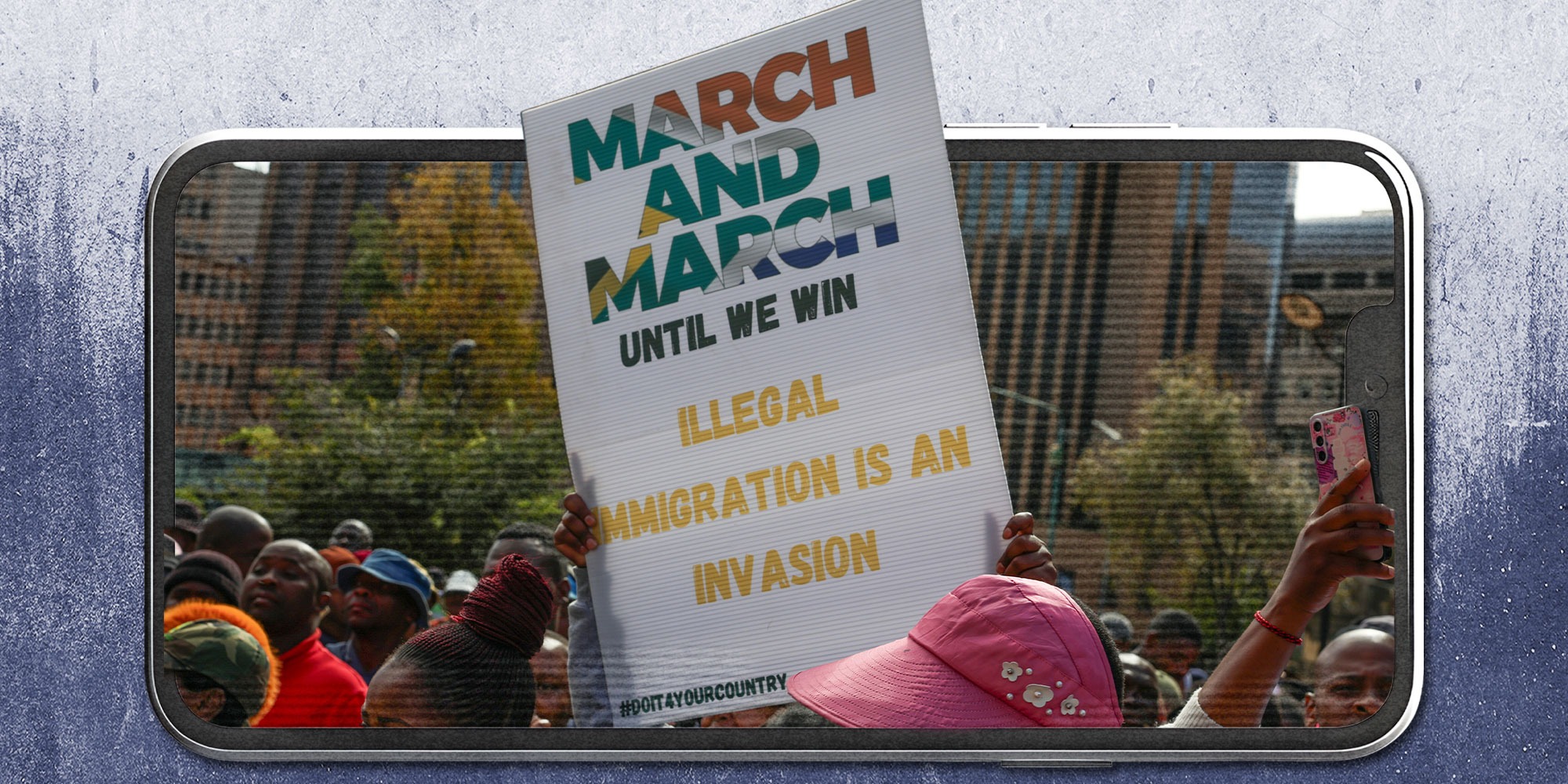
 Illustrative image: A smartphone. (Image: Magnific) | Marchers during the protest against illegal immigration at Mary Fitzgerald Square in Johannesburg. March and March is demanding tighter immigration controls. (Photo: Luba Lesolle / Gallo Images) | (By Daniella Lee Ming Yesca)
 South Africa is entering a dangerous period. Over the past few months, social media platforms have witnessed a significant increase in content targeting foreign nationals.
Alongside legitimate debates about migration policy, there has been a growing volume of misinformation, disinformation, hate speech, threats, and content that appears designed to incite hostility and violence against migrants.
Much of this content is now being circulated in the lead-up to 30 June 2026, a date promoted by anti-immigrant groups as a deadline for foreign nationals to leave South Africa.
The danger lies not only in the rhetoric itself, but in the broader context within which it is being shared.
South Africa is not a country with a theoretical history of Afrophobic violence. It is a country that has repeatedly witnessed attacks on foreign nationals, including the widespread violence of 2008 and subsequent outbreaks in 2015, 2019, and beyond.
Hundreds of people have lost their lives, thousands have been displaced and countless businesses and livelihoods have been destroyed. Accordingly, the current online information environment should be a cause for serious concern.
Growing threat of harmful online content
In recent weeks, social media platforms have carried posts falsely attributed to state institutions, fabricated announcements regarding migration policy, misleading claims about foreign nationals, and content portraying migrants as criminals, invaders, or enemies of the state. Other posts have gone further, using imagery associated with violence, including tyres, accelerants, weapons, masks, and references to the March and March organisation’s 30 June 2026 deadline.
Some openly threaten violence. Others employ coded language and dog whistles that may be understood by audiences familiar with the broader campaign against foreign nationals.
Viewed individually, some of these posts may appear relatively insignificant. Viewed collectively, they form coordinated narratives that fuel fear, hostility, polarisation, division and social mobilisation.
The problem is not merely one of false and inaccurate information. It is the convergence of mis- and disinformation and existing social tensions.
False information spreads more easily when it confirms existing frustrations, and platforms are reluctant to take these down as they generate traffic and engagement for them.
Communities facing unemployment, poverty, crime and service delivery failures are often presented with a convenient explanation: blame the foreign national.
In this environment, misinformation becomes a political tool and disinformation becomes a weapon. This is precisely why freedom of expression carries responsibilities.
The Constitution of the Republic of South Africa (1996) robustly protects freedom of expression because open debate is essential to democracy, especially considering South Africa’s history of censorship and state-controlled information under apartheid. However, this right is not absolute.
The law and hate speech
South African law does not protect advocacy of hatred that constitutes incitement to harm, nor incitement to imminent violence. Rights must be exercised in a manner that respects the rights and dignity of others.
For example, in Qwelane v South African Human Rights Commission (2021), the Constitutional Court confirmed that hate speech under Promotion of Equality and Prevention of Unfair Discrimination Act (Pepuda) is not protected where it objectively demonstrates hatred and is reasonably capable of inciting harm.
Similarly, in Centre for Child Law v Minister of Basic Education (2020), the High Court confirmed that undocumented children may not be excluded from public schools.
In Gauteng High Court proceedings concerning Kalafong Hospital (2022), the courts interdicted attempts to prevent foreign nationals from accessing healthcare services.
Lastly, in Kopanong Africa Against Xenophobia and Others v Operation Dudula and Others, the courts reaffirmed that constitutional freedoms cannot be used to justify conduct that infringes rights to dignity, equality, healthcare, or education.
The Dudula judgment also highlighted the strategy of using social media to spread hatred and incite violence. These judgments highlight that while political freedoms are protected, they are not absolute; they must be balanced against fundamental human rights.
Essentially, the challenge facing South Africa today is that harmful content increasingly operates in the space between lawful speech and unlawful conduct.
False claims, inflammatory narratives, manipulated images, and coded threats may not always amount to direct incitement when viewed in isolation. Yet when repeatedly circulated within a volatile environment, they can and do contribute to real-world harm.
History demonstrates that violence rarely emerges spontaneously. It is often preceded by narratives that dehumanise, scapegoat and isolate a target group. Before people are attacked, they are blamed. Before they are blamed, they are misrepresented. Before they are excluded, they are portrayed as a threat.
Why leadership matters
Political leaders, government institutions, civil society organisations and digital platforms cannot afford to remain passive while harmful content proliferates.
Silence creates space for misinformation to flourish, ambiguity allows threats to be normalised and failure to act risks sending the message that certain groups may be targeted without consequence.
Equally concerning is the sheer volume of misinformation, disinformation, hate speech, threats and other harmful content that remains available online despite being reported to platforms.
The apparent failure of platforms to consistently and effectively enforce their own rules raises serious questions about corporate accountability and the adequacy of existing content moderation systems.
Digital platforms cannot continue to prioritise engagement, traffic and profit at the expense of human rights and public safety.
The role of social media in fuelling, facilitating and contributing to real-world violence is not new. Meta’s platforms directly contributed to the Rohingya massacre in Myanmar.
We also know that social media was used to incite violence during the May 2021 riots in South Africa.
In 2008, before social media came to dominate our communications landscape, the Daily Sun, then the country’s largest daily newspaper, fuelled Afrophobia through the repeated use of headlines referring to non-South African black Africans as “aliens”.
The term was dehumanising and, in many instances, served to legitimise growing anger and hostility. Sixty-two people were killed in the 2008 attacks, and 21 of those who died were South Africans.
While other media outlets at the time were far more responsible in their reporting, the role of our news media in covering the current rise of Afrophobia remains critical.
Ethical reporting
The decimation of our news media, where fewer journalists are expected to cover an ever-expanding range of issues, combined with the juniorisation of newsrooms, has in many instances led media outlets to turn to social media not only for easy stories but also in pursuit of online audiences.
In some cases, this has resulted in an abject failure to uphold even the most basic tenets of journalism, with news organisations failing to act as journalists and instead simply parroting social media accounts.
Open letters calling on the media to adhere to ethical reporting principles, together with complaints lodged with self-regulatory bodies, reveal a growing recognition of the failures of our news media: a critical democratic pillar entrusted with upholding fundamental rights and the standards of good journalism.
However, it is not too late for the media to do the right thing. On 18 June 2026, together with the South African National Editors’ Forum and other partners in the Social Media for Peace South Africa initiative, we will be hosting a workshop with news media practitioners to strengthen reporting on Afrophobia and promote ethical, responsible journalism.
The period leading up to 30 June requires vigilance and leadership.
Government must clearly communicate the legal position regarding migration and respond swiftly to false claims.
Law enforcement agencies must monitor and investigate credible threats of violence. Digital platforms must enforce their own rules against hate speech, incitement, and coordinated harassment.
Equally, political actors must refrain from exploiting migration anxieties for short-term political gain, particularly in the lead up to the 2026 local government elections.
As members of the public, you can also play an important role in preventing violence, reducing hatred and polarisation, and protecting our democracy.
If you encounter content that you believe constitutes misinformation or disinformation, incites violence, or amounts to hate speech, report it to Real411. In addition to enabling the content to be assessed against applicable laws and regulatory frameworks, reports can assist researchers in identifying harmful actors, coordinated networks, and emerging trends.
They can also provide a basis for engaging platforms and requesting appropriate action on harmful content. At a time when misinformation and hate can spread rapidly online, public vigilance and responsible reporting are more important than ever.
Afrophobia: Lessons of the past are clear
South Africans must recognise that the country’s social and economic challenges cannot be solved through scapegoating and targeting vulnerable groups. The lesson of previous Afrophobic violence is clear.
Once violence is normalised, it rarely remains confined to its original target; it spreads, evolves and damages social cohesion and weakens democratic institutions.
The question facing South Africa is therefore not simply how to manage migration; it is whether we will allow misinformation, hatred and fear to drive public discourse during a moment of heightened tension.
The answer will shape not only the safety of foreign nationals, but the character of South African democracy itself. DM
Gudani Tshikota is the Campaigns and Projects Coordinator of the SOS Support Public Broadcasting Coalition. William Bird is the director of Media Monitoring Africa.
Comments
Scroll down to load comments...