




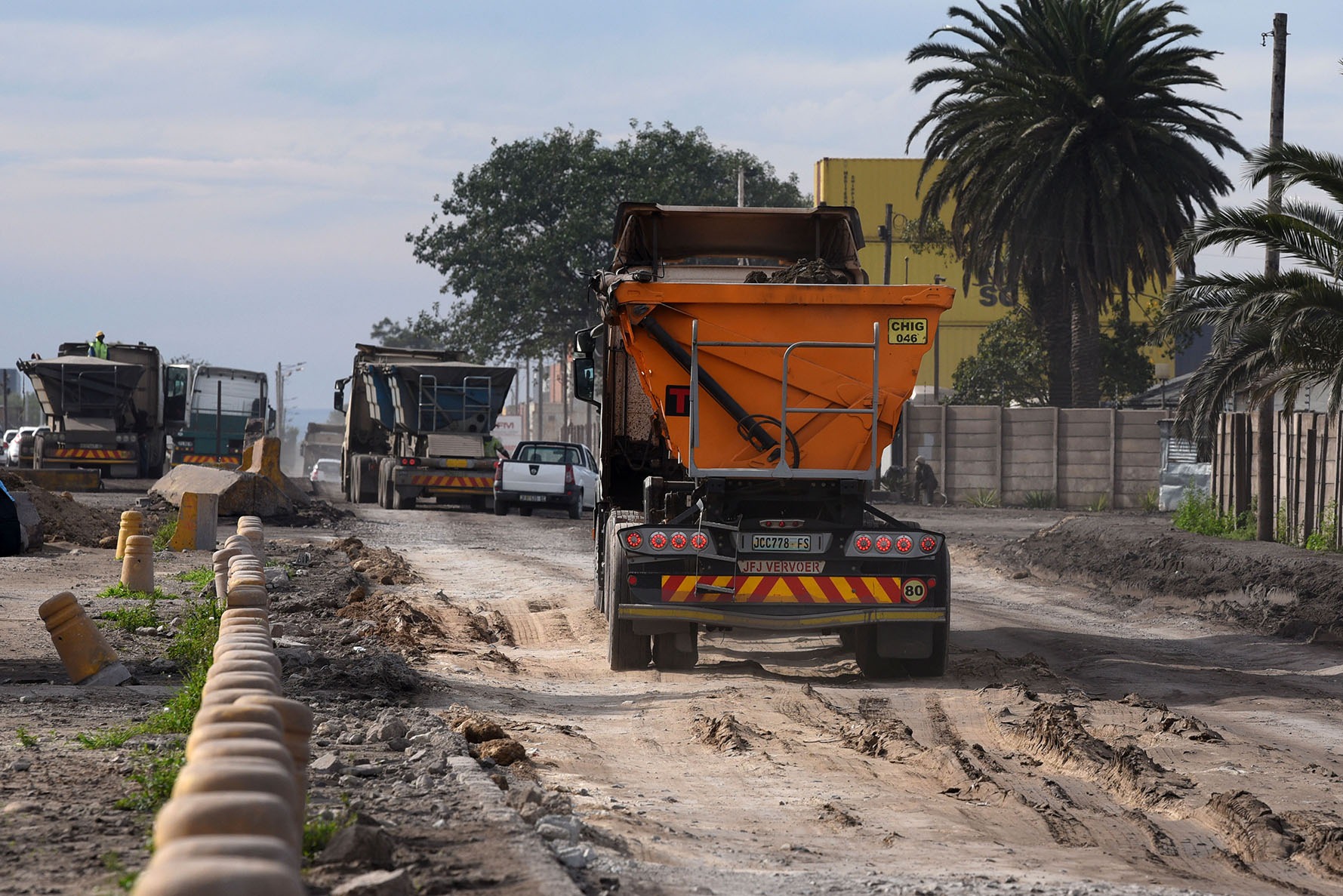
 A manganese truck drives on damaged roads in the Markman Industrial Area near Port Elizabeth harbour. (Photo: Deon Ferreira)
 The Democratic Alliance has asked the South African Human Rights Commission to investigate whether manganese pollution in Nelson Mandela Bay is violating residents’ constitutional right to an environment that is not harmful to their health.
DA councillor Annette Lovemore wrote to the commission on 10 June after a municipal report revealed excessive dust levels around the Port Elizabeth harbour and Markman industrial area, questioning why authorities had failed to bring the pollution under control despite years of complaints and previous surveys showing dangerous levels of contamination.
“How is it possible that operations responsible for dust production at levels such as those quoted continue?” she asked.
A report on air quality brought to the economic development committee last week, with samples taken at the PE Harbour and at Markman, where manganese companies operate, shows that the local airshed has reached a state of saturation with dust deposition rates far exceeding the non-residential limit.
This can cause health challenges such as neurological damage and respiratory diseases.
The move comes as South-End residents have launched a petition calling on the municipality and Transnet to urgently protect public health and accelerate the relocation of manganese operations from the Port Elizabeth harbour to Coega.
Residents noted that Transnet had been planning to relocate its manganese operations to the Coega Industrial Development Zone since 2016, but that the target date had since shifted to 2031.
“The municipality is legally required to enforce its by-laws, environmental health standards, and zoning rules, and to ensure compliance with national air quality laws and international pollution control guidelines,” the petition reads.
“Despite this, manganese operations at the PE Harbour continue to affect surrounding communities without sufficient enforcement or protection measures.”
/file/attachments/orphans/Dusty_897536.jpg "Eroded roads and manganese trucks have caused health risks. The Nelson Mandela Bay metro in the Eastern Cape conducted a survey that revealed severe air pollution. (Photo: Deon Ferreira)")
The petition states that “dangerous” manganese dust affects air quality and health, pollution settles on homes and public spaces, heavy truck traffic damages roads and increases safety risks.
Due to ongoing exposure and long-term health concerns, the residents demand that:
- The municipality immediately enforces all relevant by-laws and environmental regulations at the PE Harbour;
- The municipality and Transnet implement urgent mitigation measures in line with national and global air quality standards;
- Transnet immediately proceeds with relocating manganese operations from the PE Harbour to the Coega Harbour (Ngqura Deepwater Port) within a clear, accountable timeframe; and
- Proper monitoring and public reporting are put in place so residents can see that action is being taken.
The report states that initial complaints about air pollution and infrastructure damage were received in June 2020.
However, despite ongoing compliance monitoring and enforcement actions – which include the issuance of nine compliance notices last year, and the closure of unauthorised operations – dust emissions from the handling, storage and transport of manganese ore have persisted.
/file/attachments/2993/Tyres_323564.jpg "Manganese operations are causing pollution in the Markman Industrial area in Nelson Mandela Bay. (Photo: Deon Ferreira)")
Manganese operations have been widely criticised in the municipality and by concerned groups and residents, as operators have been caught contravening by-laws, particularly in the Markman area, and damaging road infrastructure.
The report states that meteorological reviews of the prevailing wind data for Gqeberha and Coega show significant wind components originating from the southwest and west, and during summer, from the northeast.
This wind pattern directs the dust plumes directly over the residential areas of Wells Estate, Bluewater Bay and parts of Amsterdamhoek.
‘Health risk to workers and residents’
“The status of air quality in the PE Harbour shows chronic non-conformance to the dust fall standards and carries a litigation risk for the municipality as it poses health risks for workers in the harbour area and to the citizens in the nearby communities.
“It must be borne in mind that the manganese ore facilities in the PE Harbour are authorised by the municipality. The licences for the bulk storage facilities in the PE Harbour will expire on 30 June 2027. It would be risky for the NMBM to renew the authorisations knowing that they pose health risks to its community,” the report states.
Transnet spokesperson Mava Mgeyiya did not respond to questions sent on Monday morning. Neither did municipal spokesperson Sithembiso Soyaya.
Lovemore wrote to the Human Rights Commission on 10 June, alleging a breach of the constitutional right to an environment that is not harmful to health or well-being.
/file/dailymaverick/wp-content/uploads/2022/06/Annette-Lovemore.jpg "DA councillor Annette Lovemore (Photo: Deon Ferreira).")
“Nelson Mandela Bay is host to approximately 20 manganese operations, mostly situated in the industrial area known as Markman and mostly unlicensed. The majority of the manganese handled in the city is exported via the PE Harbour. A minor portion is exported via the Port of Ngqura,” she wrote.
“Despite the fact that previous dust surveys have shown the dust levels in Markman to have been excessive to the extent that a danger to health exists, the municipality has delayed in replacing vandalised air quality monitoring equipment. No air quality results have been reported to the public health committee for well over a year. Finally, as a result of repeated pleas, the public health directorate has made available the dust and manganese levels as measured by operators in Markman and at the PE Harbour for the period December 2025 and January 2026.
“This municipality has three air pollution control officers. How is it possible that operations responsible for dust production [are] at levels such as those quoted? Why has no action been taken to ensure that dust levels are controlled within levels that are not harmful to health or well-being? ”
/file/attachments/2993/N2_855640.jpg "A truck transports manganese in the streets of Gqeberha on 11 June 2026. (Photo: Deon Ferreira)")
Lovemore said every resident and business owner who had complained of dust pollution caused by manganese ore operations had good reason to do so.
“Every resident living close to a manganese ore operation who has been convinced that their respiratory problems have been caused by the high dust levels has quite possibly been right.”
Lovemore said that despite the municipality being fully aware of the dangers of manganese-laden dust, particularly in Markman and near the PE Harbour, no municipal air quality monitoring had taken place for well over a year.
“We have on repeated occasions demanded that the results generated by the few manganese operations that are actually licensed and are required to produce monthly dust monitoring reports be reported to the public health committee. The request has gone ignored until now,” said Lovemore.
“The results are shocking; 89% of the dust level results in Markman far exceed the industrial limit. All of the samples taken at the harbour have yielded results well in excess of the industrial limit (which is twice the residential limit). The report makes it clear that a substantial health risk exists both in Markman and at the harbour, and the residential areas surrounding it.” DM