




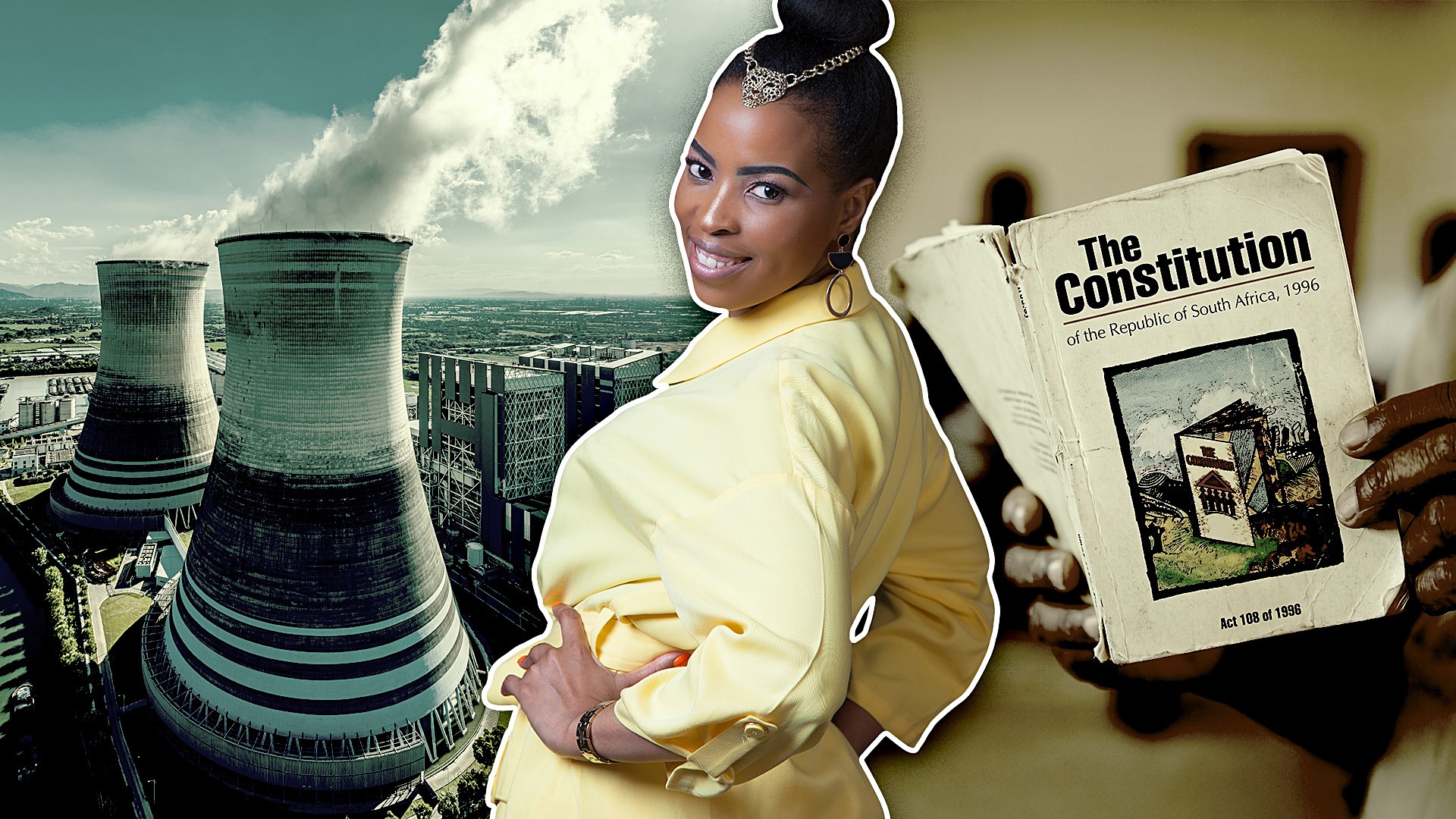
 Illustrative image: Nuclear power plant (Photo: iStock) | Necsa official Princy Mthombeni (Photo: Wikipedia) | South African Constitution (Image generated with Google Gemini Flash Image 2.5)
 Princy Mthombeni has sold South Africans a campaign about foreigners.
In an interview on eNCA that Mthombeni posted to her TikTok account on 30 May 2026, she was asked to explain the main proposals of South Africans for Constitutional Reform (SACR), the group she co-founded and chairs.
Mthombeni produced a list which is familiar in South Africa’s current anti-immigrant climate, including changing the Constitution’s preamble to specify that South Africa belongs to “its citizens”, restricting foreigners’ access to “free healthcare, free education, social grants,” and reserving “mineral resources to benefit South African citizens”.
That pitch has fallen on fertile ground and made SACR the most successful citizens-first online constitutional campaign of the past year.
The group gathered more than 30,000 signatures from a petition initially launched in May 2025. Just over a year later, it raised more than half a million rands in only two weeks to take Parliament to court for a perceived failure to consider its constitutional submissions.
But 12 days after the eNCA interview, Mthombeni gave a quite different reason for entering the fight to rewrite South Africa’s Constitution.
Asked by popular YouTuber Penuel Mlotshwa why she had taken up the cause, Mthombeni did not cite immigration or strained public services.
Hidden agenda
“The only reason I went to review our Constitution was because I wanted to check the energy sector, or the energy section of the Constitution,” she replied.
Yet SACR’s public campaign was not focused on South Africa’s energy needs.
Its interviews, its petition and its fundraising appeal have been built around citizens, foreigners and constitutional entitlement. But near the foot of the petition, beneath the demands that drew the crowds, sits another proposal with nothing obvious to do with immigration: “Oversight of NGOs and NPOs to ensure alignment with national development”.
To make sense of this, it is useful to understand that Mthombeni’s role in the public space for close on two decades has been as a tireless advocate for nuclear energy.
And one issue involving nuclear appears to preoccupy Mthombeni above any other: the Western Cape high court’s striking down of the proposed South African nuclear deal with Russia in 2017, following litigation by environmental NGOs.
As recently as April 2026, some nine years later, Mthombeni was still using her social media accounts across platforms to argue that the Zuma-era nuclear deal should have gone ahead.
Daily Maverick’s investigation into one campaign of many currently seeking to restrict the rights of foreign nationals throws up disturbing questions about whose interests are really served – and where the money raised goes.
The anger SACR captured
South Africa is in its sharpest period of anti-migrant mobilisation in years – and movements seeking to mobilise a receptive audience now have the benefit of convenient digital infrastructure.
On Backabuddy, South Africa’s leading crowdfunding website, Daily Maverick counted at least five separate campaigns targeted at raising money for anti-immigrant campaigns.
Backabuddy spokesperson Simbulele Jezile told Daily Maverick: “BackaBuddy does not permit campaigns that promote xenophobia, hate speech, unlawful activity, political-party fundraising, or content that breaches our platform standards”.
He did not explain how these principles permitted the hosting of campaigns fundraising for March and March, the movement which has issued thinly veiled threats towards undocumented migrants who fail to leave the country by 30 June 2026, and whose founder Jacinta Ngobese-Zuma has publicly declared: “Ubuntu is suspended until further notice”.
SACR has channelled public anger into far more sober language, calling for reforms to the Constitution.
But on SACR’s own BackaBuddy page, Daily Maverick’s analysis showed that the most-repeated donor message was “South Africa for South Africans,” posted 20 times. Another recurring entry was the isiZulu “abahambe”: they must leave.
SACR’s supporters, in other words, seem to echo the same xenophobic sentiments as those of the less ostensibly high-minded movements taking to the streets.
Mthombeni’s campaign’s insistence that rewriting the Constitution is the answer to migration management is not one supported by international best practice, which maintains that reforming immigration policy is a more effective approach.
What this would not do, however, is to touch the ability of NGOs to operate in South Africa,
A Necsa employee in Rosatom’s orbit
On X, Mthombeni calls herself a “Nuclear Goddess.” On LinkedIn, she is a “Multi-Award-Winning Nuclear Communicator.” Nuclear energy has been her work and her cause for nearly two decades – including as an employee of the South African government.
Necsa spokesperson Nikelwa Tengimfene confirmed to Daily Maverick that Mthombeni is a Stakeholder Relations Officer at the South African Nuclear Energy Corporation, the state-owned nuclear company, and her LinkedIn profile records that she has been there since March 2007.
Her LinkedIn profile also records a contract advising the Department of Mineral Resources and Energy on nuclear stakeholder management between 2019 and 2022.
Around this professional work, she has built a second identity as an external nuclear advocate, including coordinating the South African arm of the international lobby group Stand Up for Nuclear from 2019, and founding her own platform, Africa4Nuclear, in 2021.
Her advocacy has taken her repeatedly into the orbit of the Russian state-owned nuclear company, Rosatom.
/file/attachments/orphans/atomexpo_linkedin-Firefly-Upscaler-2x-scale_469097.jpg "A LinkedIn post from Mthombeni on 21 November 2022 records her involvement in Atom Expo in Sochi, Russia. (Image: LinkedIn)<br>")
In November 2022, she posted that it had been “great to open the #AtomExpo2022 Nuclear Spring together with Rosatom Director General and IAEA Deputy Director General.” In 2024, she toured the floating nuclear power plant at Pevek, in the Russian Arctic, as part of what she called a Rosatom “media tour”.
/file/attachments/orphans/pevek-linkedin-Firefly-Upscaler-2x-scale_879041.jpg "One of a series of LinkedIn posts by Mthombeni in July 2024 covering her trip to a Rosatom plant in Pevek, Russia. (Image: LinkedIn)")
In October 2025, she was in Moscow for World Atomic Week, where, she wrote, delegates were “addressed by leaders from across government, industry and international organisations, including President Vladimir Putin.”
In a TikTok video recording this trip, the caption reads: “I attended the World Atomic Week, invited by President Putin”.
Her video voiceover thanked “the Russian Federation for this incredible opportunity”, and added: “I’m grateful to Rosatom for inviting me to this event and for covering my trip. I’m so, so grateful”.
Necsa told Daily Maverick that Mthombeni “had previously declared her involvement and participation in nuclear-related movements,” but that it had since “re-evaluated her declaration for the current financial year, in consideration of potential conflict of interest”.
After Daily Maverick put her Rosatom-linked activity to the corporation, spokesperson Tengimfene said organisational records showed that her 2024 sponsored visit to Pevek had not been disclosed.
“The organisational records indicate that she was present at the event while on annual leave,” Tengimfene said.
On the campaign now drawing thousands into a fight over the Constitution, Necsa responded that it “is not aware of [Mthombeni’s] role” in SACR.
Daily Maverick tried to reach Mthombeni through three email addresses and by WhatsApp over the course of a week. On 11 June, she answered the phone and confirmed her identity. When she heard the call was from Daily Maverick, she hung up.
/file/attachments/orphans/PrincessMthombeniTimeline_558170.png)
A legal fight with shaky legs
In 2025, the Joint Constitutional Review Committee called for public submissions on possible constitutional amendments, which is what SACR was formed to respond to.
Parliament has since indicated that it received about 1,400 submissions, of which the majority were immediately discarded as not being within its mandate.
Of the 348 remaining, the committee’s own summary said, the submissions “predominantly” proposed that the Constitution’s preamble be changed to say South Africa belongs to its legal citizens rather than to “all who live in it”.
SACR’s submissions in this regard were in no way unusual. In other words, this was a proposal already made by Action SA, among other bodies.
But these submissions have also already been effectively ruled dead in the water.
In legal opinions to the committee, Parliamentary Legal Services advised that proposals to confine constitutional rights to citizens were “not supported by the current constitutional framework or jurisprudence”, that the Constitutional Court had consistently read rights such as healthcare and education to cover everyone present in the country, and that the changes would collide with basic constitutional principle and require supermajorities SACR has no obvious way to assemble.
SACR is now threatening legal action, saying that Parliament ignored its submission and denied it transparency and meaningful public participation. This is the ostensible purpose of its astonishingly successful crowdfunding campaign, launched in May 2026.
Half a million rands, mostly in R50 donations
Over ten months, March and March, arguably the most high-profile anti-immigrant movement of the moment, has raised just R13,167 of a R20,000 target in its Backabuddy campaign to date.
SACR, wrapped in the language of citizenship and the Constitution, raised more than R500,000 in two weeks – of which almost half came through in just four days.
BackaBuddy told Daily Maverick that reaching half a million rands that fast places a campaign “among the stronger-performing” appeals on its platform.
Daily Maverick’s analysis suggests that the trigger point for the campaign’s ignition was a single night.
On 26 May 2026, the TikTok account of content creator Enhle Njomane announced a livestream in service of SACR, posting a video carrying the on-screen call “Live tonight at 8” and the prompt, “Have you made your donation?”
The video drew 29,100 likes. Njomane went live at 8pm. The donation data shows the campaign began to spark in earnest at 9pm, and the campaign’s single biggest day followed on 27 May with 1,230 gifts worth R115,738.
Daily Maverick examined the donor record in full as on 9 June 2026 after scraping the data from the Backabuddy campaign page.
It showed 5,427 donations totalling R525,037, within rounding of the figure the campaign itself displayed. We tested the data rigorously for evidence of automation, structuring, foreign funding, coordination or any anomalous features.
None of significance emerged. The median donation was R50, the largest single gift R5,000, and just under 39% were anonymous. There was no sign of automation. Foreign-currency donations were in evidence, but numbered just 41 of the 5,427 and totalled a relatively paltry R12,070.
Only one quirk emerged: the campaign’s third-largest single donation was accompanied by a message written in Chinese characters. Translated from Mandarin, it means, “Keep going!”
There is no suggestion of anything untoward regarding the sources of the donations, in other words. But a more complicated question is where the money will go.
BackaBuddy told Daily Maverick that SACR’s page is a “Blue Tick” campaign, meaning funds are released only to a verified third-party beneficiary against an invoice.
“No payout request has been submitted,” spokesperson Jezile said.
Jezile also said that once funds are released, the platform “does not actively track, audit, or guarantee how they are spent”.
More than half a million rand has been raised for a legal challenge by a campaign whose legal form is not publicly clear, for a beneficiary not yet named.
The NGOs she cannot leave alone
On the Penuel YouTube show, after naming the energy section as her primary motivation for entering the constitutional fight, Mthombeni turned to NGOs.
“Why [do] NGOs keep winning court cases?” she asked.
“The last court case that NGOs won said the whole process was unconstitutional. There was no public participation process.”
She was describing the 2017 nuclear judgment, which Mthombeni has returned to repeatedly in social media posts.
In April 2017, the Western Cape high court threw out the Zuma administration’s nuclear agreement with Rosatom, which would have cost an estimated R1-trillion and locked South Africa into energy dependency on Russia for decades, on the grounds that the process lacked lawful transparency and public participation.
Mthombeni has repeatedly argued on social media that if South Africa had gone through with the nuclear deal with Rosatom, its electricity problems over the past years would not have happened.
In a TikTok video posted on 30 March 2026, Mthombeni lamented: “We may have walked away from one of the cheapest sources of energy in its system, one of the most reliable forms of clean base power, and most importantly, we missed the economic transformation opportunity”.
In April 2026, she posted on LinkedIn:
“Unelected NGOs must not dictate South Africa’s future. If Greenpeace Africa, Earthlife Africa and SAFCEI want to govern, they must contest elections. Courtrooms are NOT substitutes for democratic mandates.”
Earthlife and SAFCEI were the organisations that beat the nuclear deal in court.
/file/attachments/orphans/greenpeace-linkedin_173629.jpg "A LinkedIn post from Mthombeni on 10 April 2026 sees her still criticising the NGOs which litigated against the nuclear deal in 2017. (Image: LinkedIn)")
SACR’s petition does not single out any specific NGOs.
What it calls for is “Oversight of NGOs and NPOs to ensure alignment with national development”.
This wording is so broad that it may sound benign – but the demand to bring NGOs under state oversight belongs to a wider state-first politics that treats independent civil society as an obstacle to national policy.
Russia has codified that treatment more aggressively than most countries.
Its Federal Law 255-FZ of July 2022, “On Control over Activities of Persons Under Foreign Influence”, places organisations and individuals on a state register and under monitoring when authorities deem them subject to foreign influence.
SACR is not proposing precisely that law; its wording is far vaguer, while still expressing the principle that civil society should be supervised to keep it aligned with the state’s view of national development.
Where countries pursue large nuclear deals, the institutions that challenge procurement, secrecy, cost and safety are often environmental, faith and legal NGOs, as was the case in South Africa.
It is impossible to ignore, meanwhile, the fact that Rosatom has a documented pattern of exporting an influence “ecosystem” of educational and youth programmes, public-diplomacy platforms and communication strategies built to manufacture public acceptance and, where civic space is fragile, to work at “narrowing public debate and marginalising dissent” – in the words of researcher Nelya Rakhimova.
The fight beneath the fight
Many of SACR’s donors believed they were giving R50 to put South Africans ahead of foreigners, and the messages they left say as much.
But the evidence trail points somewhere else as well: to nuclear energy, and to the NGOs that used the courts to stop a Russian nuclear deal.
The campaign was sold as a fight about foreigners. On the evidence, it may equally reflect the unfinished business of a fight about Russian nuclear reactors.
What the example of SACR suggests is that an anti-immigrant campaign can serve as a container for many other things. Anti-foreigner anger has become one of the cheapest ways to raise money and mobilise a following in South Africa, and a campaign built on it can be turned toward an end its donors may not truly foresee. DM