



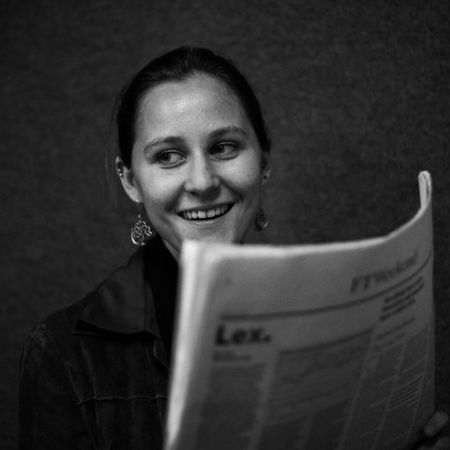
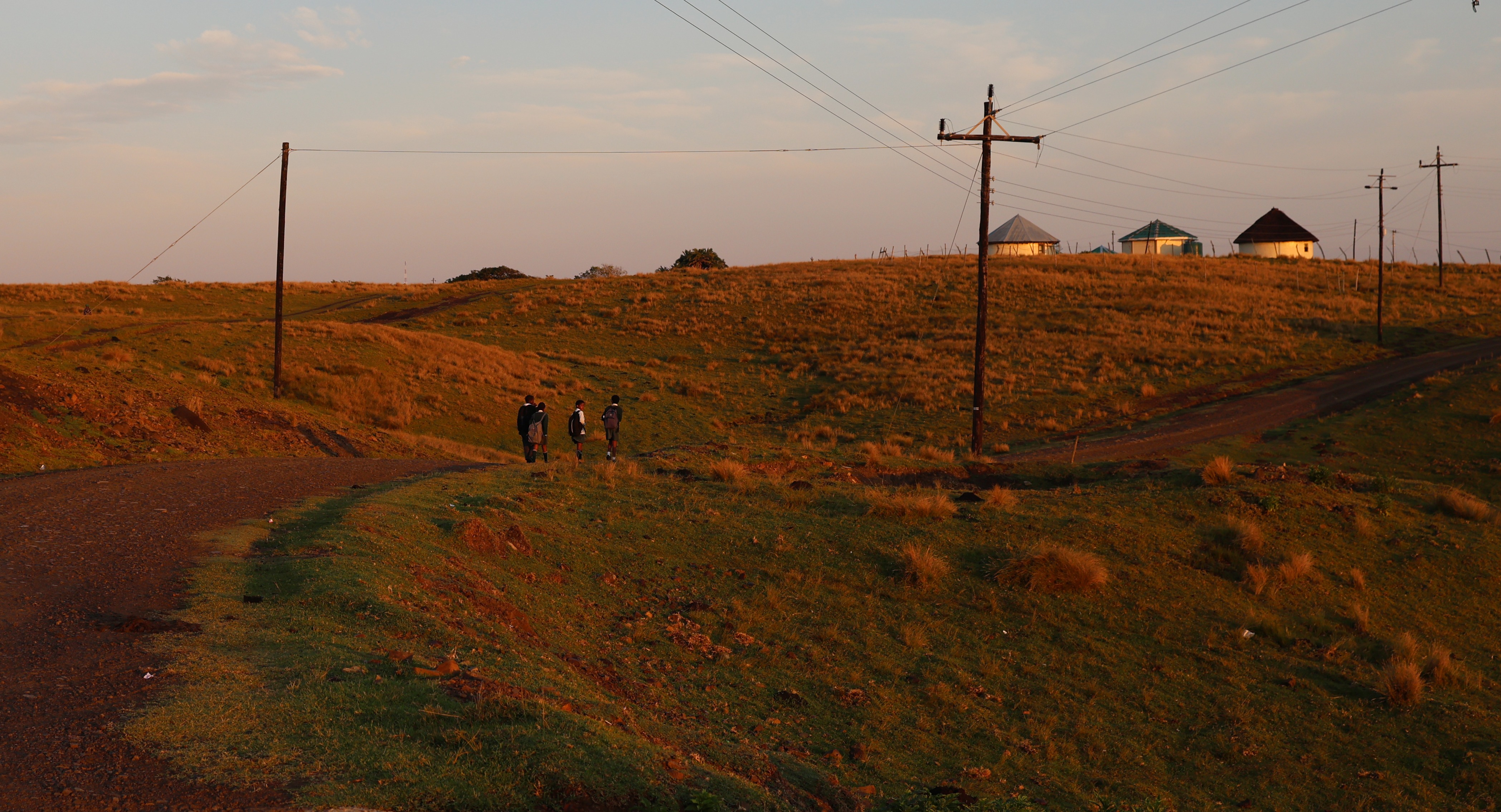
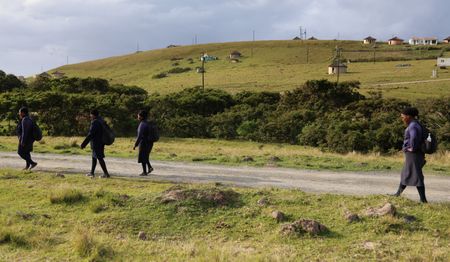
 Pupils from Xhora Mouth, a remote coastal community in the Eastern Cape, walk long distances to and from school each day. (Photo: Felix Dlangamandla)
In the remote rural region of Xhora Mouth in Elliotdale, Eastern Cape, the nonprofit Bulungula Incubator has spent the past 20 years driving a quiet revolution for children’s development spanning the life course of young people, from conception to career.
In 2026, the incubator celebrated the graduation of university students from the community who had moved through the full spectrum of its education programmes, from formative years in its early childhood development (ECD) centres to matric preparation in the high school it established in 2019.
Rejane Woodroffe, director and co-founder of the Bulungula Incubator, has described the organisation’s efforts as an example of “place-based development”, with a context-specific, deep focus on a particular area. By treating healthcare, nutrition and education not as isolated issues but as interconnected drivers of human potential, the incubator has fundamentally transformed what it means to grow up in the deep rural community.
“We talk about scaling deep... It takes 20 years to have this kind of impact,” Woodroffe explained. “And then also scaling out, which is the incubation of other organisations [and] enabling individuals who have good ideas.”
/file/attachments/orphans/6I1A1799_266867.jpg "Rejane Woodroffe, co-founder of the Bulungula Incubator, has played a key role in driving community-led development initiatives and improving access to education, healthcare and sustainable livelihoods in Xhora Mouth, Eastern Cape. (Photo: Felix Dlangamandla)")
/file/attachments/orphans/6I1A1769_192197.jpg "Bulungula Incubator co-founder Dave Martin. (Photo: Felix Dlangamandla)")
Building BI
The Bulungula Incubator began its work in 2007, just three years after co-founder Dave Martin launched the Bulungula Xhosa Community Lodge in the area as a joint job creation venture with the community. At the time, Xhora Mouth had no roads, piped water, electricity or sanitation infrastructure. Falling under the former black homeland region known as the Transkei, it had seen very little development in terms of government services.
In 2006, a third of the babies in the local village died as a result of contaminated drinking water.
“That was when we started trying to think of what other interventions could be done outside the lodge... We started very small, with some rainwater tanks, so at least we could get uncontaminated drinking water, and then that was essentially the birth of the incubator,” said Martin.
/file/attachments/orphans/6I1A1618_872669.jpg "Rural pupils make their way back home from school. (Photo: Felix Dlangamandla)")
/file/attachments/orphans/6I1A1635_216700.jpg "Pupils walk home after a full day of learning. (Photo: Felix Dlangamandla)")
Much has changed in Xhora Mouth since then. A network of roads now connects the four villages that make up the area to the surrounding region; a water system supports communal taps for the homesteads scattered across the rolling hills; and in the past two years transmission lines have brought electricity to the furthest edge of the community where it runs along the Wild Coast.
The Bulungula Lodge, which Martin handed over to be fully owned and run by locals in 2014, continues to draw a steady stream of tourism to the breathtaking coastline.
But one of the greatest transformations, driven largely by the incubator, in partnership with the local government and community, has been in education.
/file/attachments/orphans/WFD_3730_870965.jpg "Pupils in a classroom at Bulungula Preschool. (Photo: Felix Dlangamandla)")
/file/attachments/orphans/6I1A1503_568134.jpg "Children outside a classroom at Bulungula Preschool. (Photo: Felix Dlangamandla)")
Early childhood development
Daily Maverick sat down with Martin and Woodroffe in the rondavel that houses a small library at the Jujurha ECD Centre, the first early learning facility the Bulungula Incubator established back in 2009. The organisation targeted the development of education as the lever through which the cycle of poverty in the Xhora Mouth area could be broken, said Woodroffe.
“We needed to demonstrate what excellent education was, and that was [through] this very preschool that you’re sitting in,” she said.
“It was our first major project, and after two years, parents... said to me: ‘You’ve turned the light on in my child’s mind’ – because you could see the difference.”
/file/attachments/orphans/WFD_4103_873433.jpg "Children at Phaphamani Preschool in Xhora Mouth. (Photo: Felix Dlangamandla)")
/file/attachments/orphans/WFD_3795_348487.jpg "Pupils gather for breakfast at Bulungula Preschool in Xhora Mouth – vital nutrition that sets them up for a day of learning. (Photo: Felix Dlangamandla)")
After the success of the first ECD centre, the traditional leader in the Xhora Mouth area pushed the incubator to establish an early learning facility in each of the three neighbouring villages. Local residents contributed to the effort, donating land and building mud huts to house classes.
Today, the incubator has five registered ECD centres, staffed by 11 teachers, supporting 146 children in the area, according to Lindiwe Tukane, education programme manager at the organisation.
/file/attachments/orphans/WFD_3770_588382.jpg "Breakfast time at Bulungula Preschool. (Photo: Felix Dlangamandla)")
But early learning does not start at the centres. It starts in the home, with nomakhayas (community health workers) walking from hut to hut to guide parents on how to stimulate their children’s development within the critical first 1,000 days of life, explained Tukane.
These nomakhayas also provide support to pregnant and new mothers, teaching them how to ensure proper nutrition and stay on track with immunisations for their babies. Stunting and malnutrition cases are rare in Xhora Mouth.
There are a number of community vegetable gardens in the villages, including at each of the five ECD centres, which provide fresh produce used in the meals for the young pupils.
/file/attachments/orphans/WFD_4159_882947.jpg "Residents who receive social community grants tend to a vegetable garden in Xhora Mouth. The garden promotes food security and supports household livelihoods while fostering community participation and self-sufficiency. (Photo: Felix Dlangamandla)")
/file/attachments/orphans/WFD_3791_799588.jpg "Pupils have breakfast at Bulungula Preschool. (Photo: Felix Dlangamandla)")
E-learning and Bulungula College
Across the government schools in Xhora Mouth the Bulungula Incubator is running an e-learning programme called iiTablet Tshomiz, with tablet-based online tools supplementing mathematics and English/isiXhosa literacy tutoring.
The project has aimed to use technology and local youth facilitators to “teach at the right level” for children with different needs in classrooms.
/file/attachments/orphans/WFD_3603_555827.jpg "Pupils use tablets at Kwa No Ofisi Primary School in Xhora Mouth. Digital learning tools are helping to support teaching and improve access to educational resources in this rural community. (Photo: Felix Dlangamandla)")
/file/attachments/orphans/WFD_3610_613615.jpg "Kwa No Ofisi Primary School uses tablets to supplement maths and English/isiXhosa literacy tutoring. (Photo: Felix Dlangamandla)")
On an early morning in late May, Daily Maverick joined schoolchildren as they traversed the steep hillsides to reach their schools. From 6am, pupils emerged from their homes in ones and twos, combining with larger groups on the long walk, until they coalesced into steady streams heading through the schools’ gates. Some were carrying bundles of papers in their hands, revising for the day’s tests en route.
The only high school in Xhora Mouth is the incubator’s Bulungula College, which offers grades 10 to 12. It started in 2019 with Grade 10 only, building towards the graduation of its first Grade 12 class in 2021.
/file/attachments/orphans/WFD_4233_753768.jpg "Pupils in Xhora Mouth walk long distances to and from school each day. The demanding journey highlights the challenges many rural children face in accessing education. (Photo: Felix Dlangamandla)")
“The high school is very helpful in the village because we didn’t have one here before the Bulugula College came,” said Betty Ndukumbini, administrative manager at the high school.
“Even the programmes that we have here are different from the other high schools... Our learner support deals with the learners who are having difficulties at home – those who cannot afford to buy the basics or don’t have parents. We are funding them, paying for items like toiletries, uniforms and the other things that they need.”
There are still challenges. Siyabulela Matshayana, principal of Bulungula College, said that children were sometimes behind on learning outcomes coming out of primary and secondary schools, requiring more support to catch up. Parents were not always able to help with studies in the home, since they themselves faced literacy challenges.
/file/attachments/orphans/WFD_3715_589367.jpg "Pupils make their way to Bulungula College in Xhora Mouth. (Photo: Felix Dlangamandla)")
In 2016, only 13% of residents in Mbhashe Local Municipality, in which Xhora Mouth falls, had a matric. Less than 5% had received higher education.
Ndukumbini noted that children with learning disabilities and special needs were not always identified early in their schooling careers. By the time they reached the high school it was often too late to place them in specialised educational programmes.
However, teachers at Bulungula College have gone above and beyond to prepare children for matric, providing bridging courses in English, maths and science for the Grade 9s from the feeder schools for the high school, and running after-school study sessions for those in grades 10 to 12.
/file/attachments/orphans/6I1A1670_614417.jpg "Langelihle Khanyile at Bulungula College. (Photo: Felix Dlangamandla)")
Job skills and employment
Langelihle Khanyile, manager of the incubator’s job skills and entrepreneurship programme, is working to prepare young people from the community for the world of work, in a country where opportunities are limited and unemployment high.
He noted that it was not enough to guide people through matric, only to leave them without a path forward.
Through the job skills programme the incubator provides internships at its other projects, including the ECD centres, the school e-learning interventions and the Bulungula Health Point, a centralised facility for primary healthcare services.
“We also have someone who deals with the maintenance here, as BI is a very big organisation [with] these small centres across the villages... That person is responsible for grooming those who are not really academically inclined, but who can become handymen,” said Khanyile.
“We place our interns in these different [spaces] just so that they can get the first-hand experience [on a] 12-month programme, while also getting a stipend.”
The incubator also provides entrepreneurship training, helping young adults to identify business opportunities in the community, do market research and build relationships with companies.
Reflecting on the work on the Bulungula Incubator, Woodroffe emphasised that it was not only important to tackle the interrelated challenges within communities, but also to bring local people on board with making a change.
“There isn’t just one intervention that any human being needs – it’s everything,” she said.
“Development projects take longer than people think, and in order to embed them in the community, you have to give time for the community to demand that the project grows and evolves... The initial idea might come from outside, but in order for it to be sustainable and embedded over time, there has to be this ownership.” DM
Comments
Scroll down to load comments...