




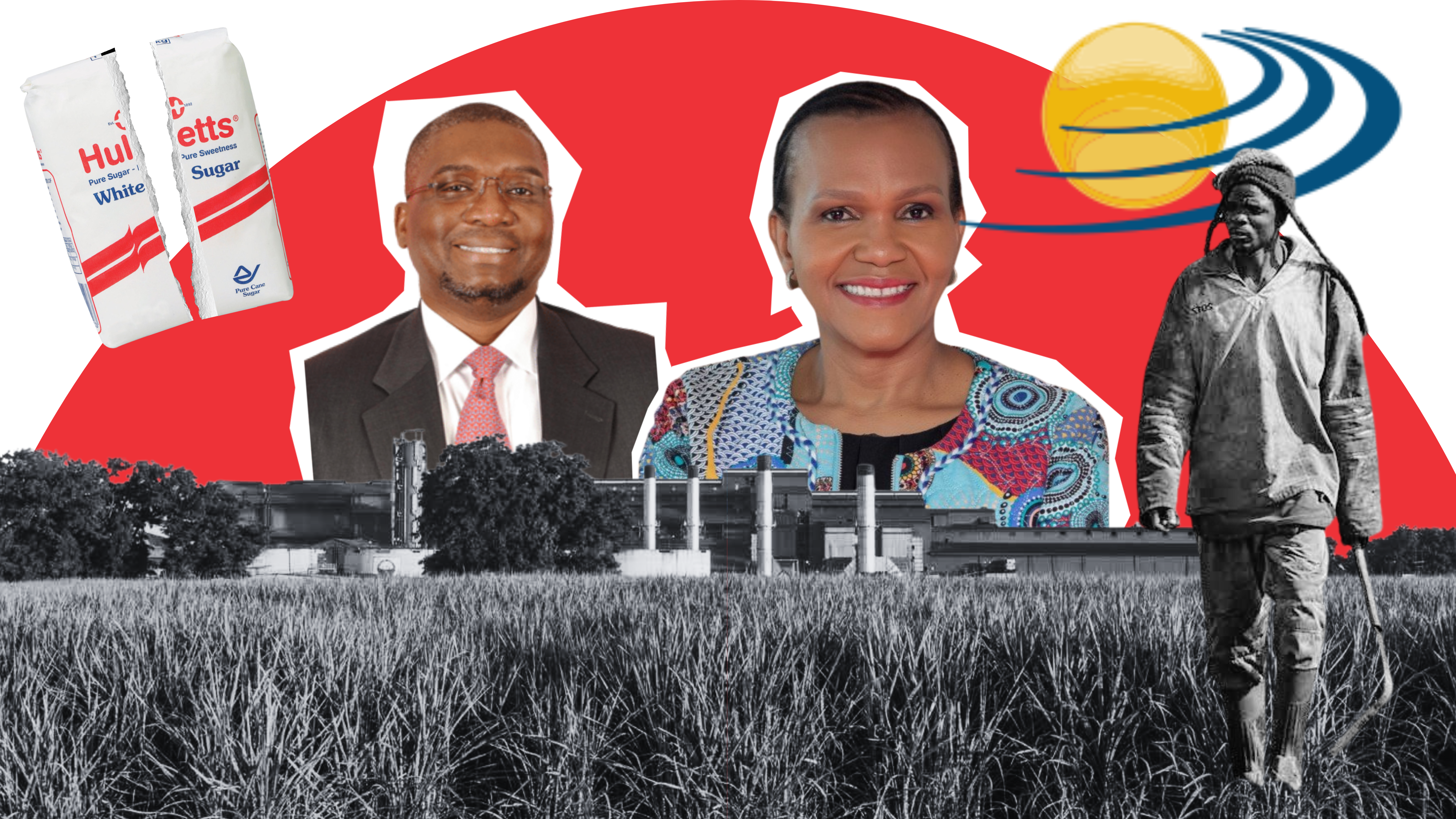
 Zimbabwean businessman Rute Moyo (left) fronts Vision Sugar Holdings, the entity seeking control of Tongaat Hulett, while IDC chief executive Mmakgoshi Lekhethe (right) faces pressure over whether the state-owned financier should bankroll the rescue of the troubled sugar giant. (FBC/LinkedIn/Huletts/Canva)
It seems both unjust and ironic that, while poor South Africans are mobilising against Zimbabwean migrants (among others) who are mostly just seeking refuge from their own predatory mafia-state, South African power-brokers appear poised to open the door for a Zimbabwean-dominated elite to seize control of one of our major assets: Tongaat Hulett.
It is also unfortunate that the hammering at that corporate door has been directed by heavyweight South African banks and lawyers who, since the time of the 2022 take-over bid by the controversial Rudland family, appear cynically indifferent to where the money is coming from and what the ultimate plans for the company are.
And those whose job it is to care – notably the Industrial Development Corporation (IDC) and the Department of Trade Industry and Competition (DTIC) – appear to be politically browbeaten, legally outgunned and fundamentally unable to imagine how to engage in a fight to protect South Africa’s sovereign interests.
This is where we are.
But how did we get here? And why is amaBhungane so interested in Tongaat Hulett, a colonial relic that arguably should have been broken up a long time ago?
There are many reasons, but the first is that Zimbabwe is effectively controlled by a ‘state mafia’ keen to expand beyond the confines of what is left of their own national carcass (and its annoying exchange controls) and to find new feeding grounds.
This poses a threat to its neighbours.
Secondly, sugar is known in the region as a risk commodity for trade-based money laundering – suggesting a need for close scrutiny of anyone seeking control of such a strategic company.
That’s why we raised the alarm over the attempt in early 2022 by Tongaat Hulett management to hand control of the company to the controversial Rudland family of Zimbabwe. That was abandoned following disclosures by amaBhungane and the Takeover Regulation Panel that linked tobacco mogul Simon Rudland to the deal.
That concern has not gone away simply because Rudland appears to have.
No one is suggesting that respected Zimbabwean businessman Rute Moyo – who fronts the Vision Sugar consortium now bidding for control of Tongaat-Hullett – is equivalent to Simon Rudland, but the nature of the Zimbabwean state means suspicions tend to remain.
Is the initiative driven by politically exposed Zimbabweans pushing to externalise their cash and their influence by gaining control of the sugar value chain across Southern Africa?
There are some worrying indicators, which we’ll get to later – including that weird trip by President Cyril Ramaphosa to see President Emmerson Mnangagwa on 3 May.
Thirdly, for amaBhungane there are strategic issues at stake with the role of banks, accountants, lawyers, business rescue practitioners (BRPs), state entities and bidders in the process that has unfolded since this ‘too-big-to-fail’ giant was pushed to the wall.
Our reporting has highlighted concerns about the process, which are now sharpened as the BRPs’ application to put Tongaat Hullett into provisional liquidation returns to the Durban high court on 17 June – and new evidence emerges of the extent of the brinkmanship taking place in the background.
Extraterritorial shenanigans
When we set the scene for the initial liquidation application by the BRPs on 16 April (earlier this year) we had no idea of the drama that had already unfolded at offshore regions of the Tongaat Hulett empire, which includes divisions in Botswana, Zimbabwe and Mozambique.
Simply put, Vision had without notice to affected parties, attempted to operationalise its leverage over Tongaat Hulett’s debt and security to take effective control of some of its offshore companies.
That included obtaining an ex parte order (without the other side being notified) in Botswana, giving them control of the THL shares in its Botswana arm (and with them the right to vote directors and receive economic benefit).
Vision argues that this was merely a matter of protecting their security ahead of the possible liquidation of THL.
The BRPs contest this and have gone to court in Botswana to have the ex parte order rescinded.
Neither Vision nor the BRPs – who knew about this as early as 31 March – chose to inform the Durban Court or the other parties (including the IDC) about this development at the hearing on 16 April.
That adds another stone to the cairn of contested calls by the BRPs, though, as we’ll see, they deny emphatically that this was something they should have disclosed.
Recap
In May 2025, Vision completed its acquisition of the banking Lender Group’s claims and security against Tongaat Hulett, obtaining a steep discount by paying around R3.2-billion for debt with a face value of about R9-billion. (For comparison, in 2021, the Zimbabwe division alone was valued at about R3.2-billion.)
This allowed Vision to step in as the controlling creditor – and put them in a position to exert pressure on the IDC essentially to fund the whole takeover in exchange for a 40% stake in the struggling South African sugar business only.
It seems likely no other investor would touch such a deal, but the IDC was placed under enormous pressure by the severe consequences for the economy and stability of KwaZulu-Natal (KZN) that flowed from the power Vision purchased to pull the plug on the company.
On 8 February 2026, after key sale and acquisition agreements lapsed, Vision submitted a formal letter of demand to Tongaat Hulett for the immediate repayment of approximately R11.7-billion.
This led the business rescue practitioners to file for the provisional liquidation of Tongaat Hulett on 12 February 2026 and the matter was set down for 16 April in the Durban High Court.
But Tongaat Hulett was and remains in business rescue, which, among other things, suspends its debt obligations – so Vision cannot enforce its claims at this point.
Yet they had tried to give them practical and economic force in Botswana (and, as we’ll see, Zimbabwe) without notice to the BRPs or other affected parties.
Disclosure
We asked both Vision and the BRPs why they had not informed the Court on 16 April about the developments in Botswana, which had begun playing out in February.
Both essentially argue that the Botswana litigation was irrelevant to the liquidation application before the court in Durban – and both (somewhat childishly) accuse amaBhungane of acting as the mouthpiece of RGS, the rival Mozambican bidder seeking to set aside the Vision business rescue plan. See their full responses here and here.
An argument hard to swallow
It’s pretty hard to swallow the argument that Vision’s Botswana gambit was irrelevant to what happened in court on 16 April – given that it had the effect of increasing Vision’s leverage.
This is particularly so given that, in the days and hours before the court convened, the BRPs, Vision and the IDC hammered out a deal for the IDC to extend its revolving credit loan (providing working capital to Tongaat Hulett during the business rescue) until 30 June and raise credit ceiling from R2.3-billion to R2.5-billion.
Before that, the IDC, the minister of Trade, Industry and Competition, the Cane Growers Association and other parties had vehemently opposed the BRPs application for liquidation, which was premised on the failure of the Vision rescue plan.
After reaching the last-minute deal, the BRPs, Vision and the IDC asked the Court to postpone the liquidation application by two months, to give Vision more time to persuade the IDC to fund the rescue – and the court granted the postponement without engaging with the underlying issues and arguments, including the key one as to whether the Vision rescue plan was valid in the first place.
Things might have played out differently had the events in Botswana been disclosed.
The IDC, for one, was not aware and told amaBhungane, “We believe that Vision should have disclosed their actions in the court filings prior to the hearing that took place in April. It was important for Vision to disclose this fact to the court in Durban. This raises questions on why they did not take the South African court into confidence on this very important issue with material bearing on the case.”
Both Vision and the BRPs dispute this characterisation in court papers filed ahead of the resumption of the liquidation hearing on 17 June.
But Botswana was not the only attempt by Vision to strengthen their position. A similar move played out in Zimbabwe – and it’s here that we catch a glimpse of what could be behind the Vision corporate veil.
Behind the veil?
On 2 April lawyers representing Vision and its security agent wrote to Tongaat Hulett’s 100% subsidiary in Zimbabwe, Triangle Sugar, stating, “We are instructed to notify you that Vision, as holder of the rights over the controlling Shares will, in due course, submit its nominees for appointment to the Board of Directors of Triangle Sugar Corporation Limited, together with any further directions in accordance with the rights enjoyed by the security holder aforementioned.”
On 21 April this was followed up with two names required to be appointed to represent Vision on the Triangle board: Shepherd Shonhiwa and Edwin Isaac Manikai.
Although Triangle and Tongaat Hulett management refused to accede to this demand, Manikai’s attempted appointment may be significant.
He has been described as President Emmerson Mnangagwa’s lawyer and chairs the Presidential Advisory Council as well as sitting on the board of the Reserve Bank of Zimbabwe (RBZ).
His law firm represents Vision in Zimbabwe and his law partner, Caanan Dube, chairs the board of Hippo Valley Estates, which is controlled by Tongaat Hulett’s Triangle Sugar.
Rute Moyo, who controls the majority of shares in Vision, also already sits on the board of Hippo Valley, a position he has occupied since 2020.
Digging deeper, amaBhungane can say with reasonable confidence that among the significant shareholders alongside Moyo in Vision Sugar Holdings is Moses Chingwena, who is believed to hold about 14% of the shares (VSH is a Mauritius company which is understood to be the Vision parent).
Chingwena is embedded within Zimbabwe’s political establishment and his car dealership Croco Motors is an important state supplier, though not without suffering a few bumps in the road.
In September 2019, the RBZ’s Financial Intelligence Unit temporarily froze the accounts of several major entities including Croco Motors and Sakunda (the country’s largest fuel supplier).
The mention of Sakunda takes us into the realm of speculation concerning the role of its founder, Zimbabwean billionaire businessman Kudakwashe Tagwirei.
Rumour and speculation
Corridor talk at Tongaat Hulett holds that Tagwirei is somewhere in the mix of the cash that flowed from Zimbabwe to help fund Vision’s initial R1.6-billion deposit to secure control of the business rescue.
Such a connection would not be advertised given that Tagwirei is still under sanctions by the US and the UK – and may not even be known to Vision, given that he is rumoured to operate via or in conjunction with other entities, such as the Mutapa sovereign wealth fund, which unsuccessfully tried to bid for Tongaat Hulett’s Zimbabwe assets.
In recent years, Tagwirei has expanded his influence into politics, including his co-option into the ZANU–PF Central Committee in October 2025 amid speculation about his potential role in the party’s succession dynamics.
Perhaps that explains his presence on Ramaphosa’s unconventional trip to visit Mnangagwa at his Kwekwe farm in early May.
News outlet ZimLive reported that joining the two leaders on the helicopter flight to Kwekwe “was a coterie of businessmen whose fortunes are closely tied to state patronage – Wicknell Chivayo, Kudakwashe Tagwirei and Paul Tungwarara”.
The report noted, “The three sat in on a briefing for Ramaphosa, before a private meeting between the two heads of state, an unusual arrangement that underscored the murky intersection of business and power that has come to define Zimbabwean politics under Mnangagwa.”
Ramaphosa’s spokesperson Vincent Magwenya told the media later that the South African president was invited by Mnangagwa and had “no prior knowledge” of who would be present.
The publicly unacknowledged purpose of the meeting was, according to ZimLive, for Ramaphosa to convey concerns about the “threat of a new political crisis in Zimbabwe which would also carry economic consequences”.
That threat flows from the contestation for power between Mnangagwa and his vice- president General Constantino Chiwenga, but the destabilisation could flow in the other direction if Vision uses its leverage to precipitate a liquidation of Tongaat Hulett.
We asked Magwenya if either side raised the Tongaat Hulett deal. He declined to give any further specifics about the meeting.
Endgame
Meanwhile, pushing for a provisional liquidation is exactly what the BRPs and Vision are now doing in the latest round of affidavits prepared for the Durban High Court hearing on 17 June.
The BRPs have doubled down on their view that there is no reasonable prospect of saving Tongaat Hulett. They are now openly joined in this chorus by Vision.
Both heap blame on the IDC – mixed with some unbecoming scorn – not recognising that, without the IDC, the business rescue would have collapsed years ago.
But for its part the IDC has been reluctant to be honest and confront the real choice they are faced with.
On the one hand the IDC can pay an extortionate premium to subsidise Vision’s take-over, trusting that this will cushion KZN for now and in the hope that Vision turns out not to be a ruthless asset-stripper.
This is not a sure bet and carries with it the risk the IDC will be castigated (and perhaps legally challenged) for effectively allowing the same asset – Tongaat Hulett in South Africa – to be simultaneously valued grossly differently depending on who is paying for it, Vision (much less) or the IDC (much more) .
On the other hand the IDC, backed by the minister, can grasp the nettle it has been avoiding for months and challenge the lawfulness of the process – building, dare we say it, on the foundation laid by RGS.
Not a safe bet either, but a bolder one. DM
This story was produced by the amaBhungane Centre for Investigative Journalism. Sign up for the newsletter.
Comments
Scroll down to load comments...