




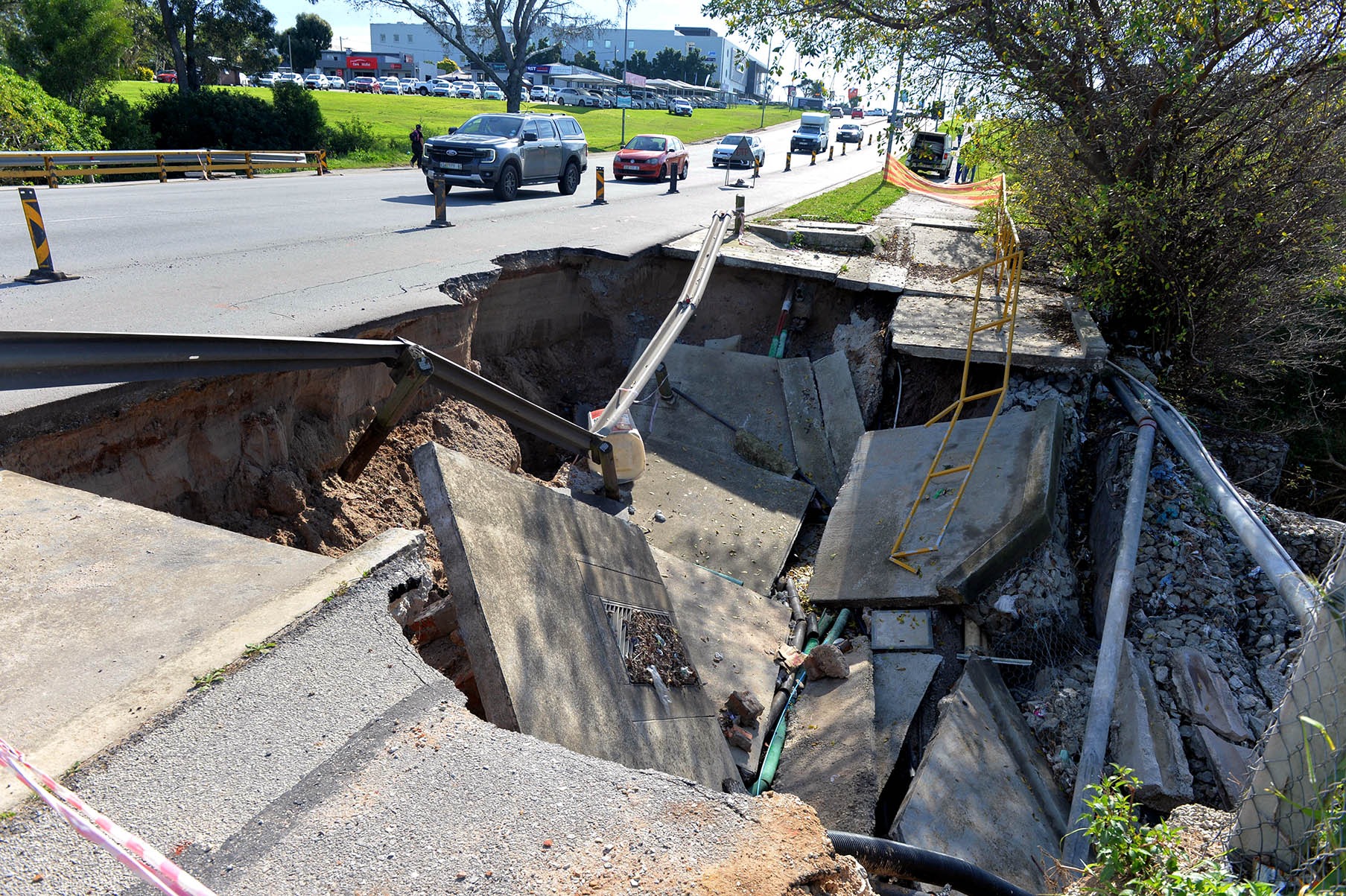
 Motorists will likely have to learn to live with a large sinkhole in the William Moffett Expressway, one of Nelson Mandela Bay’s busiest roads, after the municipality indicated that it will take between six months and a year to fix flood damage. (Photo: Deon Ferreira)
The Nelson Mandela Bay Municipality has refused to set a date for when repairs will start on two of the metro’s busiest roads, which have partially collapsed after heavy flooding in May.
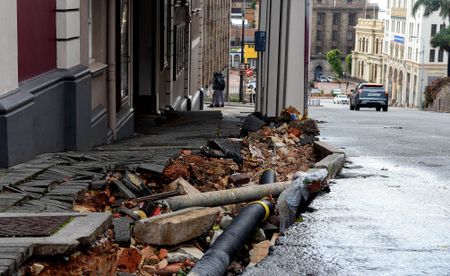
The William Moffett Expressway has partially collapsed at a bridge, and one lane has been closed to traffic. If the condition of the road deteriorates further, it is understood that officials will reduce the four-lane road to a two-lane road.
But while the collapsed section of the William Mofett Expressway has been demarcated with warning signs, the warning signs belonging to Ward 39, the site of the other damaged road, were stolen on a previous occasion. As a result, officials have set up two drums, a piece of plywood and some danger tape over a huge sinkhole in Kabega Road.
/file/attachments/orphans/DSC_8080copy_351927.jpg "A sinkhole in Kabega Road, one of Nelson Mandela Bay’s busiest roads. (Photo: Deon Ferreira)")
But the red drums are not very visible at night as this section of the road also does not have any streetlights.
“Last weekend, a car hit one of those drums at a very high speed. The drum travelled 350 meters,” Ward 39 councillor Margaret de Andrade said. “I am very worried. You also can’t see what is going on underneath that hole so the road may be collapsing.”
Municipal response
“The Nelson Mandela Bay Municipality is aware of the damage to a section of the William Moffett Expressway near Walmer Park and understands the concerns raised by residents and road users, particularly in light of the recent adverse weather conditions and forecast rainfall,” said the City’s communication director, Sithembiso Soyaya.
“Firstly, it is important to note that the damage in question occurred less than a month ago as a direct consequence of severe weather conditions that affected parts of the metro. Following the incident, municipal engineering teams conducted assessments and implemented interim safety measures to safeguard road users while detailed investigations and repair planning continue,” he said.
He added that a report on the road damage was sent to the National Disaster Management Centre (NDMC).
“The municipality is currently awaiting feedback regarding potential disaster recovery funding from national and provincial government, where applicable and appropriate,” Soyaya said.
“In terms of timelines, it would be premature and irresponsible for the municipality to provide an exact commencement or completion date for permanent repairs at this stage. Infrastructure repairs resulting from disaster-related incidents must follow prescribed legislative and regulatory processes, including detailed technical assessments, cost quantification, engineering design requirements, and, where applicable, engagement with provincial and national disaster management structures regarding potential disaster recovery funding,” he said.
Funding process
In terms of the Disaster Management Act, the NDMC must immediately, after a national disaster has been declared, initiate efforts to assess the magnitude and severity or potential magnitude and severity of the disaster.” The municipality is then required to submit a report on the damage and to verify and quantify damage to infrastructure and municipal services.
These detailed assessment reports and supporting evidence are then submitted to the relevant Provincial Disaster Management Centre for verification and coordination. Further joint assessments may be undertaken by municipal, provincial and national officials where required.
These assessments are then evaluated against applicable disaster management legislation, frameworks and funding criteria.
Only then can a disaster be classified or declared as one in terms of the Disaster Management Act, and that is followed by funding requests that are processed through the prescribed provincial and national government channels.
Only then will funds be allocated, and repair projects can be implemented.
“These processes are designed to ensure accountability, compliance, transparency and prudent expenditure of public funds. As such, disaster-related infrastructure recovery projects cannot simply be implemented immediately without following the required statutory processes,” Soyaya said.
But De Andrade said even without considering national disaster funding it previously took her three years just to get the railings of the bridge near the current collapsed road fixed.
“For the road, we were told without a shadow of a doubt that it will take between six months and a year,” she said.

“Officials assured me that they will make it safe and more visible, but nothing has happened so far,” she said.
Soyaya claimed that the affected areas were “prioritised” and that temporary safety interventions, traffic management measures, regular inspections and ongoing engineering assessments are being undertaken to minimise risks and prevent further deterioration as far as reasonably possible.
“In anticipation of further rainfall, municipal teams remain on high alert across the metro. High-risk infrastructure locations are being monitored continuously; drainage systems are receiving attention where necessary; and response teams are prepared to implement additional mitigation measures should weather conditions warrant further intervention,” he added.
“The municipality remains committed to restoring affected infrastructure as quickly as possible while ensuring that all repairs are undertaken in accordance with engineering standards, legislative requirements and available funding mechanisms. Public safety remains the foremost priority throughout this process,” Soyaya added.
Daily monitoring
The ward councillor for Ward 6, Gert Engelbrecht, said he too was told it will take between six months and a year for the metro to even receive disaster funding. The collapsed part of the William Moffett Expressway falls under his ward.
He said officials are monitoring the safety of the road daily.
“Initially, officials told us that they would consider the project in the new financial year. I have an allocation of R2-million for this road in the 2027/2028 financial year. I have requested that it be brought forward, but this was refused,” he said.
He said he remained positive that it would take less than six months. “I want to assure motorists that the lane that is still open is safe. Less than 50% of the road that is closed has collapsed, but we are carefully monitoring it,” he said.
“What is frustrating is that there is money available in the municipality to do the repairs without waiting for the disaster funding,” he said.
De Andrade said it was not possible to close Kabega Road as it is used by residents to access the N2 and to get their children to a nearby high school.
“I just want to make it safe,” she said, calling on residents to be patient.
“But I also want to ask why can’t they apply for funding as an emergency? I think it is a massive emergency,” she said.
“There is money in the Roads and Transport department to fix it. It is a matter of doing some simple accounting. Just pay for it now, and later put the money back. That road should have been fixed yesterday already,” she said.
Extensive repairs
Engelbrecht said it is estimated that the repair of the collapsed portion of the expressway will cost around R10-million. The sidewalk must be rebuilt, power cables relaid and stormwater drains reconstructed.
“What we found is that in times of very heavy rain, the water runs down this road so fast that it does not go into the stormwater drain,” he said. “So some re-engineering must take place.” He added that trees also had to be removed. DM
Comments
Scroll down to load comments...